
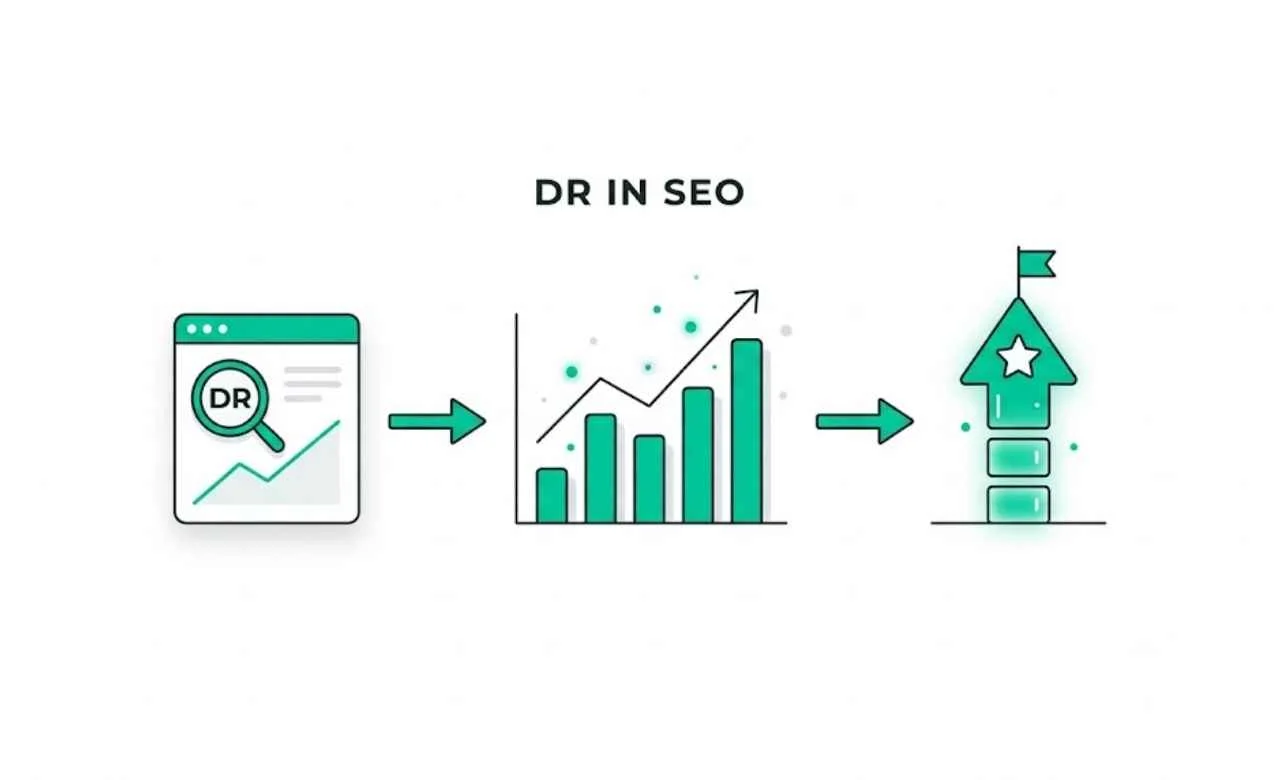
If you’ve started learning SEO, you’ve probably seen websites bragging about a high DR score. But what is DR in SEO, and does a higher score actually help your website rank higher on Google? These questions matter, especially when you’re analyzing competitors, evaluating backlinks, or deciding whether a website is worth getting a link from.
DR, or Domain Rating, is an Ahrefs metric that shows the relative strength of a website’s backlink profile on a scale from 0 to 100. A higher DR generally means the site has a stronger backlink profile. However, there’s a catch: DR is not a Google ranking factor. So, simply increasing your DR won’t automatically push your DR in SEO pages to the top of search results. In this guide, you’ll learn exactly how DR works, what counts as a good DR score, how it differs from DA, and how to use it correctly in your SEO strategy.
What Is DR in SEO?
DR stands for Domain Rating. It is an Ahrefs metric that measures the relative strength of a website’s backlink profile compared with other websites in the Ahrefs database.
DR ranges from 0 to 100.
A website with a higher DR generally has a stronger and more authoritative backlink profile than a website with a lower DR.
For example:
- A new website may have a DR of 0–10.
- A growing website may reach DR 20–40.
- An established website may have DR 50–70.
- Very strong websites can have DR 80–90+.
However, these numbers should not be treated as strict DR in SEO quality categories. A lower-DR website can still rank above a higher-DR website for a specific keyword.
Why Does DR Matter?
DR can be useful when you want to:
- Compare competitors
- Evaluate backlink opportunities
- Analyze a website’s link profile
- Find websites with strong backlinks
- Track changes in backlink strength
- Research potential guest-post websites
- Identify link-building prospects
Think of DR as a backlink-profile comparison metric, not a direct Google ranking score.
How Is Domain Rating Calculated?
Ahrefs calculates DR primarily by analyzing the backlinks pointing to a website.
The basic idea is that websites receiving strong backlinks can have a stronger DR.
However, simply collecting hundreds of backlinks doesn’t automatically produce a high DR.
Several factors influence the calculation, including:
Referring Domains
A referring domain is a unique website that links to your website.
For example, if 20 different websites link to your site, you have 20 referring domains.
Getting backlinks from multiple relevant websites can be more valuable than receiving hundreds of links from one domain.
Authority of Linking Domains
The strength of the websites linking to you also matters.
A backlink from a strong website can contribute more to your backlink profile than a link from a weak website.
Link Equity
Websites that link to many other domains have their available link equity distributed across those links. This means a site having a high DR doesn’t necessarily pass the same amount of value through every individual backlink.
Followed Links
Ahrefs’ DR calculation focuses on followed backlinks when evaluating the link relationships used for the metric.
Because DR is calculated using a relative system, improving your own backlink profile can sometimes result in a smaller DR increase than expected.
What Is a Good DR Score?
There is no universal DR score that Google considers good.
A “good” DR depends on your website, niche, competitors, and SEO goals.
Here’s a general way to think about the scale:
| DR Range | General Interpretation |
|---|---|
| 0–10 | New or weak backlink profile |
| 10–20 | Early-stage website |
| 20–40 | Developing backlink profile |
| 40–60 | Established website |
| 60–80 | Strong backlink profile |
| 80–90+ | Very strong backlink profile |
These ranges are only rough guidelines.
For example, if most websites ranking for your target keywords have DR 20–30, you don’t necessarily need a DR 70 website to compete.
Look at the DR of websites actually ranking in your niche.
This gives you much more useful competitive information.
DR vs DA: What Is the Difference?
One of the most common SEO questions is the difference between DR and DA.
Both are third-party SEO metrics, but they are created by different SEO platforms.
DR (Domain Rating) is an Ahrefs metric.
DA (Domain Authority) is a Moz metric.
Both attempt to estimate the strength or authority of a website, but they use different calculations.
| DR | DA |
|---|---|
| Developed by Ahrefs | Developed by Moz |
| Domain Rating | Domain Authority |
| Primarily focused on backlink profile strength | Predicts ranking ability using Moz’s link-related data |
| Score ranges from 0–100 | Score ranges from 1–100 |
| Used widely in Ahrefs backlink analysis | Used widely in Moz analysis |
A website might have a DR of 45 and a DA of 35. Another website could have a different relationship between its DR and DA.
Don’t compare DR and DA as if they are identical scores.
If you’re using Ahrefs, use DR consistently. If you’re using Moz, use DA consistently.
Most importantly, neither metric is an official Google ranking score.
Is DR a Google Ranking Factor?
No. DR is not a Google ranking factor.
Google does not use Ahrefs’ Domain Rating when determining organic search rankings.
This distinction is extremely important.
Google has its own ranking systems and evaluates many signals related DR in SEO to content, relevance, links, quality, user experience, and other factors.
Ahrefs created DR as a tool for SEO professionals to analyze and compare backlink profiles.
Therefore:
High DR does not guarantee high Google rankings.
A DR 70 website can have pages that rank poorly, while a DR 20 website can rank DR in SEO extremely well for a less competitive keyword.
Your goal should not simply be to increase DR.
Instead, focus on building a website that deserves to rank.
How Can You Increase Your DR?
If your goal is to increase your Domain Rating, the primary strategy is to build a strong, natural backlink profile.
Here are some effective approaches.
Create Link-Worthy Content
The easiest backlinks to maintain are usually earned because another website genuinely finds your content useful.
Create:
- Original research
- Helpful guides
- Statistics pages
- Infographics
- Case studies
- Original data
- Expert resources
- Comprehensive tutorials
Useful content gives other websites a reason to reference your pages.
Earn Relevant Backlinks
Relevance matters.
For example, if you run an SEO website, a backlink from a relevant marketing or SEO website is generally more useful for your SEO strategy than a random backlink from an unrelated website.
Build Relationships
Networking with website owners, journalists, bloggers, publishers, and industry experts can create legitimate opportunities to earn mentions and backlinks.
Promote Your Content
Publishing great content isn’t always enough.
You can promote it through:
- Outreach
- Digital PR
- Industry communities
- Social media
- Expert collaborations
- Resource pages
The goal is to put your content in front of people who may find it useful enough to reference.
Read more:What Is a Niche Edit? A Complete Guide to Niche Edits in SEO
Does a High DR Website Always Have Better SEO?
No.
DR only tells you about a DR in SEO website’s backlink profile according to Ahrefs’ methodology.
A high-DR website can still have:
- Poor content
- Irrelevant content
- Low-quality pages
- Technical SEO problems
- Weak search intent alignment
- Pages with no organic traffic
Similarly, a lower-DR website can have excellent content and rank successfully.
When evaluating a website, don’t look at DR alone.
Consider:
Organic Traffic
Check whether the website receives real organic search traffic.
Organic Keywords
Look at how many relevant keywords the site ranks for.
Topical Relevance
A relevant website is often more useful than a random high-DR domain.
Referring Domains
Check the number and quality of unique websites linking to the domain.
Traffic Trends
A website with declining organic traffic may not be the best backlink prospect, even if its DR looks impressive.
Content Quality
Review the actual pages. A strong backlink profile doesn’t automatically mean the website publishes high-quality content.
Why Does DR Increase or Decrease?
Your Domain Rating can change over time as Ahrefs discovers new backlinks, loses existing backlinks, or recalculates the strength of websites linking to your domain.
A DR increase usually happens when your website earns strong backlinks from reputable domains. However, your DR can also change even when you haven’t built or lost any links.
This is because DR is a relative metric. If other websites in the Ahrefs database gain stronger backlink profiles, your position within the overall link graph can change.
Common reasons for DR changes include:
- Gaining backlinks from strong websites
- Losing important referring domains
- Changes in the backlink profiles of linking websites
- Ahrefs discovering new backlinks
- Links becoming nofollowed or removed
- Changes in the overall link graph
Don’t panic over a small DR fluctuation. Instead, look at your overall backlink quality, referring domains, organic traffic, and rankings.
What Is the Difference Between DR and UR in Ahrefs?
DR and UR are both Ahrefs metrics, but they measure different things.
Domain Rating (DR) evaluates the strength of a website’s overall backlink profile, while URL Rating (UR) evaluates the backlink strength of a specific webpage.
For example, your website might have a DR of 45, while one of your individual blog posts could have a UR of 30.
Here’s the basic difference:
| Metric | What It Measures |
|---|---|
| DR | Overall backlink strength of a domain |
| UR | Backlink strength of a specific URL |
| Scale | 0–100 |
| Useful for | Domain-level analysis |
| UR useful for | Page-level backlink analysis |
If you’re evaluating a particular page for a backlink or analyzing why one page ranks better than another, UR can provide useful additional information.
For general domain comparison, DR is more relevant.
Can a New Website Have a High DR?
Yes, but building a high DR on a new website generally requires earning strong backlinks.
A brand-new domain usually starts with little or no backlink authority. As it earns links from established websites, its backlink profile can become stronger.
However, you shouldn’t try to increase DR as quickly as possible by collecting random links.
Instead, focus on earning relevant and trustworthy backlinks.
For a new website, a practical SEO strategy is to:
- Publish useful content consistently.
- Target low-competition keywords.
- Build topical relevance.
- Promote your best articles.
- Earn links naturally.
- Develop relationships with relevant websites.
- Monitor referring domains.
- Improve existing content.
A website doesn’t need a huge DR to generate organic traffic.
If you target realistic keywords and create better content than competing pages, you can start ranking while your backlink profile is still developing.
Why Referring Domains Matter More Than Just Backlink Numbers
When analyzing DR, it’s important to understand the difference between backlinks and referring domains.
A backlink is an individual link pointing to your website.
A referring domain is a unique website that links to you.
For example, suppose one website links to your homepage 50 times. You may have 50 backlinks but only one referring domain.
Now imagine another website receives links from 50 different relevant websites. It may have fewer total backlinks but a much more diverse backlink profile.
This is why you shouldn’t judge a website’s SEO strength simply by counting backlinks.
When analyzing a potential backlink opportunity, check:
- Number of referring domains
- Quality of referring domains
- Relevance of those domains
- Link placement
- Followed vs. nofollow links
- Organic traffic of the referring websites
- Overall backlink profile
Quality and diversity matter more than simply collecting large numbers of links.
What Should You Check Alongside DR?
DR is useful, but it should never be your only SEO metric.
If you’re analyzing a website for link building, guest posting, competitor research, or SEO outreach, look at several metrics together.
1. Domain Rating
Use DR to understand the relative strength of the site’s backlink profile.
2. Organic Traffic
Check whether the domain receives meaningful search traffic.
3. Referring Domains
Look at how many unique websites link to the domain and whether those links appear legitimate.
4. Organic Keywords
Check whether the website ranks for relevant keywords in your target country.
5. Topical Relevance
A website closely related to your industry can be more useful than an unrelated website with a much higher DR.
6. Traffic History
Look for steady growth rather than relying on the website’s current traffic alone.
7. Content Quality
Read the site’s articles and check whether they provide genuine value to users.
8. Backlink Quality
Analyze where the site’s backlinks come from. A high DR supported by questionable links isn’t necessarily a positive signal.
The best approach is to evaluate the entire SEO profile instead of chasing a single number.
For example, when selecting a website for a backlink, a relevant DR 40 site with strong organic traffic and quality referring domains may be a better opportunity than an unrelated DR 80 site with little or declining search traffic.
What Is the Difference Between DR and Website Traffic?
DR measures backlink-profile strength, while organic traffic measures search visibility and visitors.
These are completely different metrics.
Consider two websites:
Website A
- DR: 70
- Organic traffic: 5,000/month
Website B
- DR: 35
- Organic traffic: 100,000/month
Website B has a much lower DR but significantly more organic traffic.
Which is better?
It depends on your objective.
If you’re evaluating a potential backlink, you may want to consider DR, traffic, relevance, referring domains, content quality, and editorial standards together.
Don’t assume that the website with the highest DR is automatically the best choice.
Should You Buy Backlinks Based on DR?
No. DR should not be the only metric you use when evaluating a backlink.
This is especially important when buying guest posts DR in SEO or sponsored placements.
Some websites advertise extremely high DR but may have questionable backlink profiles.
Before considering a backlink opportunity, check:
- DR
- Organic traffic
- Relevant organic keywords
- Referring domains
- Backlink quality
- Topical relevance
- Traffic history
- Website content
- Outbound link patterns
- Indexation
- Spam signals
For example, a DR 40 website with strong US organic traffic and relevant content may be more valuable for an American SEO campaign than a DR 70 website with almost no organic traffic.
Also avoid choosing websites simply because they promise a particular DR.
Quality and relevance are more important than chasing a number.
How to Check DR in Ahrefs
You can check a website’s Domain Rating using Ahrefs.
Enter the domain into Ahrefs Site Explorer, and you’ll be able to see its DR along with other backlink and SEO metrics.
When analyzing a website, don’t stop at DR.
Review the complete profile:
- Check Domain Rating.
- Check referring domains.
- Analyze backlinks.
- Review organic traffic.
- Check organic keywords.
- Look at top-performing pages.
- Analyze traffic trends.
- Review the site’s topical relevance.
- Check the quality of its content.
- Compare it with competing websites.
This gives you a much more realistic picture of a website’s SEO strength.
FAQs
What does DR mean in SEO?
DR means Domain Rating, an Ahrefs metric that measures the relative strength of a website’s backlink profile on a 0–100 scale.
Is a DR of 50 good?
A DR of 50 can represent a strong backlink profile, but whether it’s “good” depends on your niche and competitors.
Is DR a Google ranking factor?
No. DR is an Ahrefs metric and isn’t used directly by Google as a ranking factor.
What is better, DR or DA?
Neither is universally better. DR comes from Ahrefs, while DA comes from Moz. Use the metric consistently within the SEO tool you’re using.
How can I increase my DR?
Earn high-quality backlinks from relevant websites, create link-worthy content, and build a diverse and natural backlink profile.
Does high DR mean high traffic?
No. DR measures backlink strength, while traffic measures search visibility and visitors. A high-DR website can have low organic traffic.
Conclusion
Understanding what is DR in SEO can help you make smarter decisions about backlinks, competitors, and website authority. Domain Rating is a useful Ahrefs metric that measures the relative strength of a website’s backlink profile, but it should never be treated as a direct Google ranking score.
A high DR can indicate a strong backlink profile, but it doesn’t guarantee high rankings, traffic, or quality content. When evaluating a website, look beyond DR and consider organic traffic, referring domains, DR in SEO backlink quality, topical relevance, keyword rankings, and content quality. Use DR as one part of your SEO analysis, while your main focus should remain on creating valuable content and earning relevant, trustworthy backlinks.