
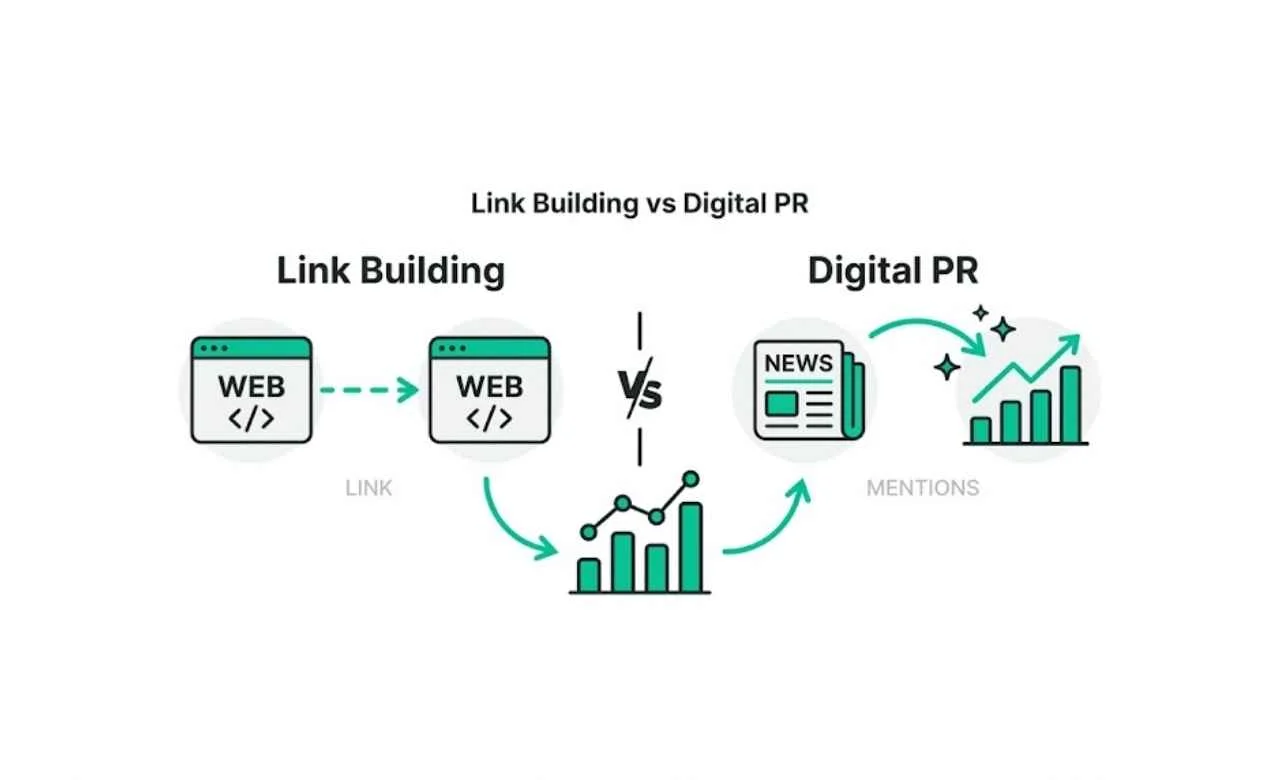
Building backlinks is important for SEO, but not every link-building strategy works the same way. Link building vs Digital PR is a common comparison for businesses that want stronger search visibility, more authority, and greater brand exposure.
Link building focuses mainly on earning relevant backlinks, while digital PR uses newsworthy stories, original data, expert insights, and creative campaigns to attract media coverage. In this guide, you’ll learn how Link Building vs Digital PR both strategies work, where they differ, what benefits they offer, and when to use each one.
What Is Link Building?
Link building is the process of acquiring hyperlinks from external websites to your own website. These links are commonly called backlinks.
For SEO, backlinks can help search engines understand that other websites find your content useful or relevant. However, not every backlink carries the same value. A relevant editorial link from a trustworthy Link Building vs Digital PR website can be much more meaningful than a large number of unrelated or low-quality links.
The main goal of link building is to earn or acquire links that support your website’s authority and help relevant pages become more competitive in search results.
How Does Link Building Work?
A typical link-building campaign starts with identifying websites that are relevant to your industry or audience.
You then find opportunities to earn a link through methods such as:
- Guest posting
- Resource page outreach
- Broken link building
- Digital asset promotion
- Unlinked brand mentions
- Expert contributions
- Linkable content
- Relationship-based outreach
- Industry directories
- Relevant business citations
For example, suppose you run an SEO website and publish an in-depth guide about technical SEO.
You might contact websites that have existing articles about technical SEO and explain why your guide could provide additional value to their readers.
If the publisher chooses to reference your guide, you earn a backlink.
What Makes a Good Backlink?
A useful backlink generally comes from a website that is:
- Relevant to your topic
- Trusted by its audience
- Editorially maintained
- Able to provide genuine referral traffic
- Contextually related to your page
Relevance matters because a link should make sense within the content.
For example, a backlink from an established SEO publication to an SEO guide is Link Building vs Digital PR contextually relevant. A random link from an unrelated website may provide far less value.
Common Link-Building Goals
Businesses typically use link building to:
- Strengthen website authority
- Improve visibility for target pages
- Earn referral traffic
- Build industry relationships
- Support content promotion
- Increase brand exposure
The best campaigns don’t focus only on the number of backlinks. They consider relevance, quality, context, and long-term value.
What Is Digital PR?
Digital PR combines public relations with online marketing and SEO. Instead of simply asking websites to place a backlink, digital PR aims to create something interesting enough that journalists, publishers, bloggers, and industry websites want to talk about it.
A digital PR campaign may involve:
- Original research
- Surveys
- Industry statistics
- Expert commentary
- Newsworthy reports
- Data studies
- Interactive content
- Creative campaigns
- Original visual assets
- Trends and analysis
The objective is to generate media coverage and online mentions.
A successful digital PR campaign can result in multiple publications covering the same story. Some of those stories may include backlinks, while others may mention the brand without linking.
Example of Digital PR
Imagine an ecommerce company publishes a study analyzing thousands of consumer shopping trends.
The company turns the findings into:
- A research report
- Original charts
- A press release or media pitch
- Expert commentary
- Social media assets
The marketing team then contacts journalists who cover retail, ecommerce, business, and consumer trends.
If journalists find the research useful, they may write about the findings and Link Building vs Digital PR reference the company as the original source.
This can generate both brand awareness and backlinks.
Digital PR Is Bigger Than Backlinks
One of the biggest differences between link building and digital PR is the broader purpose.
Link building often starts with the question:
“How can we earn a link to this page?”
Digital PR often starts with:
“What can we create that people will want to talk about?”
Links can be an important outcome of digital PR, but they aren’t necessarily the only objective.
Link Building vs Digital PR: Key Differences
The easiest way to understand link building vs digital PR is to compare their objectives, tactics, audiences, and expected outcomes.
| Factor | Link Building | Digital PR |
|---|---|---|
| Primary goal | Earn relevant backlinks | Generate coverage and brand visibility |
| Main audience | Website owners and publishers | Journalists, publishers, audiences |
| Typical approach | Outreach and relationship building | Newsworthy campaigns and storytelling |
| Content requirement | Can be moderate | Often requires strong original assets |
| Backlinks | Usually a central objective | Important but not the only objective |
| Brand awareness | Secondary benefit | Major objective |
| Media coverage | Possible | Core outcome |
| Research | Helpful but not always required | Often highly valuable |
| Scalability | Can be scaled through outreach | Depends heavily on campaign quality |
| Cost | Can range widely | Often higher for research-heavy campaigns |
| Time to launch | Often relatively quick | Campaign development can take longer |
| Success measurement | Links, relevance, traffic, rankings | Coverage, links, mentions, reach, traffic |
The two strategies also differ in how they approach publishers.
In traditional outreach, you may approach a publisher with an existing piece of content and ask whether they would consider linking to your resource.
In digital PR, you may approach a journalist with original research, a unique finding, or a timely story.
The Difference in Mindset
Link building is often link-first.
Digital PR is generally story-first.
That distinction is important.
If you create content only because you want backlinks, it may not be interesting enough for journalists. But if you create genuinely useful research or a strong story, links may naturally follow.
At the same time, digital PR does not eliminate the need for SEO strategy. You still need to decide which pages should receive authority, which topics matter, and how the Link Building vs Digital PR campaign supports your broader website goals.
Benefits of Link Building for SEO
Link building remains an important part of many SEO strategies because external links can help search engines understand the relationships and authority surrounding web content.
But the benefits go beyond rankings.
1. Supports SEO Authority
Relevant backlinks can strengthen the authority signals associated with your website and individual pages.
A strong backlink profile can be particularly useful when you’re competing against established websites for valuable search queries.
2. Helps Important Pages Get Discovered
External links can help search engine crawlers find pages.
If an important page receives links from other websites, it can become easier for search engines and users to reach that resource.
3. Generates Referral Traffic
A backlink isn’t valuable only because of SEO.
If the linking website has a relevant audience, visitors may click the link and reach your website.
That means a good backlink can generate:
- Targeted visitors
- Brand exposure
- Leads
- Sign-ups
- Sales
4. Builds Industry Relationships
Outreach can help you establish relationships with:
- Bloggers
- Editors
- Website owners
- Journalists
- Industry experts
- Content creators
Those relationships may create additional opportunities later.
5. Supports Content Promotion
Publishing great content doesn’t guarantee that people will find it.
Link building can help promote valuable resources to relevant websites and audiences.
6. Can Be Highly Targeted
One major advantage of link building is control.
You can target specific:
- Websites
- Topics
- Pages
- Anchor text variations
- Industries
- Geographic markets
However, control should not become manipulation. Links should be earned or Link Building vs Digital PR obtained through legitimate, value-driven methods rather than deceptive practices.
Benefits of Digital PR for SEO and Brand Growth
Digital PR can provide benefits that extend beyond traditional SEO.
1. Builds Brand Awareness
When your company appears in respected publications, more people can become familiar with your brand.
Even when an article doesn’t include a backlink, the brand mention itself can increase awareness.
2. Can Earn Multiple Backlinks
A successful story may be picked up by several websites.
For example, original research could be referenced by business publications, industry blogs, news websites, and newsletters.
This creates opportunities for multiple editorial links from one campaign.
3. Creates Strong Content Assets
Digital PR often produces valuable assets such as:
- Surveys
- Reports
- Statistics
- Original datasets
- Expert studies
- Charts
- Infographics
These assets can continue attracting attention after the initial campaign.
4. Reaches Journalists
Digital PR gives businesses a structured way to communicate with journalists.
Instead of promoting a generic sales page, you provide a story angle that fits the journalist’s audience.
5. Supports Thought Leadership
Expert commentary and original research can position a company or individual as a knowledgeable source within a specific industry.
For example, an SEO company might publish an annual report analyzing search marketing trends.
Journalists may then use the findings when writing industry stories.
6. Can Generate Referral Traffic
Media coverage can introduce your website to audiences that may never find it through search alone.
Traffic can come from:
- News websites
- Industry publications
- Blogs
- Newsletters
- Social platforms
- Online communities
7. Creates Long-Term Brand Assets
A strong digital PR campaign can become a reference point for future articles.
If your research contains useful statistics, other writers may continue citing it months after publication.
Which Is More Cost-Effective: Link Building or Digital PR?
There isn’t one universal cost for either strategy.
The price depends on your industry, market, campaign quality, Link Building vs Digital PR content requirements, outreach process, and whether you handle the work internally or hire an agency.
Link Building Costs
Link building can range from relatively low-cost outreach to expensive relationship-driven campaigns.
Your expenses may include:
- Content creation
- Outreach software
- Prospect research
- Digital PR tools
- Freelancer costs
- Agency fees
- Linkable asset development
The cost can also vary according to the quality and relevance of the websites you’re targeting.
Digital PR Costs
Digital PR campaigns can require additional resources because you may need to produce original research or creative assets.
Costs can include:
- Data collection
- Surveys
- Research
- Data analysis
- Graphic design
- Content writing
- PR outreach
- Journalist databases
- Campaign management
A simple expert-commentary campaign may be inexpensive compared with a large research study.
Think About Value, Not Just Price
A better question is not:
“Which strategy costs less?”
Instead ask:
“Which strategy can create the type of asset and exposure my business needs?”
For example, a small website may begin with targeted link building because it has useful content but limited resources for original research.
A growing brand with proprietary data may benefit from digital PR because its data can support multiple stories.
When Should You Use Link Building?
Link building can be especially useful when you have specific pages that need authority and you can identify relevant websites that would genuinely benefit from referencing them.
Consider link building when:
You Have Strong Existing Content
If your website already has comprehensive guides, research, tools, or resources, Link Building vs Digital PR outreach can help put those assets in front of publishers.
You Need Links to Specific Pages
Digital PR often generates links to the campaign or research page.
Traditional link building can give you more control over promoting relevant existing pages, where appropriate.
Your Industry Is Not Naturally Newsworthy
Some industries don’t regularly produce stories that journalists want to cover.
For example, a highly specialized B2B service may have a smaller media audience.
In such cases, targeted outreach and resource-based link building may be practical.
You Have Limited PR Resources
Digital PR can require research, creative development, and campaign management.
If your resources are limited, a focused link-building campaign may be easier to execute.
You Want Consistent Outreach
Link building can be structured into an ongoing process.
You can continuously:
- Publish useful content.
- Find relevant prospects.
- Personalize outreach.
- Build relationships.
- Earn relevant links.
- Monitor results.
The key is to prioritize quality over volume.
Acquiring large numbers of irrelevant or manipulative links can create risks and does not automatically improve SEO.
When Should You Use Digital PR?
Digital PR can be particularly useful when you have something genuinely interesting, original, or newsworthy to share.
You Have Proprietary Data
Data is one of the strongest foundations for digital PR.
If your company has unique first-party data, you may be able to turn it into a report that journalists and publishers can reference.
You Want Brand Awareness
If your objective includes increasing awareness beyond search engines, digital PR can expand your reach.
A campaign can put your company in front of audiences Link Building vs Digital PR through multiple publications.
You Can Create Newsworthy Stories
Ask whether your topic has a compelling angle.
For example:
- A new industry trend
- Original statistics
- A surprising consumer behavior pattern
- Expert analysis
- A significant market change
- A useful annual report
The story needs to offer something beyond a standard promotional article.
You Want Editorial Coverage
Digital PR is designed around earning media attention.
If your business wants relationships with journalists and industry publications, PR can become an important part of the marketing strategy.
You Have Creative Resources
Good campaigns often require:
- Research
- Writing
- Design
- Data analysis
- Outreach
- Media targeting
If you can support these activities, digital PR becomes easier to execute effectively.
Can Link Building and Digital PR Work Together?
Yes. In many SEO strategies, link building and digital PR work better as complementary tactics rather than competing alternatives.
The two approaches can support different parts of the Link Building vs Digital PR same SEO campaign.
A Combined Strategy
You can structure your strategy like this:
Step 1: Build valuable content
Create guides, tools, research, statistics, and resources that deserve attention.
Step 2: Identify link opportunities
Find websites that could naturally reference your existing content.
Step 3: Launch digital PR campaigns
Turn original data or interesting insights into media-friendly stories.
Step 4: Pitch relevant journalists
Contact journalists who cover your specific subject.
Step 5: Promote successful campaigns
Once your research receives coverage, continue promoting the findings through your website and professional channels.
Step 6: Build relationships
Keep relationships with relevant publishers and journalists rather than treating every interaction as a one-time link request.
Example
Suppose you operate a marketing website.
You publish:
- A complete SEO guide
- A keyword research tool
- An annual SEO statistics report
- A study about search behavior
Your traditional link-building campaign can promote the SEO guide and tool to relevant websites.
Your digital PR campaign can promote the original statistics report.
The same website therefore benefits from both strategies.
Why Combining Them Makes Sense
Link building can provide focused promotion for important pages.
Digital PR can generate broader awareness and media coverage.
Together, they can create a more diversified organic marketing strategy.
Read more:How to Find Quality Backlink Sites: A Complete Guide to Building Powerful Links
Link Building vs Digital PR: Which One Should You Use?
The answer depends on what you’re trying to accomplish.
Instead of choosing based on which tactic sounds more powerful, start with your business objective.
Choose Link Building When:
- Your main goal is earning relevant backlinks.
- You already have strong content assets.
- You want to promote specific pages.
- You can identify relevant websites.
- Your industry has limited media opportunities.
- You need a repeatable outreach process.
Consider Digital PR When:
- You have original research or data.
- You want media coverage.
- Brand awareness is an important goal.
- You can produce newsworthy stories.
- You want to build relationships with journalists.
- You have creative and research resources.
Use Both When:
- You want to build authority and brand visibility.
- Your website has multiple strong content assets.
- You have original data worth promoting.
- You want both targeted outreach and broader media exposure.
- You are building a long-term SEO strategy.
The most effective approach is often not about link building vs digital PR, but about understanding what each tactic is designed to accomplish.
A link-building campaign can help promote existing assets and earn relevant links. Digital PR can turn original ideas, research, and stories into broader media coverage.
What About Rankings?
Neither tactic guarantees higher Google rankings.
Search visibility depends on many factors, including content quality, relevance, technical SEO, competition, search intent, internal linking, user experience, and the overall authority and trust signals surrounding a website.
Backlinks should therefore be treated as one part of a broader SEO strategy rather than a standalone ranking shortcut.
Final Takeaway
Link building and digital PR are different but complementary SEO strategies.
Link building focuses more directly on earning relevant backlinks through outreach, content promotion, relationships, and other legitimate methods.
Digital PR focuses on creating stories, research, data, and campaigns that attract journalists, publications, audiences, and online discussion.
If your website has excellent content but needs relevant links, a focused link-building strategy can help promote it.
If you have original research, proprietary data, or a compelling story, digital PR can help turn those assets into media coverage and potential backlinks.
For many businesses, the strongest long-term approach is to combine both. Create genuinely useful content, develop newsworthy assets when you have something original to say, build relationships with relevant publishers, and focus on earning attention rather than chasing links at any cost.
The goal isn’t simply to collect backlinks. It’s to build a website that people trust, publishers want to reference, and users find genuinely useful.
Frequently Asked Questions
1. What is the difference between link building and digital PR?
Link building mainly focuses on earning relevant backlinks from other websites.
Digital PR focuses on gaining media coverage, brand mentions, and backlinks through newsworthy content.
2. Is digital PR part of link building?
Digital PR can be used as a link-building tactic, but its goals are broader than backlinks alone.
It can also increase brand awareness, referral traffic, and media visibility.
3. Which is better for SEO: link building or digital PR?
Both can support SEO, but they serve different purposes and work best in different situations.
Your choice should depend on your SEO goals, content assets, budget, and target audience.
4. Does digital PR help with backlinks?
Yes, successful digital PR campaigns can earn editorial backlinks when publishers reference the original research, data, or story.
However, coverage may sometimes generate brand mentions without including a link.
5. Can I use link building and digital PR together?
Yes, combining both can create a broader SEO and marketing strategy.
Link building can promote specific pages, while digital PR can generate wider media attention and brand exposure.
Conclusion
The debate around link building vs digital PR comes down to your goals, resources, and audience. Link building focuses on earning relevant backlinks, while digital PR focuses on creating newsworthy content that attracts media attention, brand mentions, and potential links.
You don’t always have to choose one. A strong SEO strategy can use both approaches building valuable content and earning relevant links while using original research, data, and compelling stories to gain wider media exposure. Focus on relevance, quality, and genuine value rather than simply chasing a high number of backlinks.