
You built the content, published the page, and started acquiring backlinks but your rankings still haven’t moved. So, how long does link building take to work? This is one of the most common questions in SEO, and the answer isn’t as simple as “a few weeks” or “a few months.”
In most cases, link building is a long-term SEO strategy. The time it takes to see results depends on your website’s authority, backlink quality, content strength, keyword competition, topical relevance, and how Link Building consistently you build links. In this guide, you’ll learn exactly what to expect from a link-building campaign, how long different strategies can take, and which factors can speed up or delay your SEO results.
How Long Does Link Building Take?
For most websites, meaningful link-building results commonly take several months rather than several days.
The first signs can appear relatively early, especially when a newly acquired backlink is discovered and indexed. However, ranking improvements are influenced by many other SEO signals, so a new backlink does not automatically move a keyword to the top of Google.
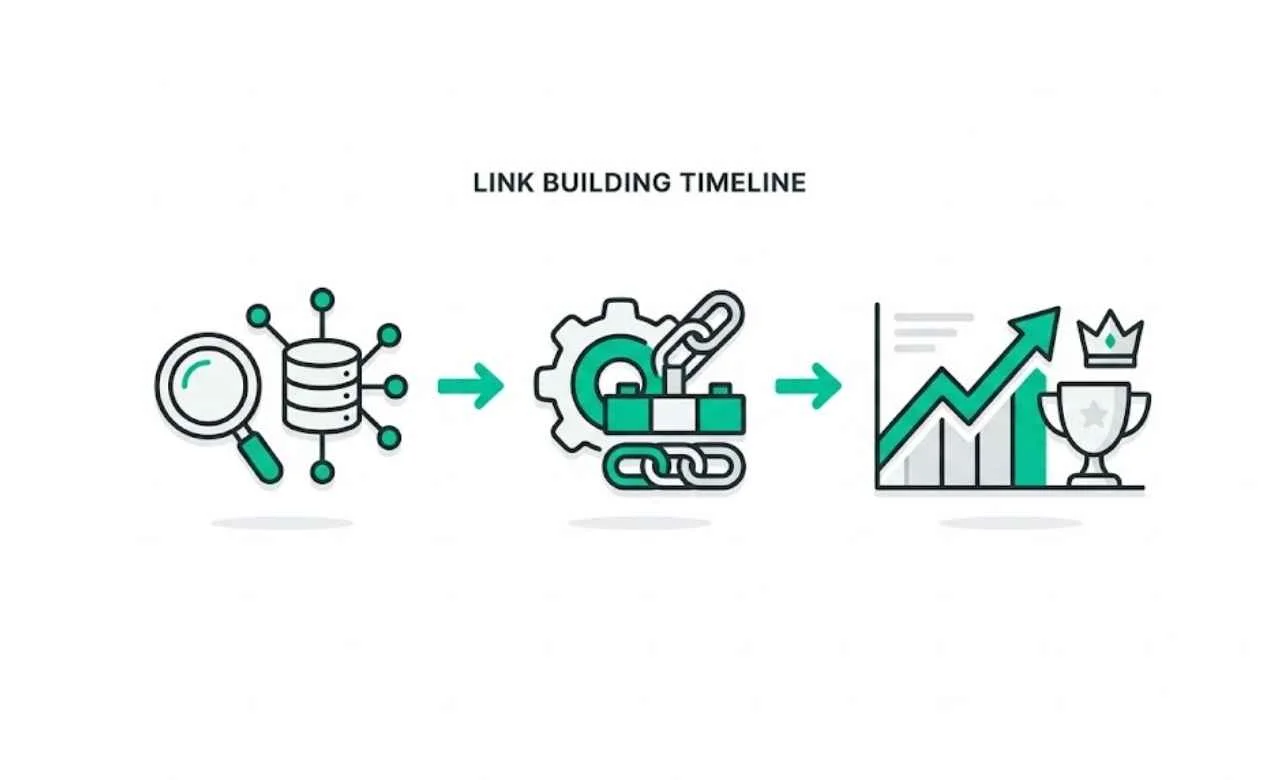
A realistic link-building timeline often looks like this:
- Weeks 1–4: Prospecting, outreach, negotiations, content creation, and initial placements.
- Months 1–2: Search engines discover and process newly published backlinks.
- Months 2–4: Early ranking and visibility changes may become noticeable.
- Months 4–6: A consistent campaign can begin producing stronger organic improvements.
- 6–12+ months: Established websites may see compounding benefits from sustained link acquisition and content growth.
These are planning ranges, not guarantees. A competitive commercial keyword may take considerably longer than a low-competition informational keyword.
The most important point is to evaluate link building as a long-term SEO strategy, not as an instant ranking technique.
Why Link Building Takes Time
Backlinks are only one component of search engine optimization.
When you build a link to a page, Google does not simply count that link and How Long Does Link Building Take immediately increase the page’s ranking. Search engines evaluate many signals surrounding the page, website, content, and backlink profile.
For example, Google may need to:
- Discover the page containing your backlink.
- Crawl the page.
- Process the link.
- Understand the relationship between the linking page and your website.
- Evaluate the quality and relevance of the link.
- Reassess your page alongside competing pages.
- Observe other signals associated with your website and content.
This means there is often a gap between getting a backlink and seeing a measurable SEO result.
Another important factor is competition.
If ten websites are competing for a low-competition keyword, gaining a few relevant backlinks may make a noticeable difference. If hundreds of strong websites compete for the same keyword, you may need substantially more time, better content, stronger topical authority, and a stronger overall backlink profile.
Read more:Link Building vs Digital PR: Key Differences, Benefits & Which One to Use
A Realistic Link Building Timeline
Understanding each stage makes it easier to set realistic expectations.
Weeks 1–2: Research and Link Prospecting
A professional link-building campaign begins with research rather than immediately sending hundreds of emails.
At this stage, you identify websites How Long Does Link Building Take that could potentially provide valuable backlinks.
The research process can include:
- Competitor backlink analysis
- Referring domain analysis
- Industry publications
- Relevant blogs
- Resource pages
- Digital PR opportunities
- Guest posting opportunities
- Editorial websites
- Unlinked brand mentions
- Broken link opportunities
- Linkable content opportunities
You should evaluate more than domain authority.
A potential link should also be assessed for:
- Topical relevance
- Website quality
- Organic traffic
- Editorial standards
- Content quality
- Existing outbound links
- Indexation
- Audience relevance
- Link placement
- Spam signals
This stage can take anywhere from a few days to several weeks depending on the size of your campaign.
Weeks 2–4: Outreach and Relationship Building
Once prospects are identified, outreach begins.
Effective outreach is personalized. Instead of sending the same How Long Does Link Building Take message to hundreds of websites, you should explain why your content is relevant to the publisher’s audience.
Depending on the strategy, outreach can involve:
- Guest post pitches
- Resource page requests
- Digital PR pitches
- Link reclamation
- Broken link outreach
- Expert contribution requests
- Content collaboration
- Journalist requests
- Partnership opportunities
Response rates vary significantly.
Some websites may respond within a day. Others can take weeks. Many will not respond at all.
That is why a successful campaign needs a healthy prospecting pipeline.
Weeks 3–8: Link Placement
After a website accepts your pitch, there may still be additional steps before the backlink becomes live.
For example, a guest post may require:
- Topic approval
- Content writing
- Editorial review
- Revisions
- Publication
- Link verification
A digital PR campaign can take a different path because journalists may select information based on newsworthiness, timing, relevance, and editorial requirements.
Once the backlink is published, your campaign How Long Does Link Building Take moves into the monitoring stage.
Months 1–3: Discovery and Early SEO Signals
At this stage, search engines may begin discovering newly published links.
You may notice changes such as:
- Improved keyword impressions
- Small ranking movements
- Increased crawl activity
- New referring domains
- More indexed pages
- Increased visibility for long-tail keywords
However, don’t expect every backlink to produce a visible ranking jump.
A backlink can be valuable even when you cannot immediately connect it to a specific keyword movement.
SEO is cumulative.
One relevant link may provide limited impact. A consistent acquisition of relevant editorial backlinks over time can strengthen your website’s overall authority and improve its ability to compete for multiple keywords.
Months 3–6: Measurable Ranking Improvements
For many campaigns, this is when the bigger picture becomes easier to evaluate.
If your content is already competitive and the backlinks are relevant and high quality, you may begin seeing more noticeable ranking improvements.
For example, a page ranking on the second or third page may gradually move closer to the first page.
But rankings can fluctuate.
Google search results are dynamic, and your competitors are also publishing content, acquiring backlinks, improving their websites, and targeting the same keywords.
Therefore, measure performance using multiple metrics instead of relying on one keyword position.
Useful metrics include:
- Organic clicks
- Organic impressions
- Organic traffic
- Ranking distribution
- Referring domains
- Quality backlinks
- Conversion traffic
- Non-branded keyword visibility
- Page-level organic performance
Months 6–12+: Compounding SEO Benefits
A consistent link-building campaign can become more valuable over time.
Instead of building one backlink and stopping, you continue strengthening important pages and publishing useful content.
This creates a broader SEO ecosystem.
New backlinks can support important pages, while those pages can internally link to related content across your website.
Over time, your site can develop How Long Does Link Building Take stronger topical authority and a more natural backlink profile.
This is one reason I recommend thinking about link building as an ongoing process rather than a one-time project.
What Factors Affect How Long Link Building Takes?
There is no universal backlink timeline because every website starts from a different position.
Here are the most important factors.
1. Website Age
A new website generally has less historical authority, fewer referring domains, and less established content than an older site.
That does not mean a new website cannot rank.
It simply means you may need to build credibility across multiple areas at the same time.
A newer website may need:
- Strong content
- Technical SEO
- Internal links
- Relevant backlinks
- Consistent publishing
- Good user experience
- Topical coverage
An established website may already have many of these assets.
2. Existing Domain Authority
Third-party metrics such as Domain Rating, Domain Authority, and Authority Score can be useful for competitive analysis.
However, these metrics are not Google ranking factors.
Do not build a campaign around How Long Does Link Building Take a single score.
Instead, evaluate the quality and relevance of your referring domains, content, organic visibility, and competitive position.
A relevant website with real readers and strong topical authority can be more useful than a high-metric website with little relevance to your industry.
3. Backlink Quality
Quality generally matters more than simply increasing backlink quantity.
A strong backlink typically comes from a legitimate website and is contextually relevant to the destination page.
For example, a backlink to an SEO guide from an established marketing publication is naturally relevant.
A random backlink from an unrelated website may have little meaningful value.
Focus on:
Relevance + editorial context + quality + authority + natural placement.
4. Topical Relevance
Topical relevance is one of the most important considerations in modern link building.
Suppose your website publishes content about personal finance.
A backlink from a reputable finance publication discussing budgeting or investing is contextually aligned with your content.
That is generally a stronger strategic fit than acquiring a link from an How Long Does Link Building Take unrelated website simply because its domain metric looks impressive.
5. Keyword Competition
Competition has a major influence on how quickly backlinks can contribute to rankings.
A keyword with low competition may require fewer authority signals.
A competitive keyword may require:
- More comprehensive content
- More authoritative backlinks
- Stronger topical coverage
- Better internal linking
- Better search intent alignment
- Stronger brand signals
This is why asking “How many backlinks do I need?” without analyzing the SERP can lead to poor decisions.
6. Content Quality
Backlinks cannot completely compensate for weak content.
Imagine you acquire ten high-quality backlinks to an article that does not satisfy search intent.
The page may still struggle.
Before building links, make sure the target page:
- Answers the searcher’s question
- Covers important subtopics
- Uses clear headings
- Provides original value
- Is easy to read
- Has strong internal links
- Loads properly
- Works well on mobile devices
- Matches the intent behind the keyword
Link building works best when it supports an already useful asset.
7. Internal Linking
Internal links help search engines understand relationships between pages on your website.
They also distribute authority throughout your site architecture.
For example, if you acquire a backlink to a strong pillar page, that page How Long Does Link Building Take can internally link to relevant supporting articles.
This can help users navigate your site and can strengthen the relationship between related content.
8. Anchor Text
Anchor text is the clickable text used in a backlink.
Common types include:
- Branded anchors
- Naked URL anchors
- Partial-match anchors
- Exact-match anchors
- Generic anchors
- Natural descriptive anchors
A natural backlink profile usually contains a varied mix.
Trying to force exact-match anchor text into every backlink can create an unnatural pattern.
The goal should be to make the link useful to readers rather than manipulate anchor text excessively.
9. Link Velocity
Link velocity refers broadly to the rate at which a website acquires backlinks.
There is no universal “safe number” of backlinks per month that applies to every website.
A website can naturally earn many links when it publishes something valuable, becomes newsworthy, or receives significant media attention.
Instead of chasing an arbitrary number, focus on sustainable acquisition and quality.
10. Industry and Niche
Different industries have different levels of competition.
Finance, legal, health, SaaS, insurance, technology, and other competitive sectors can require substantial authority to rank for valuable commercial keywords.
A smaller niche may have fewer established competitors.
Therefore, the same link-building campaign can produce different outcomes in different industries.
How Many Backlinks Do You Need to See Results?
There is no fixed number of backlinks that guarantees ranking improvements.
What matters is the competitive environment and the quality of the referring domains.
Instead of asking:
“How many backlinks do I need?”
Ask:
“What level of authority and relevance do the pages currently ranking for my target keyword have?”
Analyze the top-ranking competitors.
Look at:
- Referring domains
- Relevant backlinks
- Content depth
- Search intent
- Domain strength
- Page-level authority
- Internal linking
- Topical coverage
Then build a strategy based on the actual SERP.
For one keyword, a few strong referring domains may be enough to become competitive.
For another, you may need a long-term campaign How Long Does Link Building Take involving dozens of quality referring domains.
Do More Backlinks Mean Faster Results?
Not necessarily.
Acquiring 100 low-quality backlinks does not automatically outperform acquiring several highly relevant editorial links.
Quantity can also become misleading when many links come from the same domain.
For example, receiving 50 links from one website does not necessarily provide the same strategic value as earning links from multiple relevant referring domains.
This is why I prefer to monitor referring domains and link quality, not just total backlink count.
A sustainable campaign should aim to grow your site’s authority naturally.
How Long Does It Take to Build 100 Backlinks?
The answer depends on the acquisition method.
For example, 100 backlinks generated through scalable outreach may take weeks or months to acquire.
But 100 high-quality editorial backlinks can take substantially longer because every placement may require:
- Prospect research
- Relationship building
- Pitching
- Content creation
- Editorial approval
- Publication
If someone promises hundreds of high-authority editorial backlinks in a very short period, evaluate the offer carefully.
Ask where the links come from and whether How Long Does Link Building Take they are genuinely editorial.
The objective should not be to hit an arbitrary backlink number.
The objective should be to acquire relevant, legitimate, sustainable links.
How Long Does Guest Post Link Building Take?
Guest posting can produce backlinks relatively quickly compared with some digital PR campaigns, but the timeline varies.
A typical process may involve:
- Finding relevant publications
- Checking website quality
- Identifying suitable topics
- Sending outreach
- Receiving approval
- Writing the article
- Completing revisions
- Publication
A simple guest post may take a few weeks from prospecting to publication.
Higher-quality publications may have longer editorial processes.
The important factor is not simply publication speed.
A guest post should contribute genuinely useful information to the publication’s audience.
How Long Does Digital PR Link Building Take?
Digital PR can take longer because it depends on editorial interest.
A campaign may involve:
- Original data
- Surveys
- Expert commentary
- Industry research
- Newsworthy insights
- Journalist outreach
- Press coverage
Some campaigns can gain attention quickly.
Others may take weeks or months.
Digital PR can also generate multiple referring domains from a single successful story, but coverage is never guaranteed.
The best campaigns provide journalists with information How Long Does Link Building Take that is timely, credible, and genuinely useful.
How Long Does It Take for a New Backlink to Be Indexed?
There is no guaranteed indexing period for a backlink.
A search engine must discover and crawl the page containing the link.
If the linking website is frequently crawled, discovery may happen relatively quickly.
Other pages may take longer.
You should therefore avoid assuming:
Backlink published today = ranking improvement tomorrow.
Instead, monitor whether the linking page remains live, accessible, indexable, and relevant.
You can also use your SEO tools to track referring domains and backlink discovery.
Why Your Backlinks May Not Be Improving Rankings
If you have been building links for several months without meaningful progress, the problem may not simply be the number of backlinks.
Consider these possibilities.
Your Content Does Not Match Search Intent
If users searching for the keyword want a comparison but your article is a generic definition, additional backlinks may not solve the underlying problem.
Your Competitors Are Much Stronger
You may have gained ten backlinks while competitors have hundreds of relevant referring domains.
Analyze the SERP before deciding whether your link-building campaign is underperforming.
Your Backlinks Are Low Quality
A large backlink count does not necessarily indicate a strong backlink profile.
Review the actual referring domains.
Your Target Page Is Poorly Optimized
Check:
- Title tag
- Main heading
- Content coverage
- Internal links
- Page speed
- Mobile usability
- Search intent
Your Site Lacks Topical Authority
If your website publishes one article about a topic and immediately tries to rank for a highly competitive keyword, the site may lack sufficient topical depth.
Build related supporting content and connect it with internal links.
Your Campaign Is Too Inconsistent
Link building often works better when treated as an ongoing process.
Building five links one month and then stopping for six months makes How Long Does Link Building Take it difficult to develop consistent momentum.
How to Speed Up Link Building Results Safely
You cannot force Google to rank a page immediately, but you can make your campaign more efficient.
Build Linkable Assets
Create resources that other websites actually want to reference.
Examples include:
- Original research
- Statistics pages
- Comprehensive guides
- Free tools
- Templates
- Industry studies
- Original surveys
- Useful calculators
- Data-driven reports
The easier your content is to cite, the easier outreach can become.
Target Relevant Websites
Do not spend most of your time chasing websites solely because they have a high third-party authority score.
Prioritize websites that are:
- Relevant
- Legitimate
- Editorially maintained
- Useful to your audience
- Capable of sending qualified referral traffic
Improve Outreach Personalization
Generic outreach often gets ignored.
A better pitch demonstrates that you understand the publication and explains exactly why your resource could improve its content.
Use Multiple Link-Building Strategies
Do not depend entirely on guest posting.
Combine strategies such as:
- Digital PR
- Resource link building
- Broken link building
- Link reclamation
- Expert contributions
- Unlinked brand mentions
- Data-driven content
- Relationship-based outreach
This creates a more diversified backlink How Long Does Link Building Take acquisition process.
Strengthen Existing Content
Sometimes the fastest improvement does not come from publishing another article.
Improve an existing page that already has:
- Impressions
- Backlinks
- Rankings
- Historical traffic
- Search visibility
Updating that page and building relevant links to it can be more efficient than starting from zero.
A Practical 6-Month Link-Building Plan
Here is a simple framework you can adapt.
Month 1: Audit and Strategy
Start by auditing your existing backlink profile.
Identify:
- Valuable backlinks
- Toxic or suspicious patterns
- Lost links
- Competitor referring domains
- Link gaps
- Important target pages
Then map your highest-priority keywords to your strongest content assets.
Month 2: Content and Outreach
Publish or improve linkable assets.
Begin targeted outreach to relevant websites.
Focus on quality prospects instead of sending How Long Does Link Building Take thousands of generic emails.
Month 3: Expand Acquisition
Continue outreach while testing different methods.
Analyze which strategies generate:
- Positive responses
- Quality placements
- Relevant referring domains
- Referral traffic
Double down on methods that produce sustainable results.
Month 4: Competitor Link Gap Analysis
Recheck your competitors.
Look for websites linking to multiple competitors but not to you.
These websites may represent valuable prospects, especially when the content relationship is relevant.
Month 5: Strengthen Important Pages
Review your pages that are already ranking on page two or near the top of page one.
Build relevant links toward pages with realistic opportunities.
Improve internal linking at the same time.
Month 6: Evaluate and Refine
Compare your current performance with your starting point.
Track:
- Organic traffic
- Search impressions
- Keyword positions
- Referring domains
- New backlinks
- Lost backlinks
- Referral traffic
- Conversions
Then decide which link-building activities deserve more resources.
Link Building Metrics You Should Track
Backlinks alone are not enough.
I recommend monitoring several metrics.
Referring Domains
This tells you how many unique websites link to your domain.
It can be more informative than total backlinks How Long Does Link Building Take when evaluating link diversity.
Organic Traffic
Check whether organic visits are increasing over time.
Keyword Rankings
Track target keywords as well as groups of related keywords.
Search Impressions
Impressions can reveal increasing visibility even before clicks increase substantially.
Click-Through Rate
If impressions rise but clicks remain low, your title or search-result presentation may need improvement.
Referral Traffic
A valuable backlink can send actual visitors to your website.
This is an important benefit that can be overlooked when SEO teams focus only on rankings.
Conversions
Ultimately, traffic should support your business goals.
Track leads, sales, signups, inquiries, or whatever conversion matters to your website.
Common Link-Building Mistakes That Delay Results
Buying Links Without Evaluating Quality
A backlink package may look attractive because it promises hundreds of links.
But the real question is where those links come from.
Focusing Only on Domain Metrics
Third-party metrics can help with prospecting, but they should not replace manual quality assessment.
Using Excessive Exact-Match Anchors
Natural backlink profiles typically contain varied anchor text.
Building Links to Weak Pages
Do not send valuable backlinks to pages How Long Does Link Building Take that do not satisfy search intent.
Ignoring Relevance
A backlink should make sense in the context where it appears.
Expecting Immediate Rankings
SEO rarely works like paid advertising.
You are building an asset that can continue generating value over time.
Stopping Too Early
A campaign may require several months before enough data exists to evaluate its full impact.
Link Building vs. Other SEO Strategies
Link building is only one part of SEO.
You also need to consider:
- Technical SEO
- On-page SEO
- Content marketing
- Keyword research
- Internal linking
- User experience
- Site architecture
- Digital PR
- Brand development
A website with excellent backlinks but poor technical SEO can still struggle.
Likewise, a technically perfect website with weak content and no authority may struggle to compete for highly competitive queries.
The strongest SEO strategy combines these elements.
Should You Build Backlinks Every Month?
For most websites pursuing competitive organic search visibility, ongoing link acquisition can make sense.
However, the goal should not be:
“I need exactly 20 backlinks every month.”
Instead, establish a sustainable system.
Each month you can:
- Analyze competitor link growth.
- Find new prospects.
- Create linkable content.
- Conduct outreach.
- Recover lost links.
- Monitor new referring domains.
- Improve pages already ranking.
- Evaluate referral traffic and conversions.
This turns link building into a repeatable SEO process rather than a one-time activity.
How to Know Whether Your Link-Building Campaign Is Working
Look for trends rather than isolated changes.
A successful campaign may show several improvements over time:
- More referring domains
- Better visibility for target keywords
- Higher organic impressions
- Increasing organic traffic
- More pages ranking
- Improved rankings for long-tail terms
- More referral traffic
- More conversions
Not every metric will improve simultaneously.
For example, impressions may increase before clicks.
Long-tail rankings may improve before your primary keyword moves significantly.
Referral traffic may increase even when rankings remain relatively stable.
This is why SEO reporting should consider the entire performance picture.
Frequently Asked Questions
How long does link building take to show results?
Initial SEO signals may appear within a few weeks, but meaningful ranking and traffic improvements often take several months. The timeline depends on competition, content quality, website authority, and backlink relevance.
How many backlinks do I need to rank?
There is no universal backlink number that guarantees a ranking. Analyze the quality and referring domains of the pages currently ranking for your target keyword and build a competitive, relevant backlink profile.
Can backlinks improve rankings immediately?
Usually, you should not expect an immediate ranking change after acquiring a backlink. Search engines need to discover and process the linking page, while your overall ranking depends on many other signals.
Is link building still important for SEO?
Backlinks remain an important part of evaluating web content and discovering relationships between websites. However, link building should work alongside high-quality content, technical SEO, internal linking, and strong search-intent optimization.
Does more backlinks mean better SEO?
No. Backlink quality, relevance, editorial context, and referring-domain diversity matter. A large number of irrelevant or low-quality links does not automatically create stronger SEO performance.
Final Thoughts
So, how long does link building take?
For most websites, you should think in terms of months, not days.
The first stage is finding the right opportunities. Then comes outreach, content creation, publication, link discovery, and finally the longer process of measuring ranking and traffic changes.
The biggest mistake is treating backlinks as a simple numbers game.
A successful link-building campaign is built around relevant websites, useful content, natural anchor text, strong editorial context, and consistent acquisition. It also works best when your technical SEO, on-page optimization, internal linking, and search intent are already in good shape.
If you want sustainable organic growth, focus less on asking “How quickly can I get backlinks?” and more on asking “How can I consistently earn relevant links that strengthen my website and help users?”
That shift creates a much more sustainable approach to SEO link building.