
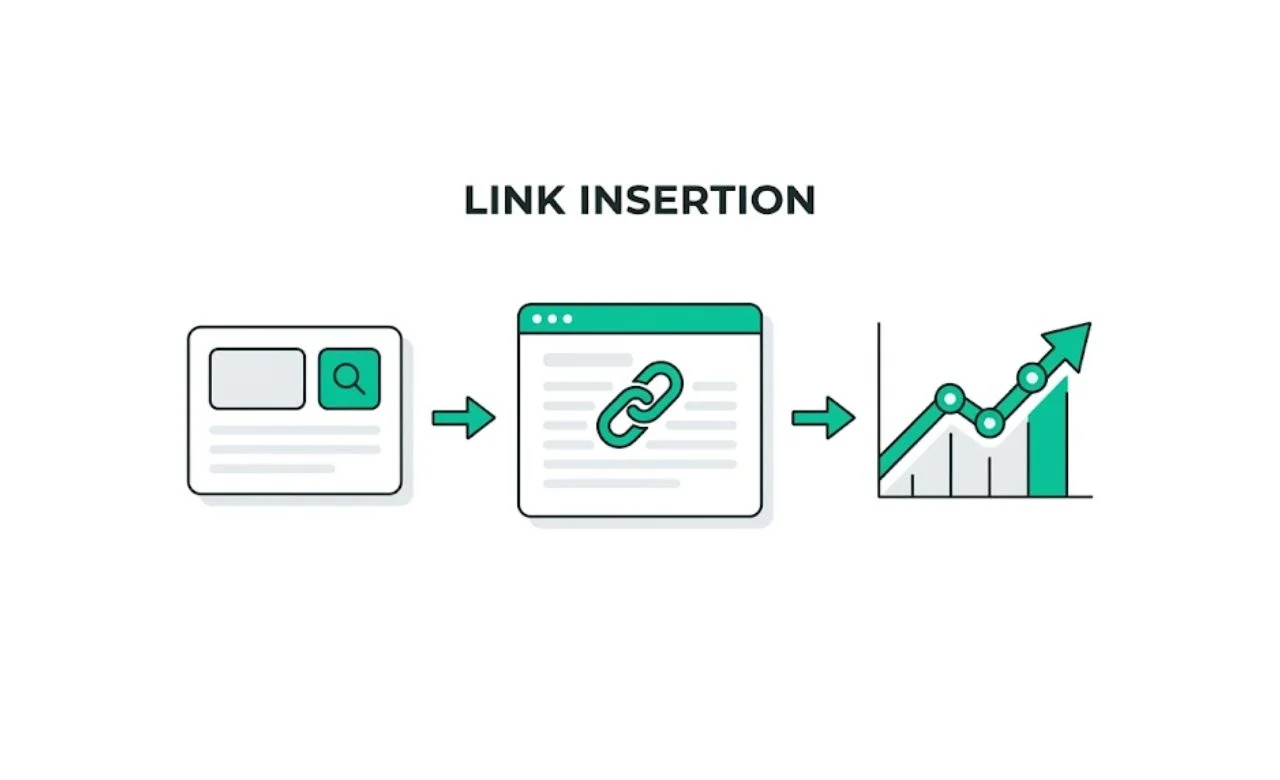
Building quality backlinks can take time, especially when you’re starting with a blank page. That’s where link insertion comes in. Instead of creating a brand-new guest article, you add a relevant backlink to content that’s already published and indexed. This makes link insertions a practical part of many modern link-building campaigns.
But getting a backlink isn’t enough. The page should be relevant, useful, trustworthy, and capable of providing genuine value to readers. A well-placed link can strengthen your backlink profile, support topical relevance, and potentially send referral traffic to your website.
If you’re comparing link insertion vs guest post, the biggest difference is how the content is created. A guest post requires you to publish a new article on another website, while link insertion works with an existing page.
What Is Link Insertion in SEO?
Link insertion in SEO (frequently referred to in digital marketing as a niche edit, curated link, or contextual link placement) is the process of adding an inbound hyperlink from an existing, already published webpage to your own target URL.
Unlike conventional guest posting where an SEO specialist writes an entirely new article and pitches it to an external webmaster link insertion capitalizes on existing content that search engines like Google have already crawled, indexed, and evaluated for topical authority.
+-----------------------------------------------------------------------+
|                        Link Insertion Concept                         |
|                                                                       |
|   [Target Website: Established Article (2+ Years Old, High UR/DR)]    |
|   "Modern email marketing requires clean deliverability metrics..."   |
|                               |                                       |
|                  (Insert Editorial Hyperlink)                         |
|                               |                                       |
|                               v                                       |
|             [Your Target Page / Value-Add Asset]                      |
|            "Definitive Guide to SPF, DKIM, and DMARC"                 |
+-----------------------------------------------------------------------+
When executing what is link insertion in practice, the link is woven organically into the copy of an existing article, guide, roundup post, or resource page. The sentence structure is often adjusted slightly to ensure that the newly placed link serves as a logical, editorial citation that genuinely aids the reader.
Why the Shift Toward Link Insertion?
Modern search algorithms rely on sophisticated Natural Language Processing (NLP) models—such as Google’s BERT, MUM, and semantic entity graphs—to decipher the contextual relevance surrounding hyperlinks. In this environment:
- New URLs face an indexing sandbox: A freshly published guest post can take weeks or months to gain search impressions, keyword rankings, and accumulated Page Authority (PA) or URL Rating (UR).
- Existing URLs hold instant equity: An established article published two years ago that ranks in the top 10 of SERP results already carries internal PageRank, historical stability, and recurring organic search traffic.
- Contextual synergy: Adding an editorial link to a live page lets your website siphon existing link equity and referral traffic immediately, bypassing the long maturation curve of net-new URLs.
How Does Link Insertion Work?
Understanding how link insertion works requires looking at both the technical SEO mechanics and the human outreach process.
+------------------------------------------------------------------------------------+
|                           The Link Insertion Workflow                              |
|                                                                                    |
|  [1. Prospecting] ----> [2. Page Vetting] ----> [3. Outreach] ----> [4. Insertion]  |
|   Identify target        Check organic traffic,  Pitch value-add    Integrate anchor|
|   niche websites via     DR/UR, indexing, and    data/point to the  naturally into  |
|   search operators       topical relevance       site editor        live copy       |
+------------------------------------------------------------------------------------+
1. Link Prospecting and Identification
The process begins with thorough website prospecting. Using advanced Google Search operators (e.g., site:, inurl:, intitle:) alongside SEO suites like Ahrefs, Moz, and BuzzStream, you map out industry-relevant websites and locate specific, high-ranking articles addressing topics complementary to your target asset.
2. Identifying Content Gaps & Opportunities
Next, you inspect the target page’s copy. You look for:
- An outdated statistic that your new study updates.
- A passing mention of a concept that lacks an explanatory external link.
- A broken outbound link (leveraging a hybrid broken link building approach).
- An opportunity to enrich the article with an interactive tool, infographic, case study, or deep-dive guide.
3. Personalized Webmaster Outreach
You contact the webmaster, site owner, or managing editor through a targeted outreach email. Instead of asking them to publish a 1,500-word draft, you propose a friction-free update: adding 1–2 sentences or hyperlinking an existing keyword phrase to your definitive resource.
4. Editorial Integration & Crawling
Once agreed upon, the webmaster updates the CMS (e.g., WordPress) by embedding the hyperlink within the existing paragraph. Search engine crawlers re-scrape the updated DOM during subsequent crawl passes, register the fresh outbound citation, recalibrate the link graph, and pass link equity (PageRank) through to your target page.
What Is a Link Insertion Backlink?
A link insertion backlink is an inbound contextual link pointing to your site from an existing webpage that carries established authority and historical crawl data.
Structural Anatomy of a Contextual Backlink
Consider the difference between a low-tier backlink and an authoritative editorial insertion:
- Low-Quality Backlink (Footer/Author Bio):
<p>Author: Jane Doe is an SEO consultant at <a href="https://example.com">Example Agency</a>.</p>(Isolated, commercially skewed, marginal algorithmic weight, often ignored by search engines). - High-Impact Link Insertion Backlink (Contextual In-Body):
<p>To prevent bounce rates from spiking during enterprise migrations, engineering teams must conduct an extensive <a href="https://yourdomain.com/technical-seo-audit">technical SEO audit</a> that diagnoses redirect chains, canonical anomalies, and server-side latency.</p>(Deep within the core content, semantically surrounded by co-occurring NLP keywords, highly click-worthy, carrying substantial algorithmic equity).
Anatomical Attributes of an Insertion Backlink
| Attribute | Ideal State for Maximum SEO Impact |
| Placement | Main body text ($> 20\%$ down the page, within core editorial copy). |
| Link Attribute | Standard rel="dofollow" (or natural editorial mix). |
| Surrounding Text | Rich with relevant semantic entities and co-occurring NLP keywords. |
| Target URL | High-utility, authoritative, non-thin informative resource or product guide. |
| Anchor Text | Natural, descriptive, conversational phrase or partial-match keyword. |
Why Is Link Insertion Important for SEO?
Google’s search architecture relies on traversing links to discover, categorize, and rank content. However, not all links pass equivalent value. Algorithms analyze the age of the hosting URL, its historical trust metrics, the frequency of crawl cycles, and the surrounding topical ecosystem.
1. Bypassing the “Fresh Page Sandbox”
A major hurdle in modern off-page SEO is that search engine bots do not assign full algorithmic weight to new pages instantaneously. A new guest post published on an authoritative domain sits at the periphery of that site’s internal link architecture until it gains inbound links of its own. In contrast, an existing article that has ranked on Page 1 or 2 for three years has already passed Google’s trust barriers. Securing a link insertion backlink on that page taps directly into that historical link equity.
2. Semantic Relevance and Topic Clusters
Modern search engines employ sophisticated entity indexing. When your backlink appears inside an article that Google already classifies as an authoritative node on a topic (such as “enterprise cloud architecture”), your target page is incorporated directly into that topic cluster. This contextual link insertion signals that your page is a vetted, trusted citation within that subject matter.
3. Accelerated Crawling and Discovery
Search engine crawlers allocate finite crawl budget based on site popularity and update frequency. Pages that rank well and attract continuous organic search traffic are visited by crawlers regularly. When a crawler detects a modified DOM containing your new outbound link, the link is discovered, indexed, and processed far faster than one buried on a brand-new, unindexed blog post.
What Are the Benefits of Link Insertion?
Integrating link insertion link building into your broader digital marketing strategy unlocks distinct operational and algorithmic advantages over traditional outreach tactics.
               +--------------------------------------------+
               |        Benefits of Link Insertion          |
               +--------------------------------------------+
                                     |
         +---------------------------+---------------------------+
         |                           |                           |
         v                           v                           v
   [Immediate Link             [Zero Content               [Compounding
       Equity]                   Overhead]               Referral Traffic]
  Taps into established       No need to write          Real visitors clicking
  PageRank and live rankings  fresh 2,000-word          contextual links on
  instantly.                  guest articles.           active, ranking pages.
1. Immediate Infusion of Page-Level Authority
Domain-level metrics (like Domain Rating or Domain Authority) reflect the collective strength of an entire root domain, but Google ranks individual URLs, not whole domains. A guest post on a high-DR domain starts with a Page Authority of zero. A link insertion, however, lands on a URL with an established URL Rating (UR) and a mature backlink profile of its own, delivering immediate link equity directly to your target page.
2. Radical Reduction in Content Production Costs
Executing a scalable guest posting campaign requires substantial resources: topic ideation, briefing, drafting 1,500+ words per site, graphic design, and multiple rounds of editorial revisions. With link insertions, you bypass the content creation pipeline entirely. You leverage high-performing content that the publishing site has already produced, designed, and optimized, saving time and operational capital.
3. Sustainable Referral Traffic
Because effective link insertions target articles that already rank prominently for transactional or informational queries, your hyperlink is placed in front of real, engaged readers. This can generate ongoing referral traffic and qualified leads—an outcome rarely delivered by low-tier guest posts hidden deep in blog archives.
4. Natural Link Velocity and Profile Diversification
Relying exclusively on one link acquisition channel raises algorithmic red flags. Blending link insertions with resource page links, digital PR, unlinked brand mentions, and select guest contributions produces a balanced, natural link profile that mirrors authentic editorial citations.
Link Insertion vs. Guest Posting: What’s the Difference?
While both approaches yield contextual backlinks on external domains, their operational mechanics, turnaround times, and algorithmic behaviors diverge significantly.
| Comparison Parameter | Link Insertion | Guest Posting |
| Hosting Content Status | Pre-existing, indexed, aged article | Brand-new, unindexed URL |
| Page-Level Metrics (UR/PA) | High; already possesses page-level equity | Zero at the time of publication |
| Content Creation Required | None (or minimal 1–2 sentence snippet) | Complete long-form article (1,000–2,500 words) |
| Turnaround Time | Fast (often 24 to 72 hours post-approval) | Slow (2 to 8 weeks for editorial approval) |
| Organic Traffic from Page | Immediate; page already ranks and attracts traffic | Delayed; relies on future ranking performance |
| Editorial Control | Moderate; fits around existing text | High; you dictate the overarching topic & flow |
| Risk of Non-Indexing | Minimal; page is already indexed in SERPs | Present; new post may get stuck in crawl queues |
| Production Cost | Low resource overhead (outreach-focused) | High resource overhead (copywriting + editing) |
When to Use Which?
- Deploy Link Insertion When: You want to move competitive keyword positions quickly, elevate the Page Authority of commercial or product landing pages, and capture immediate link equity from aged, established URLs without writing net-new articles.
- Deploy Guest Posting When: You are pursuing foundational brand-building, wish to establish your founders as thought leaders, need full narrative control, or seek coverage for an angle absent from existing industry publications.
Link Insertion vs. Niche Edits: Are They the Same?
The industry often uses the terms link insertion and niche edits interchangeably. However, their technical nuances, ethical frameworks, and risk profiles differ substantially across the SEO spectrum.
The Historical Evolution of “Niche Edits”
When the phrase niche edit first emerged in off-page SEO communities, it often referred to black-hat practices. Unscrupulous operators gained unauthorized access to vulnerable WordPress sites via compromised credentials or outdated plugins, silently injecting outbound hyperlinks into aged blog posts without the webmaster’s knowledge.
Search engine security updates, automated malware scanners, and Google’s link spam detection models eventually marginalized this compromised approach.
The Modern Reality
Today, the vast majority of SEO agencies use niche edits simply as an industry synonym for contextual link insertion. The distinction lies entirely in the method of acquisition:
                                [Existing Page Placements]
                                            |
                  +-------------------------+-------------------------+
                  |                                                   |
                  v                                                   v
        [White Hat Link Insertion]                          [Black Hat Compromised Edits]
     • Transparent webmaster communication               • Unauthorized CMS injections (Hacked)
     • Contextual, value-add updates                     • Silent insertion without site owner consent
     • Permanent, secure editorial links                 • High risk, transient, algorithmically penalized
- White Hat Link Insertion: You engage the website owner, editor, or author directly. You suggest a contextually relevant resource, fix a broken link, or negotiate an editorial update that enriches the content for readers. Everything is handled transparently within the site’s editorial standards.
- Questionable/Black Hat Edits: Links placed via automated scripts, hacked databases, or Private Blog Networks (PBNs) masquerading as real sites. These tactics introduce substantial risk of manual actions and algorithmic penalties.
Bottom line: Clean, white-hat link insertion is based on transparent editorial cooperation and real site quality, not automated exploits.
How to Find Websites for Link Insertion
Sourcing high-quality link opportunities requires structured prospecting. The goal is to identify active, authoritative websites within your thematic vertical that actively maintain their existing content.
+---------------------------------------------------------------------------------------+
|                              Prospecting Methodologies                                |
|                                                                                       |
|  [Google Search Operators]       [Ahrefs / Competitor Analysis]   [Resource Profiling]|
|  Uncover live, indexed pages     Reverse-engineer top-performing  Find roundups and   |
|  matching core keywords          backlink profiles in your niche  curated link hubs   |
+---------------------------------------------------------------------------------------+
1. Advanced Google Search Operators
Google Search remains an exceptional, real-time discovery engine for link prospecting. By chaining search parameters, you can identify pages open to external references.
- Locating Informational Guides with Specific Terminology:
[Target Keyword] intitle:"guide" inurl:blogExample:cloud security intitle:"guide" inurl:blog - Finding Listicles and Resource Compilations:
[Target Keyword] intitle:"resources" OR intitle:"tools" inurl:resourcesExample:remote work tools intitle:"resources" - Discovering Contextual Hubs with Room for Expansion:
"target keyword" "further reading" inurl:blog"target keyword" "recommended tools" inurl:articles - Targeting Year-Specific Roundups Needing Updates:
"target keyword" "best practices" "2024" OR "2025"
2. Reverse-Engineering Competitor Backlink Profiles
Your direct SERP competitors have already executed successful link building outreach. By analyzing their backlink profiles, you can identify the exact pages linking to them and pitch your resource as an alternative or supplementary citation.
- Open Ahrefs Site Explorer or Moz Link Explorer.
- Input the URL of a competing page that ranks on Page 1 for your target keywords.
- Filter the Backlinks report by:
- Link Type: In content (Contextual)
- Platform: Blogs / CMS
- Target status: Dofollow
- One link per domain.
- Export the resulting list of referring domains. These domains have a demonstrated history of linking out to content in your niche, making them prime candidates for personalized outreach.
Ahrefs Workflow:
Site Explorer -> Enter Competitor URL -> Backlinks -> Filter: "Dofollow", "In Content" -> Export to CSV
3. Prospecting via Broken Link Building
Broken link building serves as a natural entry point for link insertions:
- Crawl authority domains in your niche using Ahrefs or a web crawler like Screaming Frog.
- In Ahrefs, enter a competitor’s domain, navigate to the Best by Links report, and set the HTTP response code filter to
404 Not Found. - Locate pages with dozens of referring domains that point to these dead URLs.
- Reach out to the webmasters hosting those broken outbound links, notify them of the dead reference, and position your active, high-value URL as a direct replacement.
How to Choose High-Quality Link Insertion Sites
Not every site that accepts a link insertion provides value. In fact, acquiring links on link farms or compromised sites can dilute your backlink profile. You need a rigorous vetting framework to separate authoritative publications from low-quality domains.
+--------------------------------------------------------------------------+
|                     The 4-Pillar Site Vetting System                     |
|                                                                          |
|   [1. Organic Traffic Trends]       ---> Minimum 1,000+ monthly visits   |
|   [2. Authority Metrics]            ---> Consistent DR/DA & solid UR/PA  |
|   [3. Traffic-to-Keyword Ratio]     ---> Healthy keyword spread across   |
|                                          multiple pages                  |
|   [4. Backlink Profile Health]      ---> Clean anchor text, zero spam    |
+--------------------------------------------------------------------------+
Essential Vetting Checklist
1. Verifiable Organic Search Traffic
Third-party domain metrics (DR, DA) can be artificially inflated using private redirect networks and automated pinging services. Real organic search traffic cannot be faked easily.
- Open the domain in Ahrefs Site Explorer.
- Confirm the domain receives at least 1,000+ monthly organic visits from search engines.
- Analyze the historical traffic trend: Is the trajectory stable or growing? If organic traffic dropped precipitously by $70-90\%$ over recent Google core algorithm updates, the domain may be under an algorithmic penalty. Avoid it.
2. Domain Authority & Page-Level Strength
- Domain Rating (Ahrefs DR) / Domain Authority (Moz DA): Aim for sites within the $DR\ 40-75+$ bracket for impactful link equity transfer.
- URL Rating (Ahrefs UR) / Page Authority (Moz PA): Evaluate the specific page hosting your insertion. A backlink on a $DR\ 70$ site with a $UR\ 0$ (an orphaned, dead page) passes significantly less equity than a link on a $DR\ 45$ site with a $UR\ 28$ that receives sustained traffic.
3. Anchor Text Profile & Outbound Link Hygiene
Inspect the target website’s outbound links:
- Are they linking out to dubious online casinos, essay-writing services, or unlicensed pharmaceutical portals? If so, the site likely operates as an open link farm.
- Check the site’s backlink profile: Does its inbound anchor text distribution look natural, or is it dominated by commercial, keyword-stuffed anchors? A healthy site features a balanced mix of branded, URL, and contextual anchors.
4. Topical Relevance Over Generic Authority
A contextual link from a $DR\ 42$ website focused specifically on your niche (e.g., enterprise cybersecurity) will generally provide more topical value and search visibility than a link from a generic $DR\ 75$ site that publishes uncurated content on unrelated subjects.
How to Find Relevant Pages for Link Insertion
Once you have identified an authoritative target website, you must locate the exact URL within its index that offers the highest topical overlap with your target page.
The Site-Search Discovery Technique
Use Google’s site: operator to search exclusively within the target domain for specific keywords, phrases, and semantic entities:
site:targetdomain.com "target keyword"
site:targetdomain.com "conceptual synonym"
site:targetdomain.com intitle:"related topic"
Example: If your target asset covers “enterprise cloud backup strategies,” run the following queries against an authoritative tech publication:
site:cloudtechmag.com "data backup"site:cloudtechmag.com "disaster recovery plan"site:cloudtechmag.com intitle:"storage"
+--------------------------------------------------------------------+
|                         Google Search Run                          |
|                                                                    |
|  Query: site:techtarget.com "zero trust architecture"              |
|                                                                    |
|  Result 1: techtarget.com/security/zero-trust-principles           |
|            -> Published 14 months ago | Ranks for 180 keywords     |
|            -> Clear content gap regarding identity micro-segmentation|
|            -> Prime Target for Link Insertion                     |
+--------------------------------------------------------------------+
Analyzing the Page with SEO Tooling
Once you pull up 3–5 candidate URLs from the target domain:
- Paste each URL into Ahrefs Site Explorer (set to Prefix or Exact URL).
- Examine the URL Rating (UR) and its organic keywords.
- Confirm that the target page is actively ranking for relevant terms.
- Open the live page, press
Ctrl + F, search for your target terms, and locate the exact paragraph where your reference can be introduced naturally without disrupting the narrative flow.
How to Choose the Right Anchor Text for Link Insertion
Anchor text selection plays a vital role in off-page optimization. Google’s algorithms evaluate anchor text to help understand the subject matter of the destination page. However, over-optimizing your anchor text profile can trigger algorithmic link spam filters.
               Anchor Text Distribution Strategy

               +----------------------------------+
               |  40% Branded / URL Anchors       |
               +----------------------------------+
               |  30% Partial-Match / LSI Phrases |
               +----------------------------------+
               |  20% Topical Descriptive Strings |
               +----------------------------------+
               |  10% Exact-Match Target Keywords |
               +----------------------------------+
Categories of Anchor Text
- Exact-Match Anchors: The anchor matches your target keyword exactly. Example:
link insertionpointing to a page targeting the phrase link insertion. Usage: Use sparingly ($< 5-10\%$ of your overall profile) to avoid over-optimization filters. - Partial-Match Anchors: The anchor incorporates your primary keyword alongside adjacent words. Example:
effective link insertion strategyorlearn how link insertion works. Usage: Highly effective, natural, and carries strong contextual weight. - LSI / Semantic Anchors: Uses synonyms, related entities, and conceptual matches. Example:
contextual link building,niche edits,editorial backlink acquisition. Usage: Expands your page’s semantic footprint while minimizing over-optimization risks. - Branded & Mixed Anchors: Combines your brand name with a descriptive phrase. Example:
Ahrefs' link building guide,data from the Moz research team. Usage: Extremely natural, safe, and protective of your site’s overall trust metrics.
Anchor Text Rules for Link Insertion
- Match the host tone: Adjust your anchor to fit the natural phrasing of the host page. If the host sentence reads awkwardly after insertion, editors will decline the pitch or search engines may flag the unnatural phrasing.
- Avoid low-value generic phrases: Steer clear of uninformative anchors like “click here”, “this website”, or “learn more”, which pass minimal topical context.
- Vary your target anchors: Never reuse the exact same anchor text across multiple link insertions pointing to the same URL. Maintain a diversified, natural backlink profile.
How Much Does Link Insertion Cost?
Link insertion pricing varies significantly depending on website authority, monthly traffic volume, niche competitiveness, and your chosen acquisition path (in-house outreach vs. specialized SEO agencies).
Market Rate Benchmarks
| Domain Tier | Typical Metrics (Ahrefs DR / Traffic) | Average Cost per Link (Direct Outreach / Agency) |
| Tier 1: High Authority | DR 70+, 50,000+ monthly visits | $350 – $800+ USD |
| Tier 2: Mid Authority | DR 50–69, 10,000–50,000 visits | $180 – $350 USD |
| Tier 3: Standard Authority | DR 35–49, 1,000–10,000 visits | $100 – $200 USD |
| Tier 4: Low Quality / Farm | DR < 30, < 1,000 visits | $< $75 USD (Not Recommended) |
Acquisition Models: Paid vs. Free Outreach
1. Pure White-Hat (Resource Addition / Editorial PR)
- Direct Cost: $0 editorial fee paid to the publisher.
- Indirect Cost: High labor overhead. Requires creating exceptional assets (original research, proprietary data, free interactive tools) and executing scaled, personalized outreach to webmasters. Expect response rates between $2\%$ and $8\%$.
2. Paid Editorial Updates / Administrative Fees
- Many webmasters, particularly in competitive verticals (e.g., SaaS, FinTech, Cybersecurity), receive dozens of outreach emails daily. To offset the time required to review, edit, and update published content, they often request a standard administrative or editorial fee ($100–$300) to process an insertion.
- While common across modern digital marketing, transparent editorial contributions that add real value to the reader remain the safest approach under Google’s Webmaster Guidelines.
What Makes a Link Insertion Backlink High Quality?
To ensure your link building budget generates compounding organic ranking gains, evaluate every potential placement against this quality matrix.
+--------------------------------------------------------------------------+
|                  The Quality Backlink Anatomy Framework                  |
|                                                                          |
|   Indexation Status    ---> Verified live in Google's index              |
|   Page Performance     ---> Steady or growing organic search traffic     |
|   Topical Cohesion     ---> Tight semantic alignment with your niche     |
|   Editorial Quality    ---> Natural placement within core copy           |
|   Outbound Ratio       ---> Minimal links to competing commercial pages  |
+--------------------------------------------------------------------------+
1. Indexed and Ranking in Google SERPs
If the target page is not indexed by Google, it cannot pass link equity. Verify this before reaching out by pasting the complete URL into Google with the site: operator: site:targetdomain.com/blog/article-slug If the result appears, the page is indexed. Check further in Ahrefs or Moz to see if the URL ranks for its primary keywords.
2. Contextual Alignment and Co-Occurring Keywords
The text immediately surrounding your link (the 50 words before and after) should contain relevant terminology, entities, and conceptual keywords that support your subject matter. Search engine NLP algorithms evaluate these co-occurring terms to determine contextual relevance.
3. Balanced Outbound Link Profile
Inspect the page’s existing links. If a 1,000-word article already contains 45 outbound links pointing to external commercial sites, the link equity (PageRank) distributed to each individual link is diluted. Aim for pages that maintain disciplined editorial standards with fewer than 5–8 high-quality outbound references.
4. Direct Editorial Integration
High-quality link insertions read as natural citations. They should never look like forced add-ons tacked onto the end of a post. The sentence should feel incomplete without the citation, seamlessly guiding the reader toward your resource for deeper clarification.
Executing Outreach: Templates and Workflows
Successful link insertion outreach depends on personalization, clarity, and clear value delivery. Webmasters discard generic, automated pitches. Your email must quickly highlight a genuine opportunity to improve their existing content.
High-Converting Outreach Email Frameworks
Template 1: The Broken Link Replacement Strategy
Subject: Broken resource on your [Topic] guide?

Hi [First Name],

I was reading through your guide on [Article Topic] (loved the breakdown on [Specific Subtopic]):
https://targetsite.com/target-article-slug

I noticed one of the outbound links in your section on [Section Heading] is broken—it returns a 404 error:
Dead URL: https://brokenlink.com/dead-page

I recently published a detailed, up-to-date guide on the same topic that covers [Brief Value Proposition]:
https://yoursite.com/target-asset

If you're updating the post, it might make a seamless replacement for your readers. Either way, keep up the great work with the site!

Best regards,

[Your Name]
[Your Title & Website]
Template 2: The Value-Add Data / Missing Resource Pitch
Subject: Quick addition for your [Article Topic] post

Hey [First Name],

I came across your article covering [Topic]:
https://targetsite.com/target-article-slug

I noticed you touched on [Specific Concept or Strategy], but didn't link out to an updated statistical breakdown or actionable walk-through for readers looking to implement it.

We recently released a comprehensive study analyzing [Data Point / Core Finding], featuring original metrics from [Sample Size/Target Field]:
https://yoursite.com/data-study

Would you be open to referencing this data within that section? It could add helpful context for readers exploring [Specific Concept].

Happy to share a quick 1-2 sentence snippet to make the update frictionless if that helps!

Cheers,

[Your Name]
[Your Company]
Outreach Best Practices
- Keep it brief: Webmasters review pitches in seconds. State the target URL, the exact section, and the value proposition immediately.
- Reach the right person: Avoid sending pitches to generic addresses (
info@,admin@). Use tools like Hunter.io or LinkedIn to find the Managing Editor, Content Marketing Lead, or Site Owner. - Follow up once: Send a polite follow-up 4 to 6 days after your initial email. If there is no response, move on to other targets.
Common Link Insertion Mistakes to Avoid
Executing a link insertion campaign without clear quality controls can waste resources or trigger search engine penalties. Here are the most critical mistakes to avoid:
               Common Link Insertion Pitfalls

  [Irrelevant Niches]     ---> Buying links on domains outside your industry
  [Over-Optimized Anchors]---> Repeating exact-match keywords across placements
  [Declining Domains]     ---> Linking from sites hit by recent core updates
  [PBNs & Link Farms]     ---> Sourcing cheap links from automated networks
1. Prioritizing Domain Metrics over Topical Relevance
Acquiring a link on a generic $DR\ 75$ lifestyle publication to promote an enterprise cybersecurity product is an inefficient use of resources. Search engines prioritize semantic coherence. A link from an authoritative, niche-relevant publication will consistently deliver stronger, safer ranking signals.
2. Over-Optimizing Exact-Match Anchor Text
Directing 20 link insertions to a single commercial URL using the exact same keyword as your anchor text looks unnatural to link spam algorithms. Always vary your anchor text profile across branded, partial-match, and semantic variations.
3. Ignoring Domain Traffic Trajectories
Never evaluate domain authority in a vacuum. A domain showing a $DR\ 60$ metric that has lost $80\%$ of its organic search visibility over consecutive search algorithm updates is a clear warning sign. Always check the site’s organic traffic trends in Ahrefs or Moz before securing an insertion.
4. Relying on Unvetted Marketplaces and PBNs
Many low-cost marketplaces sell links from Private Blog Networks (PBNs) or link farms designed solely to sell backlinks. These sites often feature hundreds of outbound links to unrelated industries, thin AI-generated content, and zero real search traffic. Links from these networks provide negligible value and expose your domain to manual link penalties.
Read more:Dofollow vs Nofollow Links: What’s the Difference and Which Matters for SEO?
Is Link Insertion Safe and Effective for SEO?
When executed with a focus on editorial quality, link insertion is safe, scalable, and highly effective for SEO.
+-------------------------------------------------------------------------+
|                  The Safety & Effectiveness Spectrum                    |
|                                                                         |
|  [HIGH RISK]                                                [SAFE & ROI]|
|  Automated PBNs ---> Low-Tier Link Farms ---> Real Editorial Insertions  |
|  Compromised sites   Irrelevant contexts      Topically aligned pages    |
|  Spammy anchors      Unnatural anchor spikes  Organic anchor mix        |
|  No search traffic   Zero page-level traffic  Active, ranking URLs       |
+-------------------------------------------------------------------------+
Algorithmic Compliance and Safety Considerations
Google’s Search Essentials (formerly Webmaster Guidelines) state that any links intended to manipulate PageRank or search rankings may be treated as link spam. However, the foundational design of the web relies on editorial curation—authors linking to external sites to provide value, cite sources, and expand on topics.
To ensure your link insertions remain safe, natural, and resistant to algorithmic updates:
- Focus on Quality Sites: Only pursue sites with genuine audiences, active search traffic, transparent authorship, and rigorous editorial standards.
- Prioritize the Reader: The insertion must make editorial sense. If a human editor would naturally include your resource to aid the reader, search engines will view the citation favorably.
- Diversify Your Anchor Profile: Maintain a healthy balance of branded, topical, and partial-match anchors to mirror organic linking patterns.
- Diversify Link Types: Never rely exclusively on link insertions. Combine them with digital PR, original research, resource page citations, and select guest contributions for a well-rounded backlink profile.
Step-by-Step Strategic Checklist for Link Insertion
Use this workflow to guide your link insertion campaigns:
[ ] 1. Identify Target URLs
    * Pinpoint high-priority landing pages, commercial hubs, or data studies that need authority.

[ ] 2. Perform Keyword and Topic Research
    * Establish core keywords, semantic synonyms, and entity terminology for your assets.

[ ] 3. Prospect Niche-Specific Domains
    * Run advanced Google Search operators and reverse-engineer competitor backlink profiles.

[ ] 4. Vet Potential Host Sites
    * Ensure each domain receives 1,000+ monthly organic visits and holds steady traffic trends.
    * Inspect the backlink profile and verify outbound link quality.

[ ] 5. Pinpoint the Best Host URLs
    * Use site-search queries to identify relevant, indexed pages with existing page authority.

[ ] 6. Determine Anchor Text
    * Select a natural, conversational, partial-match or semantic anchor that fits the host paragraph.

[ ] 7. Conduct Direct Outreach
    * Send concise, value-focused emails to site owners or editors proposing the update.

[ ] 8. Verify the Placement
    * Confirm the link is live, set to dofollow, pointing to the correct URL, and properly indexed.
Conclusion:
Link insertion has established itself as an essential strategy within modern SEO link building. By placing contextual links on aged, authority-rich pages that search engines already trust and rank, you avoid the lengthy maturation cycles and heavy content production costs typical of guest posting.
When managed with strict quality vetting, natural anchor text distribution, and a focus on topical relevance, link insertions deliver immediate link equity, accelerate crawling, and build lasting organic search visibility.
Audit your current backlink portfolio, pinpoint your highest-value content assets, and start executing targeted link
Frequently Asked Questions
1. What is link insertion in SEO?
Link insertion is the process of adding a relevant backlink to an existing article or webpage. It helps connect readers with useful resources while supporting a website’s link-building strategy.
2. Are link insertion backlinks good for SEO?
Relevant, naturally placed backlinks can contribute to a healthy backlink profile and may support SEO. The quality and relevance of the linking website and page are important factors.
3. What is the difference between link insertion vs guest post?
Link insertion adds a backlink to an existing article, while a guest post involves creating a new article for another website. Both can be used as part of a broader link-building strategy.
4. How do I find link insertion opportunities?
You can search for relevant existing articles using target keywords and search operators, then evaluate the website’s topical relevance, content quality, organic traffic, and backlink profile.
5. How much does link insertion cost?
The cost varies based on the website, niche, authority, traffic, and placement. Some website owners may offer paid placements, while others may accept a link when it genuinely improves their content.
Conclusion
Link insertion can be a practical way to build relevant backlinks without creating an entirely new article for every link opportunity. By adding your link naturally to an existing, useful page, you can strengthen your backlink profile, support topical relevance, and potentially attract referral traffic.
However, quality matters more than quantity. Focus on websites and pages that are relevant to your niche, have genuine organic traffic, and provide value to their audience. Avoid low-quality sites, irrelevant placements, excessive exact-match anchor text, and manipulative link schemes.
When comparing link insertion vs guest post, remember that both approaches work differently. Guest posting involves creating new content, while link insertion focuses on improving an existing piece of content with a relevant resource. The right approach depends on your content assets, SEO goals, and available resources.