
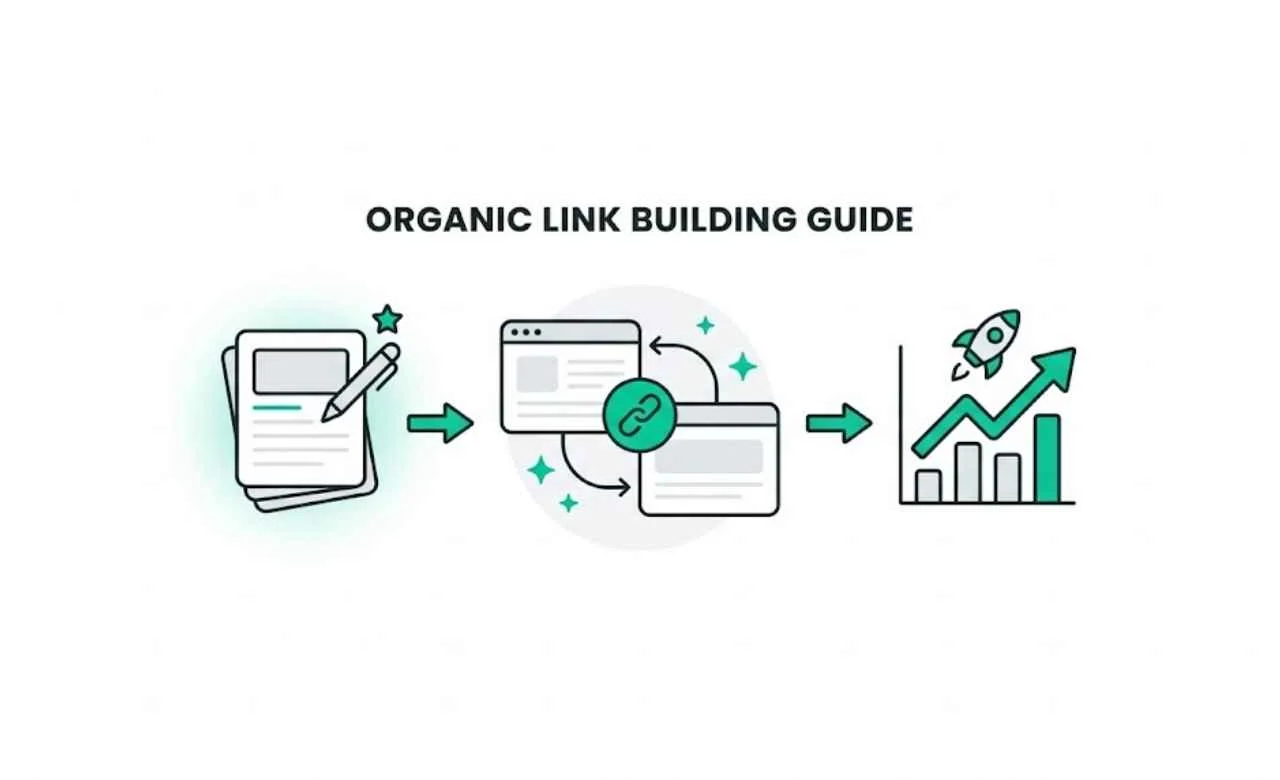
Getting backlinks is one of the most important parts of off-page SEO, but not every backlink has the same value. Some links come from paid placements or aggressive outreach, while others are earned naturally because people genuinely find your content useful. This is where organic link building comes in.
Organic link building is the process of earning natural, relevant backlinks from other websites without manipulating search rankings through link schemes. When a trusted website links to your content because it considers your page valuable, that link can support your website’s credibility, referral traffic, and search visibility.
What Is Organic Link Building?
Organic link building—often termed link earning or natural link building is an off-page SEO discipline focused on acquiring inbound hyperlinks through merit, relevance, and editorial discretion. Unlike synthetic link tactics where webmasters exchange money, goods, or reciprocal placements to manipulate PageRank, organic link acquisition relies on creating linkable assets that other content creators cite voluntarily.
Traditional Link Insertion (Manipulative)
[Your Site] -------- Paid Placement / Private Network --------> [Host Site]
(High risk of algorithmic depreciation or manual action)

Organic Link Earning (Editorial)
[Your Site] === Publishes Primary Data / Asset ===> [Industry Creator Discovers] === Cites Naturally ===> [Earned Backlink]
(Compounding link equity, zero algorithmic penalty risk)
At its foundation, an organic backlink is an editorial endorsement. An author, editor, or webmaster discovers your content, evaluates its topical authority, and embeds a contextual hyperlink to help Organic Link Building their readers explore a concept further. These earned backlinks signal to search engine crawlers that your content is trustworthy, accurate, and valuable.
True organic SEO links follow Google’s link spam policies and Search Essentials. They are not fabricated via private blog networks (PBNs), automated link software, or clandestine sponsored guest spots. Instead, they represent an authentic digital footprint that strengthens your overall backlink profile over time.
How Does Organic Link Building Work?
To understand how organic link building works, you must look at how search engine crawlers interpret the web graph. When Googlebot indexes pages, it tracks hyperlinks to understand two critical signals: topical relevance and link equity.
1. Discovery and Contextual Indexing
When an external webpage links to your resource, crawlers parse the anchor text, surrounding sentences, and broader topical theme of the host page. Natural backlinks carry contextual depth: they appear within the body of an article where the discussion naturally warrants a citation. The search engine’s Natural Language Processing (NLP) models evaluate this surrounding text to confirm that the link offers legitimate value to users.
2. Passing Link Equity (PageRank)
Links act as conduits for PageRank—Google’s foundational algorithm for measuring the relative importance of web pages. When authoritative websites with deep backlink profiles link to your URL, they pass a portion of their equity to your domain. This transferred authority boosts your page’s ability to compete for competitive, high-volume search queries.
3. The Natural Earning Flywheel
Organic link acquisition operates on a self-reinforcing flywheel:
Step 1: Create link-worthy content (original data, frameworks, or deep guides).
   │
Step 2: Seed the asset through targeted digital PR and link building outreach.
   │
Step 3: Earn initial contextual backlinks from reputable industry hubs.
   │
Step 4: Lift search visibility and Google rankings for target search terms.
   │
Step 5: Gain passive organic discovery from researchers, bloggers, and journalists.
   │
└──> (Cycle repeats, compounding your referring domains continuously)
As your search visibility improves, your content surfaces for researchers, journalists, and bloggers seeking source material. This passive discovery loop generates ongoing, unsolicited backlinks without requiring active outreach for every placement.
Why Are Organic Backlinks Important for SEO?
Contextual, high-quality backlinks remain among the most influential ranking signals used by modern search engines. Algorithms have grown increasingly adept at evaluating semantic context and user satisfaction, but external link signals still validate whether a site is a genuine authority or an unverified publisher.
Driving Search Visibility and Organic Traffic
High-quality backlinks act as an external verification system. When multiple authoritative websites link to your domain, search engines assign higher trust to your content across your entire site architecture. This elevation in overall domain authority helps newly published pages index faster and rank higher for competitive search queries.
Building Resilience Against Algorithm Updates
Websites built on low-quality link building techniques, link exchanges, or private networks risk algorithmic deprecation whenever search engines update their spam detection models. Sites with clean, organic backlink profiles routinely withstand core updates and link spam rollouts because their citations stem from genuine editorial intent across diverse referring domains.
Delivering High-Intent Referral Traffic
Organic backlinks embedded within authoritative industry resources provide direct qualified visits. When an industry publication references your technical analysis or proprietary data, interested readers follow that contextual link to your site. This referral traffic frequently converts at a higher rate than general discovery traffic because visitors arrive with pre-established trust.
Establishing Real-World Topical Authority
Google’s search systems emphasize Experience, Expertise, Authoritativeness, and Trustworthiness (E-E-A-T). Editorial backlinks from established domains within your industry validate your subject matter competence. If major industry publications consistently link to your insights, search algorithms register your domain as an authoritative voice in that topical niche.
Organic Link Building vs. Paid Link Building
Acquiring inbound links generally splits into two methodologies: organic link building and paid link building. While paid approaches promise speed and predictable turnaround times, they carry major operational and algorithmic risks.
| Metric / Dimension | Organic Link Building | Paid Link Building |
| Primary Mechanism | High-utility content, digital PR, merit-based outreach | Direct payment, link brokers, sponsored insertions |
| Google Compliance | Fully compliant with Google link spam policies | Violates guidelines unless marked rel="sponsored" |
| Penalty Risk | Low to zero risk of manual or algorithmic penalties | High risk of link devaluation or manual actions |
| Link Equity Transfer | Passes full PageRank and topical authority | Passes no equity if tagged; loses value if detected |
| Long-Term ROI | Compounding; links stay live and accumulate passively | Linear or negative; recurring payments or sudden link drops |
| Referral Traffic Quality | High-intent, contextual, engaged industry readers | Low engagement, often from artificially inflated farm sites |
| Anchor Text Distribution | Diverse, varied, natural semantic anchor texts | Often over-optimized, commercial, and repetitive |
Paid link building relies on short-term transactions. Brokers often sell placements across networks of manufactured blogs that show inflated third-party metrics but generate minimal real organic traffic. When search engines detect these footprints, they devalue the links across the entire network—erasing your ranking gains overnight.
Organic link building requires more upfront effort in content production and relationship cultivation, but it produces a durable, defensible SEO asset. An earned editorial link from an authentic industry publication carries lasting authority that competitors cannot replicate simply by opening a checkbook.
Natural Links vs. Manually Built Backlinks
Not all non-paid backlinks are created equal. In off-page optimization, backlinks exist along a spectrum from entirely autonomous, natural links to deliberate outreach placements.
[ Purely Natural Links ] <----------------------------> [ Outreached Editorial Links ]
- Unsolicited citations                                - Digital PR campaigns
- Academic or journalistic sources                     - Broken link replacements
- Passive organic discovery links                      - Strategic guest contributions
Purely Natural Backlinks
These citations occur with zero direct involvement from your marketing team. A writer discovers your content through organic search, social media, or a newsletter, finds it valuable, and cites it as a reference. Examples include:
- A journalist referencing your original study on consumer behaviors.
- A developer linking to your technical documentation or code repo.
- A blogger linking to your definition or glossary term to clarify a concept.
Manually Built (Outreach-Based) Backlinks
Manually built links are deliberately pursued using ethical, white-hat link building techniques. Rather than waiting for passive discovery, you actively pitch your content to publishers, editors, and webmasters. Examples include:
- Running a digital PR campaign that pitches exclusive industry findings to reporters.
- Identifying broken external links on authoritative websites and suggesting your asset as a working replacement.
- Contacting resource page curators to recommend your free calculation tool or data index.
Both types are valuable components of a balanced link building strategy. Manually pitched links generate the initial visibility and PageRank necessary to push your pages to page one, where passive, purely natural backlinks can take over.
What Makes a Backlink Organic and High Quality?
Search algorithms assess backlink quality using dozens of contextual variables. A single contextual link from an authoritative, trusted website can provide more ranking value than hundreds of spammy backlinks from low-tier directories.
       [Topical Relevance]  ──> Does the niche directly align?
              │
       [Domain Trust]       ──> Does the site have clean, real traffic?
              │
  High-Quality Backlink  ──> Verified by Search Engines
              │
     [Page-Level Context]   ──> Is the link editorial and in-body?
              │
     [Anchor Diversity]     ──> Is the phrasing natural and varied?
1. Deep Topical Relevance
Relevance is the primary pillar of modern link quality. A link from a site within your industry, adjacent vertical, or niche community passes far more topical weight than an unrelated link. For example, if you run a cybersecurity platform, an editorial link from a software engineering publication sends an unambiguous signal of domain competence. The same link from a culinary blog provides little to no contextual value.
2. Verified Domain Trust and Real Organic Traffic
High-quality backlinks originate from authentic, living websites. When assessing potential link prospects, look past vanity metrics like third-party Domain Authority (DA) or Domain Rating (DR). Examine whether the referring domain:
- Generates steady, verifiable organic search traffic.
- Ranks for keywords in its own right.
- Maintains an active, genuine readership.
- Has an editorial policy that weeds out spun or sponsored content.
3. Contextual, Editorial Placement
The location of a link on a webpage indicates its editorial weight. Links placed within the body text of an article—surrounded by relevant sentences and topical concepts—pass the highest amount of link equity. Sitewide footer links, sidebar widgets, and auto-generated author profiles carry significantly less trust and often trip algorithmic spam filters.
4. Natural Anchor Text Distribution
A safe backlink profile displays a natural balance of anchor text styles. Manipulative campaigns over-optimize for exact-match commercial keywords, creating an unnatural footprint. An organic profile includes a healthy mix of:
- Branded anchors: Name of your company, product, or organization.
- Partial-match anchors: Topical variations containing your target keywords alongside other words.
- Entity/Title anchors: The complete title of your referenced study or asset.
- Natural conversational anchors: Phrasing such as “source,” “learn more,” or contextual sentences.
5. Low Outbound Link Saturation
Pages that link out to hundreds of different domains dilute their PageRank. A backlink from an article that selectively references three to five authoritative resources carries far more link equity than one embedded on an over-monetized page listing dozens of commercial sites.
Best Organic Link Building Strategies
Building a sustainable, organic link profile requires reliable execution across proven white-hat link building tactics. Below are the most effective strategies for securing editorial backlinks at scale.
Original Research, Surveys, and Data Studies
Publishing primary research is the most reliable way to generate passive editorial backlinks. Journalists, editors, and content creators constantly search for data points to validate their reporting. By commissioning surveys, analyzing proprietary user data, or aggregating industry metrics, you become the primary source of citation.
Data Collection -> Statistical Synthesis -> Report Publication -> Journalist Outreach -> Earned Citations
When structuring a data study for link acquisition:
- Target specific statistical gaps in your industry (e.g., “The State of Cloud Security Costs”).
- Include clear data tables, executive summaries, and downloadable chart graphics.
- Highlight key percentages and unexpected counter-intuitive findings right at the top of the post.
The Broken Link Building Method
Broken link building is an ethical, service-first strategy where you help webmasters maintain clean user experiences on their sites.
Step 1: Use an SEO crawler to scan authoritative, resource-heavy pages in your niche for broken (404) outbound links.
Step 2: Review the dead content using the Wayback Machine to understand what it originally covered.
Step 3: Publish an updated, superior asset on your own site that covers the same subject.
Step 4: Reach out to the site owner or editor, notify them of the dead link, and politely suggest your working URL as an alternative.
Because you solve a real UX issue for the webmaster before asking for anything, this approach regularly yields higher outreach conversion rates than cold link pitches.
Resource Page Link Building
Thousands of academic institutions, industry trade groups, and niche hubs maintain curated resource lists to help their audiences locate helpful tools, guides, and services.
To earn these links:
- Locate resource lists using targeted search operators:
keyword + inurl:resourceskeyword + "helpful links"keyword + "useful resources"
- Verify that the page is actively updated and contains real external links.
- Suggest an asset that fills an obvious content gap on their page, such as a free calculator, an interactive map, or an encyclopedic industry glossary.
Building Comprehensive Unbranded Linkable Assets
A linkable asset is a standalone, utility-driven resource built specifically to solve a recurring industry challenge. These resources attract recurring links from creators looking to point readers to practical tools. Linkable assets include:
- Interactive calculators and modeling templates.
- Downloadable policy frameworks and spreadsheet systems.
- Deep diagnostic cheat sheets and troubleshooting workflows.
How to Earn Natural Backlinks to Your Website
To turn your website into a destination that attracts natural backlinks automatically, your underlying content strategy must prioritize link utility over thin, generic summaries.
Passive Backlink Attraction Engine
┌────────────────────────────────────────────────────────┐
│  Search-Driven Discovery Queries                       │
│  ("What is...", "Statistics", "Formulas", "Templates")  │
└───────────────────────────┬────────────────────────────┘
                            ▼
┌────────────────────────────────────────────────────────┐
│  Linkable Asset Content Architecture                   │
│  - Definitive Definitions                              │
│  - Copy-and-Paste Embed Snippets                       │
│  - Original Visual Frameworks                          │
└───────────────────────────┬────────────────────────────┘
                            ▼
┌────────────────────────────────────────────────────────┐
│  Editorial Backlink Citations                          │
│  (Writers and creators cite your page as the source)   │
└────────────────────────────────────────────────────────┘
1. Target “Definitional” and “Statistical” Keywords
Writers routinely look up definitions, technical specifications, and updated numbers while drafting new content. By identifying high-intent informational queries in your niche, you position your content directly in their research path. Focus on queries like:
[concept] definition[concept] formula[industry] statistics[concept] benchmark
2. Format Answers for Quick Quotation
Make citing your content effortless for writers on tight deadlines. Place explicit definitions, summary tables, and key takeaways near the top of the page. Highlight them using blockquotes, callout containers, or distinct bold statements so researchers can quickly copy them and drop in an attribution link.
3. Create Custom Visuals, Diagrams, and Infographics
Complex topics are often difficult to explain in words alone. Clean diagrams, workflow flowcharts, and comparison tables naturally attract image-attribution links. When other sites embed your graphic to explain a concept to their readers, they routinely provide a contextual backlink to the original source page.
How Content Marketing Supports Organic Link Building
Content marketing and organic link building rely on each other. High-quality content provides the substance that justifies an earned backlink, while organic link acquisition delivers the authority required for that content to rank.
             ┌──────────────────────────────────────────────┐
             │       High-Value Content Creation            │
             │ (Data studies, technical guides, frameworks) │
             └──────────────────────┬───────────────────────┘
                                    │
                                    ▼
┌────────────────────────────────────────────────────────────────────────┐
│                      Content Promotion & Amplification                 │
│                 (Digital PR, newsletters, social, outreach)            │
└───────────────────────────────────┬────────────────────────────────────┘
                                    │
                                    ▼
┌────────────────────────────────────────────────────────────────────────┐
│                       Contextual Link Acquisition                      │
│                  (Earned backlinks, referring domains)                 │
└───────────────────────────────────┬────────────────────────────────────┘
                                    │
                                    ▼
┌────────────────────────────────────────────────────────────────────────┐
│                     Elevated Topical Authority                         │
│             (Higher search rankings, sustained organic traffic)        │
└────────────────────────────────────────────────────────────────────────┘
Content marketing fuels this loop in three main ways:
1. Expanding the Topical Footprint
A single commercial landing page rarely attracts unsolicited editorial links. Content marketing allows you to publish a wide range of educational resources that explore every dimension of your target topic. This broad topical footprint surfaces your brand across diverse informational queries where writers perform research.
2. Establishing Authoritative E-E-A-T Footprints
Content that offers deep, practical solutions highlights the real-world experience of your team. When you publish actionable case studies, step-by-step methodologies, or technical teardowns, other publishers view your domain as an authoritative voice worth referencing in their own material.
3. Supplying Assets for Promotional Outreach
Cold outreach fails when your pitch focuses purely on commercial intent. Content marketing equips your outreach team with educational, non-promotional resources that editors can reference without feeling like they are publishing free advertising.
How to Create Link-Worthy Content
Generic, surface-level content will not attract earned editorial backlinks in an environment filled with AI-generated text. To win backlinks, your content must offer unique, authoritative value that cannot be found elsewhere.
Use the “Inverted Pyramid” Architecture
Journalists use the inverted pyramid model to deliver critical facts immediately. Applying this structure to your content satisfies researchers right away:
- The Lead: Answer the primary question or define the core topic within the first two sentences.
- The Supporting Details: Provide context, statistics, caveats, and data tables.
- The Deep Breakdown: Walk through historical developments, advanced applications, and practical implementation steps.
Publish Unique, Original Frameworks
Coining an insightful, descriptive name for a proprietary workflow, mental model, or design framework encourages others to reference you whenever they discuss that concept. If your framework becomes an accepted model in your niche, other creators will link to your original post to explain how it works.
Ensure Rigorous Fact-Checking and Citation
If your goal is to earn links from trusted, authoritative publishers, your own content must mirror their journalistic standards. Attribute every external claim, link out to primary sources, and display transparent author credentials to demonstrate deep subject-matter expertise.
How Guest Posting Can Support Organic Link Building
Guest posting has evolved. Low-tier, mass-scale guest blogging on sites with open submission policies is heavily penalized under modern Google link spam policies. However, strategic, high-level guest contributions on respected industry publications remain a legitimate way to build authority and earn contextual backlinks.
Low-Quality Guest Posting (Toxic)
- Submitting spun, generic content to any open blog.
- Hiding exact-match commercial anchors inside irrelevant paragraphs.
- Targeting sites with zero organic traffic that exist solely to sell links.

High-Value Strategic Contribution (Effective)
- Pitching original editorial concepts to genuine, industry-recognized publications.
- Integrating naturally relevant citations that point readers to complementary deep resources.
- Building genuine relationships with active editors and industry thought leaders.
To use guest posting safely:
- Target Selective Publications: Pitch only to established industry sites that maintain strict editorial standards and an active readership.
- Prioritize Reader Value: Write deep, thoughtful articles that provide genuine value to the publication’s audience.
- Use Natural Anchor Texts: Avoid forcing commercial exact-match anchors into the text. Point citations exclusively to relevant informational assets that support the points made in your article.
- Diversify Referrals: Treat guest spots as brand-building opportunities that introduce your expertise to an aligned audience, not merely as single-link transactions.
How Digital PR Helps Earn Organic Backlinks
Digital PR merges classic public relations strategies with technical off-page SEO. Instead of targeting individual blogs, you run creative, data-backed campaigns designed to earn coverage across major news outlets, regional news sites, and respected trade publications.
1. Identify Trending Angle ──> 2. Mine Internal Data ──> 3. Draft Press Pitch ──> 4. Pitch Target Journalists ──> 5. Earn High-Authority Citations
Uncovering Compelling Data Hooks
Journalists look for fresh angles, counter-intuitive data, and human-interest stories that hook their readers. Effective digital PR angles frequently leverage:
- Proprietary platform data (e.g., anonymized user trends, usage statistics, pricing shifts).
- Timely surveys assessing public sentiment around breaking industry developments.
- Public dataset combinations that reveal novel geographic or demographic patterns.
Crafting Pitches That Respect Tight Deadlines
Journalists receive hundreds of pitches every day. To cut through the noise, make your initial outreach as scannable and practical as possible:
- Keep subject lines direct, concise, and focused on the key finding.
- Lead with the central data insight in bullet points within the first paragraph.
- Include a direct link to the full methodology, datasets, and high-resolution visuals.
- Avoid fluffy buzzwords and sales-focused corporate language.
Common Organic Link Building Mistakes to Avoid
Executing a white hat link building strategy requires patience, precision, and adherence to search engine guidelines. Avoid these common missteps:
1. Over-Optimizing Anchor Text Distribution
Manipulative link builders often try to accelerate rankings by forcing repetitive, exact-match commercial keywords into anchor text. When a site’s backlink profile shows an unnaturally high concentration of commercial anchors, search engines register this footprint and discount the links or apply an algorithmic penalty. Ensure your anchor profile stays diverse, branded, and conversational.
2. Targeting Vanity Metrics Over Audience Relevance
Relying exclusively on third-party metrics like DA or DR often leads to wasted resources. A backlink from a high-DA general entertainment website offers little relevance to an enterprise SaaS provider. Prioritize contextual relevance and real organic traffic over vanity metrics.
3. Relying on Low-Quality Directories and Automated Syndication
Submitting your website to automated directory submission engines, social bookmarking farms, or article directories creates low-tier web spam. Modern search engines easily identify and devalue these low-effort networks, wasting your time and creating unnecessary risk.
4. Directing Every Earned Link to Commercial Pages
In an organic ecosystem, third-party sites naturally link to guides, research studies, free tools, and foundational educational resources. If every incoming backlink points straight to your transactional checkout or sales page, your profile will look artificial. Direct the majority of your earned links to top-of-funnel informational assets, and use internal linking to pass that equity down to your commercial landing pages.
Earned Editorial Links
          │
          ▼
[ Top-Of-Funnel Linkable Assets / Guides ]
          │
          │ (Contextual Internal Links passing PageRank)
          ▼
[ Commercial Solutions / Service Pages ]
How Long Does Organic Link Building Take to Work?
Organic link building is a long-term investment. Unlike paid search advertising, which drives traffic the moment a campaign launches, earned links require time to be discovered, crawled, and integrated into search algorithms.
Months 1-2: Setup & Launch
- Publish linkable assets
- Run outreach campaigns
- Early citations appear

Months 3-4: Indexing & Crawling
- Crawlers process new links
- Initial indexing completed
- Authority begins to register

Months 5-6: Ranking Improvements
- Core pages climb rankings
- Target keywords rise
- Organic search traffic grows

Months 6+: Compounding Returns
- Page 1 rankings reached
- Passive links begin to roll in
- Continuous, self-sustaining loop
- Months 1 to 2: Initial research, asset creation, and outreach campaigns run. The first editorial links appear, and search crawlers discover the new citations.
- Months 3 to 4: Search engines index the new referring domains and incorporate the earned link equity into their ranking algorithms.
- Months 5 to 6: Target pages rise in search rankings for competitive queries. As positions improve, initial organic search traffic increases.
- Months 6 and Beyond: Pages reaching page one surface regularly for researchers, kicking off a passive link-earning flywheel that sustains long-term growth.
Read more:What Is a PBN in SEO? Private Blog Networks Explained
How to Measure the Success of an Organic Link Building Campaign
Evaluating an organic link building campaign requires looking past simple vanity link counts. To understand how your off-page optimization efforts translate into business growth, monitor these core performance metrics:
Growth in High-Quality Referring Domains
Track the total number of unique, authoritative domains linking to your website over time. Acquiring ten links from ten distinct, trusted websites builds far more link equity than acquiring ten links from a single domain.
Natural Anchor Text Balance
Use an SEO analysis tool to audit your anchor text distribution regularly. A healthy, low-risk profile shows a wide variety of branded terms, author names, content titles, and natural semantic phrasing.
Organic Keyword Trajectory and Keyword Spread
Monitor the ranking performance of both the target linkable assets and the commercial pages supported by your internal links. Look for consistent upward movement across your core target keywords and an expansion in total ranking secondary queries.
Referring Domain Quality and Inbound Referral Traffic
Review your web analytics platform to see how many qualified visitors arrive via your earned links. High-quality editorial placements on legitimate industry publications deliver engaged visitors who spend time on your site and view multiple pages.
Frequently Asked Questions
What is the difference between white hat and black hat link building?
White hat link building relies on ethical, guideline-compliant techniques such as creating valuable content, digital PR, and direct outreach to earn links based on merit. Black hat link building relies on manipulative, deceptive methods—including paid link networks, hidden links, automated spam, and hacked sites—designed to trick search algorithms. Black hat tactics carry high risks of severe search penalties.
Can a website rank in competitive niches without building backlinks?
While a website can rank for low-competition, long-tail search terms on the strength of well-optimized content and solid technical SEO alone, competitive and commercial queries almost always require external backlinks. In high-value niches, backlinks remain the primary trust signal that search engines use to decide which reputable sites deserve page-one rankings.
What should you do if your website has low-quality or spammy backlinks?
Modern search engines ignore the vast majority of automated, low-quality web spam links algorithmically. However, if your domain receives an explicit manual action or you discover a large, targeted negative SEO link attack, you can compile the suspicious referring URLs into a text file and submit them through Google’s Disavow Tool to disassociate your site from those bad links.
How many backlinks does a new website need to start ranking?
There is no fixed quota of backlinks required to rank. Search algorithms evaluate the overall authority of the competing pages for a given search query. A new page may rank for an uncompetitive query with only two or three authoritative, contextually relevant links, while a competitive commercial keyword might demand hundreds of referring domains. Focus on acquiring high-quality, topically relevant links rather than hitting an arbitrary total link count.
Final Thoughts:
Organic link building is an ongoing, strategic practice that turns your website into a recognized industry authority. By focusing on deep topical relevance, building genuine utility into your content, and earning editorial citations from respected publishers, you create a defensible digital footprint that elevates your search visibility, drives high-intent referral visits, and compounds your organic traffic over time.