
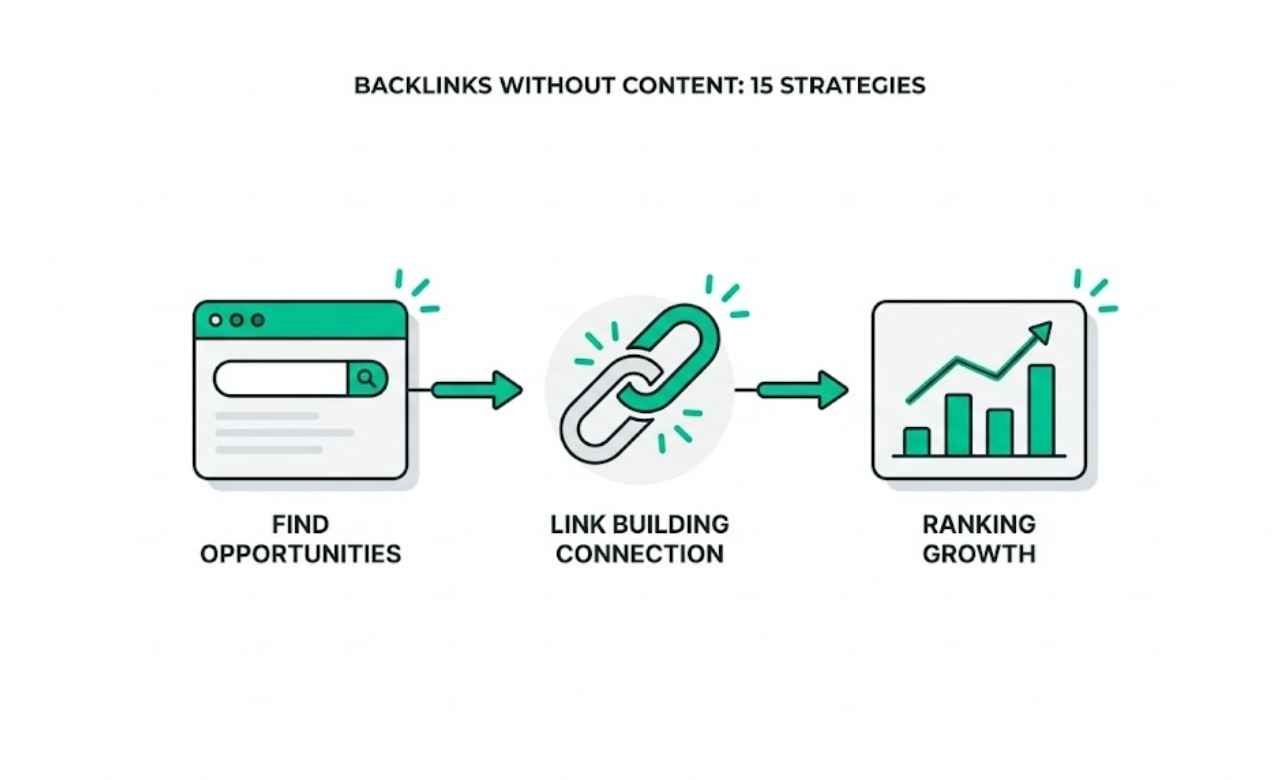
Think you need to publish dozens of blog posts before you can build backlinks? Not necessarily. You can build backlinks without content by using practical link building strategies such as business directories, social profiles, niche edits, guest posting, resource pages, testimonials, and brand mentions.
Backlinks remain an important part of off-page SEO because they can help search engines understand your website’s relevance, authority, and credibility. The key is to focus on high-quality backlinks from relevant and trustworthy websites instead of chasing a large number of low-value links.
In this guide, you’ll learn 15 proven ways to build backlinks without creating content, along with practical techniques for finding backlink opportunities and developing a natural backlink profile.
Why Backlinks Still Matter for SEO
Despite advances in Google’s retrieval systems from early PageRank algorithms to sophisticated neural matching, RankBrain, and modern Transformer-based understanding hyperlinks remain the primary structural mechanism for verifying external trust, semantic topicality, and domain authority.
Search engines evaluate text semantics internally, but they rely on external backlinks to evaluate consensus. When an authoritative third-party website links to your domain, it acts as a cryptographically verifiable citation.
[Authoritative External Domain]
       │
       ▼ (PageRank + Semantic Seed Weight)
[Contextual Anchor Text / Dofollow Link]
       │
       ▼
[Target Commercial Landing Page / Root Domain]
       │
       ▼ (Boosts Trust & Crawl Frequency)
[Search Engine Rankings & Algorithmic Trust]
The Anatomy of Algorithmic Trust
Search engines do not view every backlink equally. Modern search evaluation breaks external links down into several mathematical vectors:
- Seed Site Proximity: Modern engines use algorithmic frameworks derived from models like TrustRank. The closer your site sits in link hops to human-verified “seed sites” (major media, government institutions, universities, established industry leaders), the higher your domain’s baseline trust score.
- Topical Relevance (Topic-Sensitive PageRank): A backlink from an authoritative site in a completely unrelated niche passes significantly less targeted equity than an equivalent link from a direct industry peer. Algorithmic indexers assess the linguistic footprint of the referring URL to confirm thematic alignment with the target.
- Anchor Text Distributions: Natural search engine rankings depend heavily on anchor text profiles. Over-optimized, commercial exact-match anchors can trigger algorithmic quality penalties, while natural distributions (branded, naked URLs, topical partial-match anchors) signal organic peer citations.
- Link Placement and Dwell Semantics: Search engines analyze whether a link sits within the main editorial body text or is relegated to boilerplate footers, sidebars, or automated widget zones. Body-level contextual backlinks, surrounded by topically aligned text, yield the highest ranking utility.
Building a defensible backlink profile without content relies on securing authoritative backlinks from real, relevant referring domains using the business assets you already possess.
Read more:What Is Organic Link Building? A Complete Guide to Natural Backlinks
The Strategic Framework: Link Building Without Content Assets
When you strip away content creation, link building shifts from inbound discovery to active asset exploitation. You must audit and deploy your non-content corporate assets:
| Business Asset | Latent Equity to Leverage | Primary Link Building Tactics | Target Link Type |
| Existing Brand Name | Unlinked media coverage, forum chatter, historical press | Unlinked Brand Mentions, PR outreach | Editorial, Contextual Dofollow |
| Vendor & Partner Relationships | Cash-flow relationships with B2B suppliers and SaaS providers | Testimonial link building, Case study participation | High-Authority Brand Citations |
| Corporate Footprint | Physical addresses, corporate registries, phone lines | Local citations, Business directories | Foundation Citations, NAP Signals |
| Technical Site Footprint | Outdated URLs, dead 404s, redirected domains | Link reclamation, Broken backlink extraction | Equity Preservation, Internal Flow |
| Subject Matter Expertise | Founder or executive insights | Digital PR, Journalist requests, Podcast guesting | High-Tier News, Authoritative Mentions |
Build Backlinks Through Business Directories
Business directories are often misunderstood in SEO. Low-tier link networks that host automated, unvetted directories offer little value and can pollute your link profile. High-tier, human-curated business directories, however, serve as foundational trust signals that validate business legitimacy to search engines.
       [Official Business Registration & Entity Signals]
                              │
            ┌─────────────────┴─────────────────┐
            ▼                                   ▼
 [General Trust Repositories]         [Niche-Specific Registries]
  • Better Business Bureau (BBB)       • Associated General Contractors
  • Dun & Bradstreet                   • Clutch.co / GoodFirms
  • YellowPages / ThomasNet            • Chamber of Commerce Local Portals
            │                                   │
            └─────────────────┬─────────────────┘
                              ▼
            [Consistent NAP + Authoritative Backlinks]
                              │
                              ▼
            [Entity Verification in Search Knowledge Graph]
Strategic Directory Curation
Focus strictly on human-moderated directories that require corporate verification, utility billing, or business registration numbers.
- National Registries: Secure verified corporate placements on platforms like the Better Business Bureau (BBB), Dun & Bradstreet, ThomasNet, and YellowPages. These directories pass crawl priority and establish entity verification within Google’s Knowledge Graph.
- Vertical-Specific Directories: For trade, manufacturing, or service firms, inclusion in specialized directories (e.g., Clutch.co for agencies, Avvo for legal, Houzz for interior and contracting services) establishes explicit topical relevance. Search engine algorithms associate these directories with trusted sector nodes.
Optimization Rules for Directory Links
- Maintain Absolute NAP Consistency: Ensure Name, Address, and Phone number are formatted identically across every listing. Mismatches dilute algorithmic entity resolution.
- Avoid Tier-3 Submission Farms: Disregard software promising automated submissions to “5,000 directories.” These run on link farm networks that risk algorithmic devaluation. Hand-pick 30 to 50 authoritative, high-tier directories and secure deep, verified profiles with branded anchor text.
Get Listed on Local Citation Websites
Local citations form the structural backbone of regional visibility and local map pack rankings. If your business operates within specific territories, local citation websites supply geo-relevant authority signals without requiring continuous blog production.
Local citation platforms function as geo-anchors. Algorithms cross-reference geographic coordinates and regional domain authority across local directories to establish geographic confidence for search queries with local intent.
Step-by-Step Citation Deployment
- Claim the Core Data Aggregators: Primary data aggregators feed location data down to hundreds of tertiary directories. Secure and verify listings on platforms like Data Axle, Localeze, Foursquare, and Factual.
- Submit to Tier-1 Core Platforms: Build complete profiles on Apple Maps, Bing Places for Business, Google Business Profile, and Yelp. While several pass nofollow links, their crawl frequencies generate high referral authority and validate your web address.
- Target Geo-Specific Portals: Secure backlinks from regional chambers of commerce, municipal business improvement districts, and regional trade organizations. These websites hold high regional authority (
.organd.govlocal domains), passing significant geographical relevance to your root domain.
Use Social Profiles for Link Building
Social profiles rarely pass direct PageRank equity, as most platforms use rel="nofollow" or redirect parameters on external website fields. However, social profiles play an essential structural role in building a natural backlink profile without content.
A legitimate modern enterprise owns verified brand handles across major social networks. If a domain possesses high-authority contextual backlinks but lacks foundational social assets, search engine algorithms can flag this as an inorganic link manipulation footprint.
                  [Your Root Domain]
                           │
       ┌───────────────────┼───────────────────┐
       ▼                   ▼                   ▼
 [LinkedIn Company]  [X (Twitter)]       [GitHub / Crunchbase]
  • High DR Foundation• Rapid Indexing   • Entity Co-Citation
  • Canonical Identity• Live Social Feed • Clean Referral Traffic
       │                   │                   │
       └───────────────────┼───────────────────┘
                           ▼
          [Algorithmic Trust & Entity Verification]
Essential Social Link Deployments
- Corporate Entity Profiles: Establish and fully optimize corporate pages on LinkedIn, X (Twitter), Facebook, Pinterest, YouTube, GitHub, and Crunchbase. Fully populate descriptions, mission data, and target URLs.
- Executive-Level Profiles: Tie company founder and executive profiles back to the corporate root domain. This creates mutual topical reinforcement across individual author entities and corporate entities.
- Indexing Accelerators: Search engine crawlers crawl high-traffic social platforms constantly. When you launch new commercial pages, product updates, or service sections, sharing links on verified corporate social handles encourages immediate search engine discovery and re-crawling.
Submit Your Website to Relevant Web Directories
Beyond consumer business registries, the internet retains high-authority web directories. These portals operate like modern telephone directories for specialized technical platforms, software libraries, and enterprise service providers.
The value of a web directory depends entirely on its editorial barrier to entry. If approval is instantaneous and automated, the link equity is usually zero. If acceptance requires code verification, domain ownership validation, and manual human curation, the backlink carries legitimate algorithmic weight.
               [Web Directory Target]
                         │
        ┌────────────────┴────────────────┐
        ▼                                 ▼
[Automated / Instant Acceptance]    [Human Curated / Manual Review]
  • Low editorial barrier             • Deep domain validation
  • Zero algorithmic weight           • Contextual, dofollow links
  • Link-farm penalty risk            • High referring domain equity
        │                                 │
        ▼                                 ▼
   [AVOID TACTIC]                    [PURSUE ACTIVELY]
                                      (e.g., BuiltWith, Product Hunt)
Navigating Web Directories
- Tech Stack Registries: If your business runs on specialized technology stacks, list your domain on systems like BuiltWith, StackShare, and SourceForge. These platforms automatically associate your digital properties with enterprise technological terms.
- Startup and Product Repositories: Launch profiles on Product Hunt, BetaList, and G2. These platforms generate high-authority, dofollow and nofollow contextual mentions, driving referral traffic and trusted referring domain signals.
- Strict Quality Filters: Discard directories that charge low flat fees for automated approval, use generic site templates, or host unrelated categories (e.g., hosting online casinos alongside industrial plumbing). Prioritize platforms with strict editorial guidelines and clear thematic focus.
Build Backlinks Through Guest Posting
While guest posting involves written text, it does not require publishing informational content on your own website. By contributing guest posts, you deploy your industry expertise to land contextual backlinks inside established editorial streams on high-authority external sites.
The objective is to avoid low-end “guest posting networks.” Focus instead on secure, highly relevant niche publications where your operational insights solve specific editorial problems for the host publisher.
[Audience Identification & Publication Audit]
                 │
                 ▼
[High-Touch, Personalized Editorial Pitch]
                 │
                 ▼
[Production of Specialized, Technical Host Material]
                 │
                 ▼
[Contextual Anchor Integration to Target URL]
                 │
                 ▼
[Dofollow Link Placed on Authoritative Niche Domain]
The Professional Guest Placement Framework
- Prospect Identification: Use targeted search parameters to uncover genuine, non-commercial publications in your space:
"[niche keyword]" + "editorial guidelines""[niche keyword]" + "contributing writer""[niche keyword]" + "inurl:contributors"
- Strict Metrics Review: Evaluate prospective sites using concrete analytical thresholds:
- Legitimate, stable organic search traffic profiles (avoid domains with sharp drops indicating algorithmic penalties).
- Strict semantic topical alignment.
- High domain rating and authentic referring domains.
- A clean outgoing link profile (verify that the site does not link out to low-quality, spammy niches).
- Outreach & Link Placement Strategy: Do not pitch generic titles. Pitch hyper-specific frameworks addressing topics the publication has overlooked. Place your backlink natively within the educational narrative rather than an isolated author bio. Direct this contextual backlink to an appropriate commercial or service landing page using descriptive, natural anchor text.
Try Niche Edits and Link Insertions
Niche edits—frequently described as link insertions—involve embedding a link into an existing, indexed article on an external website. Because the host page has already accumulated age, historical PageRank, and user engagement signals, niche edits can route link equity into your domain faster than waiting for a new piece of content to be indexed and ranked.
Existing High-Ranking URL (Indexed 2+ Years, Steady Organic Traffic)
┌─────────────────────────────────────────────────────────────────┐
│ Paragraph 1: Theoretical foundation...                          │
│                                                                 │
│ Paragraph 2: Practical implementation [Insert Link Here]...     │
│  └─► Contextual Anchor pointing to your Commercial Landing Page │
│                                                                 │
│ Paragraph 3: Advanced industry considerations...                │
└─────────────────────────────────────────────────────────────────┘
Execution Strategy for Link Insertions
- Identify Established Contextual Assets: Search for URLs ranking between positions 11 and 30 for keywords relevant to your commercial offerings. These pages already carry search engine trust, but they frequently require updated citations, supporting frameworks, or technical solutions.
- Propose Contextual Relevance Updates: Reach out to the site owner or editor with an analytical update:
“I was reading through your analysis of enterprise inventory management architectures and noticed your section addressing cold-chain tracking. You noted legacy hardware options, but overlooked modern automated API integrations. We have an operational framework mapped directly to this architecture that could serve as a useful reference for your readers here.”
- Anchor Text Integration: Ensure the proposed link fits seamlessly into the existing sentence structure. The surrounding sentences must provide strong semantic co-occurrence with the target page to maximize contextual relevance.
Find Unlinked Brand Mentions
Unlinked brand mentions are one of the most effective, content-free link acquisition channels for established businesses. Digital publications, journalists, local platforms, and partners often mention your company, product lines, or key executives without including an active hyperlink back to your website.
Because the publisher has already vetted your entity, these mentions hold low friction for conversion into high-quality, dofollow backlinks.
[Automated Monitoring Engine (Alerts, Ahrefs, Brand24)]
                          │
                          ▼
             [Brand Mention Detected]
                          │
            ┌─────────────┴─────────────┐
            ▼                           ▼
    [Hyperlink Present]        [Unlinked Text Mention]
            │                           │
            ▼                           ▼
    [Evaluate Anchor]          [Initiate Reclamation]
                                        │
                                        ▼
                         [Direct Editor / Author Outreach]
                                        │
                                        ▼
                         [Contextual Backlink Secured]
The Unlinked Brand Mention Workflow
- Deploy Tracking Automation: Set up active tracking alerts using tools like Google Alerts, Talkwalker, Brand24, and specialized Ahrefs Content Explorer configurations to monitor:
- Exact corporate names and common misspellings.
- Proprietary product or service names.
- Executive names and public-facing specialists.
- Filter Qualified Prospects: Scrutinize the referencing page. Verify that it holds genuine search index status and comes from a clean, non-spam domain.
- Execute Conversion Outreach: Contact the author or managing editor. Express appreciation for the reference, and offer an active hyperlink to complete the citation:
Subject: Question regarding your coverage of [Brand Name]

Hi [Editor Name],

Thank you for featuring [Brand Name] in your recent piece on [Article Topic]. We appreciate the mention of our team's work on [Specific Initiative].

I noticed that while you referenced our platform, there isn't an active link back to our technical specifications page. Adding a reference link could help readers inspect the data and implementation details you cited:

Target URL: https://yoursite.com/technical-spec

Thanks for your time and editorial consideration.

Best regards,

[Your Name]
Reclaim Broken Backlinks
Web architecture naturally degrades over time. As sites redesign their templates, sunset older services, change domains, or modify URL paths, inbound backlinks that once passed authority begin to resolve to dead 404 error pages. This dynamic provides two distinct link-building angles that require no content writing: internal link reclamation and external broken link acquisition.
       Broken Link Discovery Strategy
                     │
       ┌─────────────┴─────────────┐
       ▼                           ▼
[Internal Link Reclamation]  [External Broken Link Building]
 • Audit internal 404s        • Scrape dead competitor links
 • Identify lost backlinks    • Contact hosting webmasters
 • Implement 301 redirects    • Propose your live page
       │                           │
       ▼                           ▼
[Immediate Equity Recovery]  [Competitor Equity Transfer]
Internal Link Reclamation
- Audit Dead Inbound Links: Run your root domain through backlink analysis software to isolate all inbound links pointing to 404 status codes.
- Deploy Permanent 301 Redirects: Map each broken URL to its most logically relevant, active commercial page. This restores the flow of historical link equity back through your primary site architecture, recovering domain authority and historical PageRank.
External Broken Link Building
- Prospect Broken Competitor Equity: Analyze legacy competitor domains, sunsetted industry services, or defunct SaaS tools. Identify external pages returning 404 errors that still hold hundreds of historical backlinks.
- Execute Site Outreach: Notify the referring domain’s webmaster about the dead link on their page. Because broken links degrade user experience and waste crawl budget, webmasters are motivated to replace dead citations with your active, relevant landing page:
Subject: Dead link on your [Page Title] resource

Hi [Site Master],

I was reviewing your guide on [Page Topic] and noticed that the citation pointing to [Defunct Tool/Competitor] in paragraph 4 returns a dead 404 error.

Given that [Defunct Tool/Competitor] discontinued their platform, you might consider pointing readers to our active service page here:

https://yoursite.com/alternative-solution

This covers the exact workflows referenced in your original text, saving your readers from hitting that dead page.

Best regards,

[Your Name]
Get Links From Resource Pages
Resource page link building involves securing placements on curated link hubs that industry bodies, academic institutions, and niche websites maintain to direct users toward vetted tools, service providers, and business solutions.
Resource pages are intended to host links. Unlike traditional editorial sites where you must negotiate for an inline link insertion, resource pages are built specifically to catalog helpful external destinations.
[Prospecting Resource Pages via Advanced Search Operators]
                           │
                           ▼
 [Metric Evaluation: Organic Traffic, Site Authority, Spam]
                           │
                           ▼
[Identify Exact Categorical Fit on the Target Resource Page]
                           │
                           ▼
   [Pitch Service Utility Directly to the Page Curator]
                           │
                           ▼
    [Placement Added to Static Categorical Link Hub]
Locating High-Converting Resource Pages
Run advanced search operators tailored to identify commercial resources, service provider listings, and tool directories:
[niche keyword] + inurl:resources[niche keyword] + "useful resources"[niche keyword] + "helpful links"[niche keyword] + inurl:links[niche keyword] + "commercial partners"
Outreach Strategy for Resource Pages
Filter your targets strictly: avoid broken pages with missing stylesheets that have sat unmaintained for years. Prioritize active, regularly maintained industry hubs. Frame your outreach around practical utility:
“I saw your resource portal for industrial logistics managers. You have an extensive section dedicated to fleet management platforms, but you don’t list a dynamic route-planning solution for heavy freight. We offer a platform built for this exact route profile; linking to it could provide an actionable option for your visitors.”
Use Competitor Backlink Analysis
Competitor backlink analysis uncovers the link profiles that search engines already reward in your specific space. Rather than guessing which websites might link to your commercial pages, you reverse-engineer the link profiles of your top three to five organic competitors.
       [Top 3-5 Organic SERP Competitors]
                        │
                        ▼
       [Extract Full Backlink Profiles]
                        │
                        ▼
       [Filter: Remove Low-Tier Directory Spam]
                        │
                        ▼
       [Identify Link Intersection Clusters]
                        │
       ┌────────────────┼────────────────┐
       ▼                ▼                ▼
[Shared Vendors] [Industry Listings] [Digital PR Hits]
       │                │                │
       └────────────────┼────────────────┘
                        ▼
   [Systematic Outreach & Parity Acquisition]
The Analytical Replication Process
- Extract Full Referring Domains: Run top-ranking URLs for your core commercial keywords through your link analysis tool of choice. Pull their complete profiles of referring domains and active backlinks.
- Calculate Link Intersections: Focus on sites that link to two or more of your direct organic competitors, but do not yet link to you. These intersections reveal websites with an established pattern of linking to businesses in your niche.
- Categorize by Link Type: Group your prospects by structural mechanism:
- Did your competitor secure a directory listing? Submit your domain.
- Did they sponsor an industry event? Contact the organizers.
- Did they secure a vendor profile? Reach out to that partner network.
- Did they earn a contextual link insertion? Pitch an equivalent placement.
By methodically matching your competitors’ high-quality link sources, you work toward off-page parity and can systematically surpass them through superior technical health and targeted commercial positioning.
Build Links Through Testimonials and Reviews
Every business purchases software, retains external services, and buys hardware to maintain its operations. Modern B2B vendors routinely publish client testimonials, case studies, and partner success stories on their websites to improve their own conversion rates.
These vendor showcases provide an opportunity to secure high-authority, branded homepage or case-study backlinks without producing any content for your own site.
                      [Commercial B2B Vendor]
                                 │
           ┌─────────────────────┴─────────────────────┐
           ▼                                           ▼
[Customer Case Studies Hub]                  [Homepage Social Proof]
 • In-depth operational review                • High DR Brand Logo
 • Contextual Link to Client Site             • Authority-Passing Backlink
           │                                           │
           └─────────────────────┬─────────────────────┘
                                 ▼
                     [Your Commercial Domain]
The Vendor Testimonial Workflow
- Audit Your Operational Tech Stack: Catalog every paid platform, agency partner, and logistics provider your company uses:
- Accounting and payroll software.
- Project management and communication platforms.
- Specialist consulting agencies, hosting providers, and office vendors.
- Assess Domain Authority: Filter your vendors by domain rating and referring domain metrics. Prioritize platforms with strong authority profiles that actively showcase client logos and customer reviews.
- Pitch an Executive Endorsement: Contact their marketing department or your direct account manager. Offer a clear, concise quote from your founder or executive team:
“We’ve used your system to manage our supply chain logistics across the last fiscal year and saw our throughput efficiency improve by 22%. We’d be glad to share an executive quote or brief case study for your marketing team to use on your site, as long as it includes an attribution link back to our company domain.”
Leverage Digital PR and Online Communities
Digital PR does not require writing white papers or maintaining an active newsroom. Instead, it positions internal staff as knowledgeable sources for journalists, reporters, and media editors facing daily publication deadlines.
[Journalist Query / Breaking News Event]
                    │
                    ▼
   [Source Requests: Connectively / Qwoted / Editorial Desks]
                    │
                    ▼
   [Fast, Concise Executive Reaction Submitted]
                    │
                    ▼
[Media Placement with Contextual Link to Source Domain]
Executing Agile Media Placements
- Monitor Real-Time Media Requests: Track inbound media requests via platforms like Connectively, Qwoted, and SourceBottle, as well as specialized callouts on social networks (
#JournoRequest). - Deliver Rapid, Usable Answers: Journalists often review dozens of responses per topic. Submit direct, jargon-free executive reactions that can be copy-and-pasted cleanly into their stories. Avoid promotional marketing copy; provide clear, defensible points that add value to their coverage.
- Secure Editorial Links: Media outlets that feature expert quotes routinely include a contextual, branded citation linking back to the source’s company domain. These placements provide authoritative links from high-trust news sites.
Engaging Strategic Online Communities
Participate in curated discussions on platforms like Reddit, Quora, and specialized industry forums (such as Stack Overflow or GitHub). While these platforms typically apply nofollow or ugc attributes to user-submitted links, contributing authoritative, problem-solving responses builds direct referral traffic, enhances entity co-occurrence signals, and frequently sparks organic citations from third-party editorial writers who use these threads as reference material.
How to Build a Natural Backlink Profile Without Content
Aggressive link building without content requires disciplined quality control. When algorithms evaluate a domain’s link profile, they search for signs of artificial manipulation. A profile dominated entirely by exact-match commercial anchors or identical link types is a primary footprint for algorithmic penalties.
                  Balanced Backlink Architecture
                                 │
         ┌───────────────────────┼───────────────────────┐
         ▼                       ▼                       ▼
[Anchor Distributions]    [Link Attribute Ratio]   [Destination Topology]
 • 70% Branded / Domain    • Balanced Dofollow      • Root Commercial URLs
 • 20% Naked URLs / Misc   • Natural Nofollow & UGC • Key Service Pages
 • 10% Partial-Match       • Real Entity Footprint  • Geo/Regional Hubs
Core Architecture for Natural Profiles
- Balanced Anchor Distributions: Maintain a conservative anchor text profile. As a benchmark, keep your branded anchors and naked URLs between 70% and 80% of your total profile. Partial-match or topical anchors should make up roughly 10% to 20%, while exact-match commercial anchors should remain under 5%.
- Balanced Link Attributes: An authentic link profile contains a natural mix of
dofollow,nofollow, andugclinks. Attempting to force every placement to pass PageRank creates an artificial pattern. Focus on the authority and relevance of the referring site; let the link attributes balance naturally. - Varied Destination Topologies: Avoid pointing every newly acquired link directly to a single commercial conversion page. Spread equity cleanly across your root domain, key service pages, corporate information pages, and regional hubs to mimic organic discovery patterns.
Tactical Playbook: 60-Day Link Acquisition Framework
This phased plan outlines a clear, 60-day process for securing high-authority backlinks without content creation:
| Phase | Days | Primary Focus | Operational Deliverables |
| Phase 1: Foundation & Recovery | Days 1–15 | Link Reclamation & Citations | • Map 301 redirects for all broken internal 404 URLs. • Secure listings in top 30 human-reviewed business directories. • Standardize NAP data across primary local data aggregators. |
| Phase 2: Entity & Vendor Outreach | Days 16–30 | Brand Mentions & Testimonials | • Identify and pitch all unlinked brand mentions. • Run software audits and pitch testimonials to five active SaaS vendors. • Complete and link corporate social profiles. |
| Phase 3: Systematic Extraction | Days 31–45 | Competitive Parity & Resources | • Pull competitor link intersection matrices to isolate targets. • Secure inclusion on five authoritative industry resource pages. • Pitch three dead-link replacements on competitor targets. |
| Phase 4: Scaled Acquisition | Days 46–60 | Digital PR & Link Insertions | • Submit daily responses to qualified journalist queries. • Land three niche edits on established, ranking articles. • Audit newly indexed links and monitor overall anchor profile health. |
Frequently Asked Questions
1. Can you build backlinks without creating content?
Yes, you can build backlinks without publishing new content through directories, business listings, guest posts, link insertions, citations, and brand mentions.
2. What is the easiest way to build backlinks without content?
Creating social profiles, submitting to relevant directories, and claiming business listings are simple ways to earn backlinks without creating articles.
3. Are backlinks without content good for SEO?
They can contribute to SEO when they come from relevant, trustworthy websites and are acquired naturally. Quality and relevance matter more than simply getting many links.
4. How can I get backlinks from other websites without writing?
You can use outreach, broken-link opportunities, resource-page requests, testimonials, digital PR, and unlinked brand-mention reclamation to earn links.
5. How many backlinks should I build without content?
There is no fixed number you need to target. Focus on earning relevant, high-quality links from legitimate websites rather than building backlinks in bulk.
Conclusion
Link building without content creation is not about taking shortcuts it is an exercise in asset capitalization.
By treating your corporate footprint, brand equity, software stack, and vendor relationships as linkable assets, you can run an off-page SEO strategy that captures high-quality backlinks, preserves crawl equity, and builds domain authority without relying on an internal content mill.
Prioritize strict domain evaluation over raw link volume. Ensure your anchor text distributions remain balanced, systematically audit your inbound link health, and focus on securing links from real, relevant businesses. Over time, this disciplined approach will help build the authority needed to drive long-term search engine visibility.