
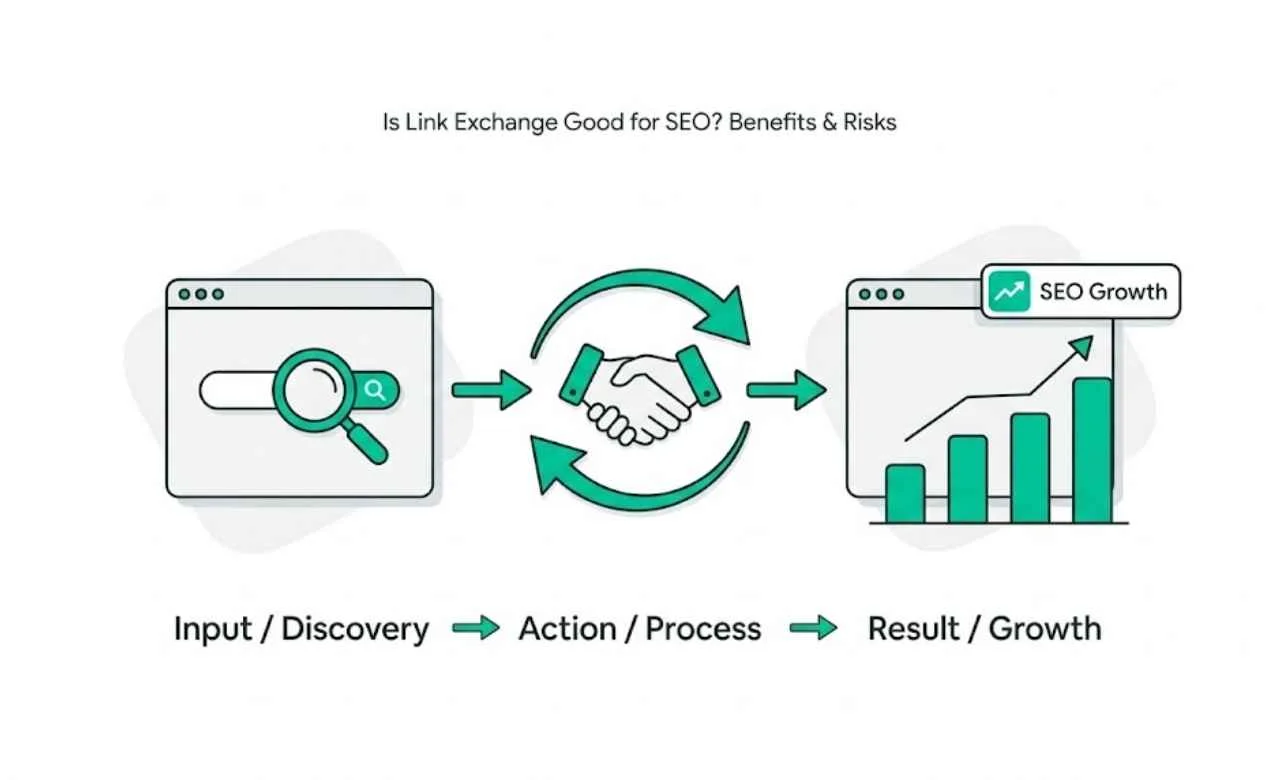
If you’re building backlinks for your website, you’ve probably come across link exchange as a quick way to earn more links. But the real question is: is link exchange good for SEO, or can it put your website at risk?
Link exchange, also known as reciprocal link building, happens when two websites agree to link to each other. When done naturally between relevant and trustworthy websites, it can help users discover useful resources and generate referral traffic. However, excessive or manipulative reciprocal linking can create SEO risks and may conflict with search engine spam policies.
In this guide, we’ll explain how link exchanges work, their potential benefits and risks, what makes a reciprocal link natural, and the best practices to follow. By the end, you’ll know when link exchange can make sense as part of a broader SEO link-building strategy.
Is Link Exchange Good for SEO? An Overview
Link acquisition remains one of the foundational pillars of modern search engine optimization. Among the oldest and most debated tactics in organic search marketing is the link exchange—a reciprocal agreement where two webmasters mutually swap hyperlinks to bolster their search visibility.
In early search engine algorithms, reciprocal linking was a rapid mechanism for inflating backlink volume and passing PageRank across collaborating domains. However, as Google’s algorithmic systems transitioned from raw link volume toward sophisticated semantic analysis, Natural Language Processing (NLP), and the SpamBrain AI system, the dynamics of exchanging links shifted dramatically. Today, reciprocal link building occupies a nuanced territory: executed naturally and contextually, it mirrors genuine industry collaboration; executed mechanically or at scale, it triggers algorithmic demotions or manual spam penalties.
This comprehensive guide unpacks the mechanics, strategic viability, underlying risks, and algorithmic considerations of reciprocal link building. Whether you are auditing an existing backlink profile or refining your broader link building strategy, understanding how Google interprets two-way backlinks is vital to sustaining long-term search engine rankings.
What Is Link Exchange in SEO?
In search engine optimisation, a link exchange (frequently termed reciprocal links or reciprocal linking) is an arrangement where two distinct domains agree to publish hyperlinks pointing to one another. The basic principle is straightforward: Site A links to Site B, and in return, Site B links to Site A.
Site A (Source Domain)  ═══════ [Contextual Inbound Link] ═══════>  Site B (Target Domain)
Site A (Target Domain)  <══════ [Reciprocal Outbound Link] ═══════  Site B (Source Domain)
At its core, a link exchange is designed to build SEO backlinks that pass search equity (historically termed link juice or PageRank) between the participating domains. Backlinks operate within search engines as third-party endorsements. When authoritative websites link to your domain, search crawlers interpret those external links as signals of trust, website credibility, and topical authority.
However, link exchanges can take several forms:
- Direct 1:1 Reciprocal Links (Two-Way Backlinks): The direct trade described above. Domain A places an outbound link to Domain B, and Domain B provides an inbound link back to Domain A.
- Three-Way Link Exchanges (A-B-C Exchanges): Designed to obscure the reciprocal nature from search crawlers. Domain A links to Domain B, but Domain B returns the favor by linking to Domain C (a secondary site owned by Domain A’s operator), or Domain B links to Domain A from a completely different site in their portfolio.
- Four-Way or Network Exchanges (PBN Exchanges): Coordinated link networks where multiple site owners systematically swap backlinks across distributed private blog networks or collaborative business webs to simulate editorial backlinks.
Modern NLP-driven search algorithms evaluate not just the existence of these links, but their linguistic context, structural placement, topical relevance, and surrounding co-occurrences.
How Does Link Exchange Work?
The operational mechanics of backlink exchange initiatives typically follow a standard outreach and negotiation lifecycle. While automated platforms and private brokerages exist, manual outreach between digital marketing teams and website owners represents the most common execution path.
1. Discovery and Prospecting
Website operators seek out relevant websites within a shared or complementary vertical. An enterprise CRM platform, for instance, might search for reputable email marketing tools, project management software blogs, or sales consultancy sites. Prospecting generally filters for domains that have:
- Strong domain authority or domain rating metrics.
- Steady organic traffic flows.
- Topical alignment with the target domain.
- A healthy, non-spammy backlink profile.
2. Outreach and Negotiation
The outreach coordinator initiates contact—typically via email or professional networks—proposing a mutually beneficial backlink partnership. The pitch often involves exchanging links between websites via existing pieces of content (niche edits or link insertions) or newly drafted guest posts.
3. Contextual Integration and Anchor Text Selection
Once agreed, both parties select target URLs and specify preferred anchor text. In an SEO-conscious exchange, the webmasters integrate contextual links directly into the body copy of relevant articles rather than relegating them to footers, sidebars, or generic “resource directories”.
Natural Contextual Anchor Text:
"When scaling customer support pipelines, adopting [modern helpdesk software] reduces ticket latency."
                                                   └───────────── Anchor Text ─────────────┘
The placement requires surrounding text that matches the conceptual theme of the destination page, establishing clear contextual relevance for search engine parsers.
4. Verification and Indexation
After publication, both parties verify that the outbound links are live, set to rel="dofollow" (avoiding rel="nofollow" or rel="sponsored" attributes, which limit standard PageRank flow), and accessible to search bots. Over subsequent crawl cycles, search engine bots discover the updated HTML, parse the new external links, and register the cross-domain connection within their respective link graphs.
Why Do Websites Exchange Backlinks?
Securing editorial backlinks purely through organic content discovery is exceptionally resource-intensive. For newer domains or highly competitive commercial niches, passive link acquisition can take months or years to move competitive needles. Webmasters turn to backlink exchanges for clear operational reasons:
Overcoming the “Cold Start” Problem
New websites lack the baseline organic search visibility required to earn links organically. If your content does not rank on page one of Google Search rankings, decision-makers and content creators rarely find it to cite it. A strategic backlink exchange provides an initial injection of external link equity, helping search engines discover and index fresh pages faster.
Predictability and Cost Efficiency
Standard outreach for unreciprocated editorial links often suffers from conversion rates beneath 2-5%. In contrast, proposing a mutually beneficial trade with an aligned partner yields substantially higher conversion rates. It eliminates the direct monetary costs associated with paid links while delivering predictable link acquisition velocity.
Targeted Referral Traffic Acquisition
Beyond raw algorithmic calculations, exchanging links with high-traffic, authoritative websites can funnel highly qualified referral traffic straight to conversion funnels. When an audience reads an in-depth analysis on a complementary site, clicking a contextual link to your resource represents a high-intent user journey.
Is Link Exchange Good for SEO?
The short answer: It depends entirely on scale, relevance, and execution.
When reciprocal links occur organically—or mimic organic collaboration within tightly aligned industries—they can support your SEO strategy by reinforcing topical authority, expanding your link profile, and driving targeted referral visits. Industry studies analyzing millions of top-ranking web pages regularly reveal that between 25% and 45% of high-ranking domains have natural overlapping reciprocal links with other industry authorities. In any healthy digital ecosystem, market leaders naturally cite and link to one another.
However, when link exchanges are treated as a programmatic, quid-pro-quo scheme, they quickly turn toxic. Algorithmic patterns that feature identical anchor texts, irrelevant niche pairings, sudden backlink velocity spikes, and footprint-heavy exchange rings are trivial for machine-learning filters to flag.
┌──────────────────────────────────────┬──────────────────────────────────────┐
│ Healthy Reciprocal Collaboration    │ Manipulative Link Schemes            │
├──────────────────────────────────────┼──────────────────────────────────────┤
│ Natural, contextually rich links     │ Scaled, programmatic 1:1 link trades │
│ Topically aligned niche partners     │ Unrelated sites (e.g., crypto & pets)│
│ Natural, branded/varied anchor text  │ Exact-match commercial anchor texts  │
│ Integrated inside relevant body copy │ Sitewide footers, sidebars, matrices │
│ Drives legitimate referral traffic   │ Exists solely to pass PageRank       │
└──────────────────────────────────────┴──────────────────────────────────────┘
Used sparingly as one small component of a diversified, white hat link building approach, reciprocal linking does not harm your site and can provide modest ranking support. Used as your primary engine for link acquisition, it exposes your domain to severe organic search penalties.
Potential Benefits of Link Exchange
When executed carefully within strict quality parameters, participating in a backlink partnership offers notable advantages:
1. Acceleration of Website Authority
Search engines compute domain-level trust and page-level authority in part through inbound link graphs. Securing high-quality links from trusted domains elevates your baseline website authority. This, in turn, helps all internal URLs on your domain compete more effectively for competitive keyword sets.
2. Contextual Topic Clustering Across Domains
Search engines rely on semantic co-occurrence to understand entity relationships. When an authoritative platform in your space links contextually to your analytical breakdown of a subtopic, it signals to search engines that your content is an authoritative node within that knowledge graph. This shared topical relevance reinforces your topical authority.
3. Diversification of Inbound Link Equity
A healthy backlink profile requires a diverse array of referring domains, subnet IPs, and page types. Incorporating selective reciprocal relationships with complementary vendors, software tools, or industry publications helps construct a resilient natural backlink profile.
How Link Exchanges Can Improve Website Visibility
The ultimate objective of any search engine optimization strategy is maximizing organic search visibility to capture qualified commercial and informational search intent. Here is the operational cascade through which high-quality, relevant backlinks alter your performance in SERPs:
[Contextual Inbound Link Published]
               │
               ▼
[Search Engine Spider Discovers & Crawls Target URL]
               │
               ▼
[Semantic Analysis: Anchor Text & Co-Occurrences Evaluated via NLP]
               │
               ▼
[Link Equity (PageRank) Distributed to Target Entity]
               │
               ▼
[Topical Trust & Domain Authority Metrics Rise]
               │
               ▼
[Target URL & Related Cluster Pages Climb Google Search Rankings]
               │
               ▼
[Compounded Organic Traffic Growth & Enhanced Impression Share]
Passing Crawl Paths and Freshness Signals
Search engine spiders discover new content primarily by traversing known external links. When an authoritative site frequently updated by Google crawlers links to your deep internal resource, it speeds up crawl frequency for your pages, ensuring updates, title optimizations, and new content clusters index rapidly.
Read more:How to Build Backlinks Without Content: 15 Proven Strategies for SEO
Reinforcing Semantic Keyword Relevance
Natural Language Processing models analyze the text immediately preceding and following a hyperlink. When an exchange places your link amid semantically relevant terminology (LSI keywords, entity variants, and industry terminology), search engines update their internal index regarding your page’s relevance to that broader query category.
The Risks of Link Exchange for SEO
While the upside of link acquisition is significant, engaging in reciprocal link building introduces specific, high-stakes vulnerabilities that every webmaster must calculate.
Algorithmic Devaluation and Nullified Equity
Google’s spam prevention algorithms (including SpamBrain) do not necessarily issue overt alerts when they identify unnatural links. Instead, modern systems often neutralize them silently. If an algorithm identifies a reciprocal pattern as artificial, it strips the links of all authority transfer. You expend time, content assets, and outreach bandwidth on links that pass zero PageRank.
Algorithmic Demotions
If an unnatural link profile crosses internal algorithmic thresholds, the impact shifts from simple link neutralization to sitewide algorithmic suppression. Your entire domain can experience sudden, broad visibility drops across core keyword clusters without receiving any formal message in Google Search Console.
The Threat of a Manual Action
A Google manual action is the most severe outcome. This occurs when a human webspam reviewer inspects your backlink profile and determines your domain actively violates search engine guidelines regarding link schemes.
Critical Warning inside Google Search Console:
"Unnatural links to your site — Google has detected a pattern of unnatural,
artificial, deceptive, or manipulative links pointing to your site."
Receiving a manual action results in targeted page removal or complete de-indexing of your domain from search results until you audit, remove, or disavow the offending links and successfully submit a reconsideration request.
Negative Impact on Backlink Profile Health
Over-indexing on reciprocal links ruins your balance of link diversity. A healthy backlink profile should feature a wide distribution: unreciprocated editorial links, citations, directory listings, brand mentions, and diverse anchor text types. An artificial skew toward direct reciprocal swaps serves as an immediate footprint for spam detection systems.
What Google Says About Link Exchanges
Google has maintained a definitive, documented stance on backlink manipulation for decades. To evaluate the viability of link exchanges, one must examine Google’s explicit Google link spam policies (formerly part of the Webmaster Guidelines).
Google explicitly categorizes manipulative reciprocal linking under prohibited link schemes:
“Any links intended to manipulate PageRank or a site’s ranking in Google search results may be considered part of a link scheme and a violation of Google’s Webmaster Guidelines. This includes… Exchanging money for links, or posts that contain links; exchanging goods or services for links; or sending someone a ‘free’ product in exchange for them writing about it and including a link.”
Furthermore, Google specifically names:
“Excessive link exchanges (‘Link to me and I’ll link to you’) or partner pages exclusively for the sake of cross-linking.”
The defining keyword in Google’s policy documentation is “excessive.”
Search engine engineers recognize that in the natural course of business, organizations frequently reference each other. A local chamber of commerce links to a local accounting firm, and the accounting firm links to the chamber. A podcast host links to a guest’s company, while the guest’s blog publishes an outbound link to the podcast episode. These are legitimate, natural backlinks.
Google’s spam systems are trained to identify the boundary where organic business collaboration stops and systematic manipulative link building begins. The parameters that trip search engine spam filters include:
- Disproportionate ratios of reciprocal to non-reciprocal backlinks.
- Reciprocal links established between commercially unrelated niches.
- Programmatic link exchanges organized via automated brokers, software, or web forms.
- Repeated use of exact-match commercial anchor texts across reciprocal partners.
Link Exchange vs. Natural Link Building
To protect your site from algorithmic suppression, you must distinguish between artificial backlink exchanges and genuine, organic link acquisition.
| Characteristic | Manipulative Link Exchange | Natural Link Building / Editorial Backlinks |
| Intent | Explicitly manipulate PageRank and search rankings. | Provide editorial value and cite authoritative sources. |
| Reciprocity | Direct, predetermined quid-pro-quo (“A links to B, B links to A”). | Asymmetrical, one-way link acquisition based on merit. |
| Topical Relevance | Often loose, forced, or entirely mismatched. | Deep, intrinsic domain relevance and contextual alignment. |
| Anchor Text | Heavily optimized, exact-match, commercial keywords. | Varied, branded, informational, or natural phrase structures. |
| Link Location | Footers, sidebars, low-tier resource directories, or awkward body edits. | Embedded organically within the primary editorial body copy. |
| Scalability | Scaled via mass cold email outreach or automated broker networks. | Scaled through high-utility assets, original data, and PR. |
| Google Compliance | Violates Google spam policies when done excessively. | Fully compliant with white hat link building standards. |
Natural link acquisition is asymmetrical. High-quality websites earn natural backlinks because other writers, journalists, and researchers find their data, tools, or guides useful. The ultimate target for any sustainable link building strategy is securing editorial backlinks that would exist even if search engines did not use links as a ranking factor.
When Is a Link Exchange Considered Manipulative?
Search engines rely on complex heuristics to separate benign reciprocal citations from intentional link manipulation. A link exchange crosses into manipulative territory when it displays any of the following technical and operational footprints:
1. The Presence of Footprint-Heavy Link Networks
Participating in private blog networks (PBNs) or coordinated link pools where webmasters trade links across tens or hundreds of distinct domains is trivial for modern machine-learning models to flag. Shared Whois data, shared IP blocks, similar CMS configurations, or closed-loop linking topologies (A $\rightarrow$ B $\rightarrow$ C $\rightarrow$ A) create immediate statistical anomalies.
2. Radical Asymmetry in Domain Relevance
When an auto insurance comparison website links to a local bakery in exchange for a backlink to its car insurance quotes page, search engines spot the absence of contextual relevance. NLP models (such as BERT and its successors) compute semantic distance between documents; when two completely unrelated topic vectors pass PageRank via optimized anchors, algorithmic trust scores drop.
High Semantic Distance (Flagged as Manipulative):
[Domain: Commercial Roofing] ═════> [Anchor: "best crypto wallet"] ═════> [Domain: Decentralized Finance]

Low Semantic Distance (Natural Semantic Connection):
[Domain: Cloud Security] ═════> [Anchor: "data compliance protocols"] ═════> [Domain: Enterprise SaaS]
3. Dedicated Reciprocal Link Hubs (“Links Pages”)
A classic holdover from early SEO that still surfaces today is the dedicated “Partners,” “Resources,” or “Useful Links” page. These are standalone URLs stuffed with dozens of unrelated external links created exclusively to satisfy exchange obligations. Search engines easily identify these link farms and discount or penalize the pages hosting them.
4. Aggressive Commercial Anchor Text Optimization
Natural link profiles feature high proportions of brand names, naked URLs, and natural conversational phrases (e.g., “source,” “learn more here,” “Company Name’s study”). If two domains exchange links using exact-match transactional search terms (e.g., “cheap running shoes” or “best personal injury lawyer”), the intent to manipulate search engine rankings becomes obvious.
How to Do Link Exchanges Safely
If your team engages in digital collaborations that involve reciprocal linking, you must apply strict quality controls. Mitigating risk requires treating every collaboration as an editorial and business partnership rather than an algorithmic shortcut.
Screen Strictly for Domain and Entity Relevance
Only collaborate with platforms operating within your immediate or adjacent industry vertical. If you market business-to-business accounting software, appropriate partners include payroll services, corporate tax consultants, invoicing platforms, and enterprise financial publications. If an outreach prospect does not serve an overlapping audience, decline the opportunity immediately.
Inspect the Prospective Partner’s Backlink Health
Before agreeing to place or receive a link, conduct a thorough backlink audit of the partner domain using reputable SEO intelligence tools. Avoid exchanging links with websites that demonstrate:
- Recent, unexplained drops in organic search visibility or keyword rankings.
- Backlink profiles dominated by spam, adult, casino, or foreign-language link injections.
- Thin, AI-spun, or low-utility content farm architectures.
- An outbound-to-inbound link ratio that skews unnaturally toward outbound commercial links.
Insist on In-Content Contextual Placements
Never accept links placed in footers, author bios, site-wide sidebars, or generic listicles. Insist that any reciprocal link resides within the main editorial body copy of a long-form, comprehensive article. Ensure the surrounding paragraphs naturally discuss the underlying concept, cementing high contextual relevance.
Never Promise Uniform Reciprocal Schemes
Avoid strict 1:1 trades across the exact same pair of articles. If a partner legitimately cites your research in an article discussing enterprise workflows, you might reference their unique industry survey in a completely different post three months later—only when it serves your readers. Natural citations do not happen simultaneously or symmetrically.
Best Practices for SEO-Friendly Link Exchanges
To maintain an unassailable profile that withstands core algorithm updates and manual reviews, integrate these SEO best practices into your operations:
1. Maintain a Low Reciprocal-to-One-Way Link Ratio
The overwhelming majority of your backlink profile (typically 80% to 90% or higher) must consist of one-way editorial backlinks, digital PR placements, and unreciprocated citations. If your backlink analytics indicate that half of your referring domains share direct reciprocal links with you, pause all collaborative outreach and focus exclusively on one-way link acquisition.
2. Vary Your Anchor Text Distribution Aggressively
Enforce strict relevant anchor text guidelines across all collaborations:
- Branded Anchors (40–50%): Using your brand or company name (e.g., “According to a study by Datasync…”).
- Natural / Generic Anchors (20–30%): Conversational cues (e.g., “view the report,” “read their analysis”).
- Partial Match / Topical Anchors (15–20%): Combining context with target concepts (e.g., “using Datasync’s integration framework”).
- Exact-Match Anchors (< 5%): Pure transactional keywords (e.g., “cloud migration software”). Keep these to an absolute minimum.
3. Embrace Asymmetric Three-Way Exchanges Thoughtfully
If collaborating across multiple related platforms, utilize triangular partnerships rather than direct two-way backlinks. For instance, Site A links to Site B, while Site B links to Site C.
         Site A
        /      ▲
       /        \
[Links to]    [Links to]
     /            \
    ▼              \
  Site B ──[Links to]──> Site C
While this breaks the direct 1:1 footprint, note that search engine graph algorithms can still detect organized rings if they are run at scale or without strict topical relevance. Treat three-way strategies with the same editorial rigor as any standard placement.
4. Implement Nofollow or Sponsored Attributes When In Doubt
If a partnership involves any exchange of commercial services, software licenses, monetary sponsorship, or contractual co-marketing, mark the external links with appropriate rel attributes:
rel="nofollow": Instructs search engines not to use the link to pass PageRank or establish ranking signals.rel="sponsored": Explicitly informs Google that the link is the result of an agreement, sponsorship, or commercial arrangement.
Using these tags eliminates algorithmic penalty risk entirely while preserving referral traffic benefits.
Link Exchange Mistakes to Avoid
Even well-intentioned digital marketing teams frequently stumble into patterns that damage their website credibility. Avoid these critical operational mistakes:
1. Buying into Automated Link Exchange Networks
Never sign up for services, software, or web rings that promise automated, reciprocal link exchanges on autopilot. These platforms maintain fixed digital footprints that search engine spam engineers routinely identify, map, and penalize in bulk.
2. Over-Optimizing Target Anchor Texts
Pushing partner sites to use identical, exact-match anchor texts across multiple URLs is an immediate signal of non-editorial activity. If five different websites link to your core service page using the exact string “best enterprise crm tool,” Google’s link spam algorithms can flag those links as unnatural, neutralizing them or triggering an algorithmic demotion.
3. Exchanging Links with Irrelevant Websites for Raw Authority Metrics
Evaluating prospects solely based on third-party metrics like Domain Rating (DR) or Domain Authority (DA) while ignoring topical context is a recipe for algorithmic trouble. A link from an authoritative fishing blog (DR 70) to an enterprise cybersecurity consultancy (DR 40) looks glaringly out of place. Contextual alignment always trumps raw numerical authority.
4. Sudden, Unnatural Spikes in Link Velocity
Acquiring dozens of reciprocal links within a three-week window after months of link stagnation creates a sharp, unnatural velocity curve. Steady, predictable, sustainable link building beats sudden influxes of coordinated links every time.
What Are the Best Alternatives to Link Exchange?
To build an authoritative, penalty-proof organic presence, your link building strategy should prioritize one-way, editorial backlinks earned through value creation and industry positioning. Here are the most effective alternatives:
1. Original Research and Data-Driven Link Assets
Publishing unique, proprietary data, industry benchmark reports, and original surveys is one of the highest-yield forms of white hat link building. Content creators, journalists, and bloggers constantly search for credible data points to cite in their work.
[Conduct Annual Industry Survey]
               │
               ▼
[Publish Comprehensive Data Report with Charts & Key Stats]
               │
               ▼
[Outreach Findings to Industry Journalists & Bloggers]
               │
               ▼
[Writers Reference Stats as Authoritative Sources Over Time]
               │
               ▼
[Passive, Continuous Generation of High-Quality Inbound Links]
When you are the original source of an industry statistic, other publications naturally link directly to your resource without requesting any reciprocal favor.
2. Digital PR and Newsjacking
Digital PR combines standard public relations tactics with search engine optimization goals. By providing expert commentary via platforms like Connectively (formerly HARO), Featured, or direct outreach to journalists covering your beat, your leadership team can secure high-authority editorial mentions in top-tier national news outlets and industry trade publications.
3. High-Utility Free Tools and Interactive Calculators
Developing lightweight, free tools—such as ROI calculators, template generators, audit checklists, or interactive data visualizers—creates persistent utility. Users bookmark, share, and link to high-utility web applications far more reliably than standard blog posts, driving an ongoing stream of natural backlinks.
4. Strategic Guest Content on Premier Industry Publications
Rather than swapping links across existing articles, pitch comprehensive, educational guest contributions to established publications within your vertical. When writing a high-standard guide for an industry platform, you can organically embed a contextual inbound link back to a relevant, non-competing resource on your own domain. Ensure the host site maintains high editorial standards and does not operate as an open guest post mill.
5. Broken Link Building
Identify broken external links (404 errors) on authoritative resource pages within your industry using backlink analysis tools. Reach out to the site owner or editor, alert them to their dead link, and suggest your high-quality, live resource as a frictionless replacement. This strategy provides immediate value to the webmaster by fixing their broken user experience while earning you a natural contextual link.
Technical Audit: Evaluating Your Existing Backlink Profile
If your website has historically engaged in reciprocal link building, conducting an exhaustive technical audit is critical to preserving your standing in Google Search rankings.
Step 1: Export Complete Backlink Profile via Google Search Console & Third-Party Tools
                            │
                            ▼
Step 2: Cross-Reference Referring Domains for Direct Reciprocal (Two-Way) Overlaps
                            │
                            ▼
Step 3: Analyze Topical Relevance, Contextual Integration, and Anchor Text Profiles
                            │
                            ▼
           ┌────────────────┴────────────────┐
           ▼                                 ▼
   [High-Risk / Low-Relevance]       [Natural / Topically Aligned]
           │                                 │
           ▼                                 ▼
Step 4: Request Immediate Removal        Retain Placement & Continue
   or Compile Disavow File                Monitoring Referral Performance
Isolating Reciprocal Footprints
Use enterprise SEO platforms to pull your complete referring domain inventory alongside your complete outbound linking inventory. Run a cross-matching script or spreadsheet comparison to isolate every instance of two-way domain linking.
Evaluating Risk Levels
Categorize identified reciprocal relationships against three key criteria:
- Niche Alignment: Is the referring domain topically related to your website?
- Traffic Flow: Does the linking page receive consistent organic search visibility, or is it an orphaned, zero-traffic URL?
- Anchor Health: Is the link embedded via branded/natural phrasing, or does it utilize exact-match commercial keywords?
Remediation and Disavow Execution
For low-quality, irrelevant, or spammy reciprocal links:
- Reach out to the respective webmasters with a polite request to remove the link or append a
rel="nofollow"attribute. - If the webmaster is unresponsive or demands payment for removal, compile the offending domains into a standard text file formatted for Google’s Disavow Tool.
- Upload the file within Google Search Console to instruct search bots to ignore the toxic inbound link signals, neutralizing the risk of future algorithmic or manual penalties.
Final Strategic Verdict
Is link exchange good for SEO? Yes, provided it reflects genuine industry collaboration, occurs naturally, maintains deep topical relevance, and accounts for a small fraction of your total backlink profile.
Direct, programmatic reciprocal linking designed solely to manipulate search rankings violates search engine guidelines and exposes your domain to severe algorithmic suppression or manual actions. Modern search engines rely on sophisticated NLP systems, semantic understanding, and machine-learning spam models that effortlessly differentiate between genuine industry citations and coordinated link trades.
To secure sustainable, long-term search engine rankings:
- Focus first on earning editorial backlinks through proprietary data, high-utility interactive tools, and definitive informational content.
- Keep your natural backlink profile diverse, letting branded and informational anchor text dominate your inbound link graph.
- Treat any collaborative link exchange as an editorial partnership: prioritize user value, contextual relevance, and audience alignment over raw link equity.
Sustainable SEO is built on authority, trust, and exceptional content. Use reciprocal linking sparingly as a supporting tactic never as the foundation of your search engine optimization strategy.