
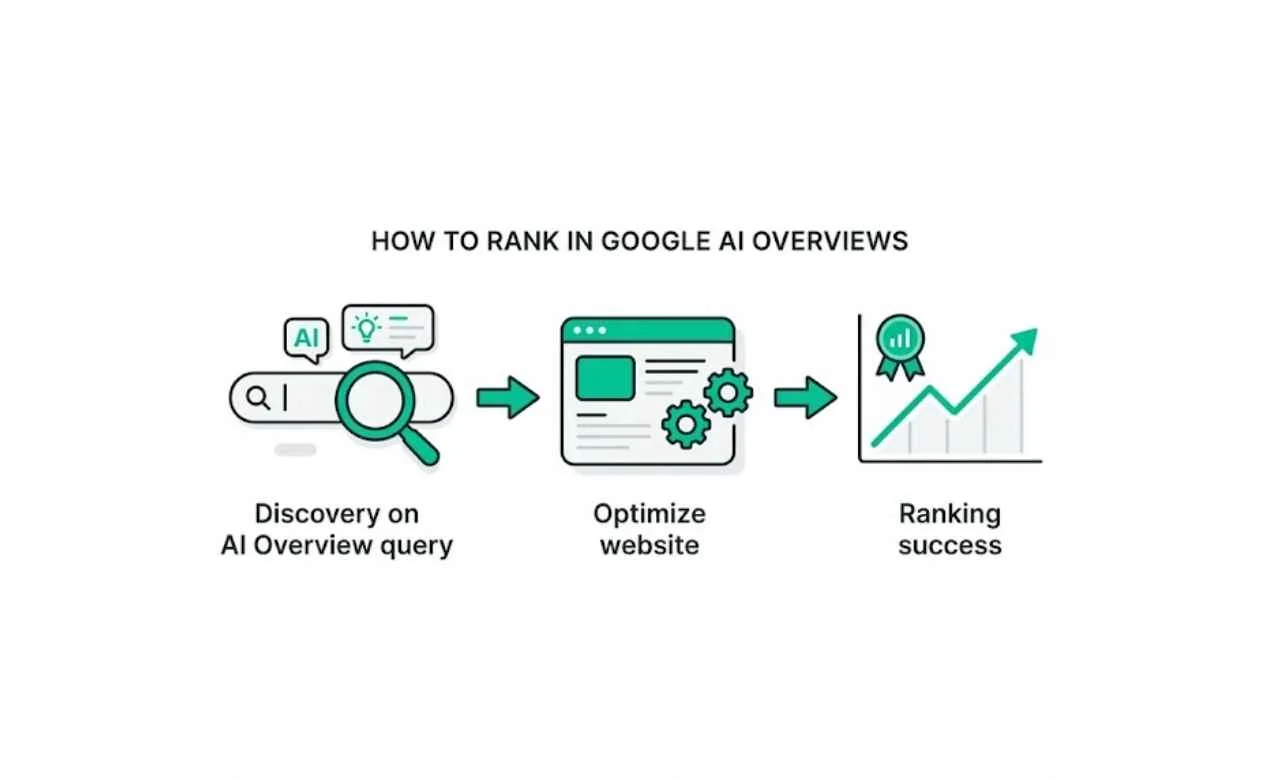
Google AI Overviews are changing how people discover information online. Instead of showing only traditional search results, Google can now display AI-generated summaries that answer users’ questions directly on the search results page.
For website owners, bloggers, and SEO professionals, understanding how to rank in Google AI Overviews is becoming an important part of a modern SEO strategy. By creating helpful, accurate, and well-structured content, you can improve your chances of being featured as a source in AI-generated answers.
In this guide, you’ll learn how Google AI Overviews work, what makes content eligible to appear in them, and which practical SEO strategies can help your website gain visibility in AI-powered search results.
What Are Google AI Overviews?
Google AI Overviews are AI-generated summaries that appear within Google Search results for certain queries. They bring together relevant information from different sources and provide links that users can visit to explore a topic in more detail.
These summaries are designed to help people understand complex topics, compare information, and find answers more quickly. Websites can appear as supporting links when their content is relevant to the AI-generated response.
For website owners, appearing in AI Overviews can create another opportunity to reach people beyond traditional organic search listings. However, there is no guaranteed method to get featured in Google AI Overviews, and ranking in regular search results does not guarantee inclusion.
How to Rank in Google AI Overviews: 10 Proven SEO Strategies
Google’s official guidance emphasizes traditional SEO fundamentals, helpful content, and a technically accessible website rather than special AI ranking tricks
Here are 10 practical strategies to help improve your website’s eligibility and visibility.
1. Create Helpful, People-First Content
The foundation of ranking in Google AI Overviews is creating content that genuinely helps readers. Your article should answer the user’s question clearly and provide information that is accurate, relevant, and useful.
Avoid publishing content solely to target search engines. Instead, focus on the needs of your audience and provide meaningful insights that go beyond what is already available online.
For example, if you are writing about SEO, include practical examples, actionable recommendations, and explanations that help readers apply what they learn.
2. Answer Search Intent Directly
Understanding search intent is essential for both traditional SEO and AI-powered search.
Before writing an article, identify what the reader wants to know. Are they looking for a definition, a step-by-step tutorial, a comparison, or a solution to a specific problem?
Start your article with a concise answer to the main question, then expand on it with useful details.
For example, for the query “How to rank in Google AI Overviews,” explain the core approach immediately: publish helpful, original content, maintain strong technical SEO, and make sure Google can crawl and index your pages.
3. Use Clear Headings and Logical Content Structure
Well-organized content makes it easier for readers to navigate your article and find relevant information.
Use a clear heading hierarchy:
- H1: The main article title.
- H2: Major sections covering the topic.
- H3: Supporting points within each section.
Keep paragraphs focused and use bullet points, numbered lists, and tables when they make information easier to understand.
There is no requirement to divide content into tiny sections specifically for AI systems. Google can understand content in different formats, so choose a structure that works naturally for your readers
4. Target Long-Tail and Conversational Keywords
Long-tail keywords often reflect specific questions and detailed search intent.
For example, instead of targeting only “Google AI Overviews,” you could cover related searches such as:
- How do Google AI Overviews work?
- How can a website appear in AI Overviews?
- Does SEO help with Google AI Overviews?
- How do I optimize content for AI search?
- Can small websites appear in AI Overviews?
Use these topics where they naturally fit your article. You do not need to create a separate page for every keyword variation. Google’s systems can understand related phrases and the meaning behind a search query.
5. Add Original Research, Examples, and Firsthand Experience
Original content can help your website stand out from pages that repeat the same general information.
Consider adding:
- Firsthand experiences and case studies.
- Original data, surveys, or research.
- Screenshots showing real processes.
- Practical examples and worked solutions.
- Expert insights and clearly attributed sources.
For example, if you are explaining how to improve organic traffic, include a real example of a content update and explain what changed and what the results showed.
Google’s guidance specifically emphasizes unique, valuable content that offers something beyond commonly available information.
6. Strengthen Your Website’s Technical SEO
Your content needs to be accessible to Google before it can be considered for AI Overviews.
Check the following technical SEO elements:
- Make sure important pages are crawlable and indexable.
- Avoid accidentally blocking Googlebot in robots.txt.
- Ensure pages return a successful HTTP response.
- Use a clear internal linking structure.
- Fix broken links and important indexing issues.
- Make sure your primary content is available in a readable text format.
- Check that your pages work properly on mobile devices.
A page must be indexed and eligible to appear with a snippet in Google Search to be eligible for inclusion in AI Overviews. Meeting these requirements does not guarantee that Google will display it.
7. Build Topical Authority With Relevant Content
Topical authority is commonly used in SEO to describe a website’s depth and coverage of a subject. Building a useful collection of related content can help readers explore a topic and discover additional information.
For example, a website covering SEO could publish related articles on:
- Google AI Overviews.
- Traditional SEO and generative engine optimization.
- Keyword research and search intent.
- On-page SEO.
- Technical SEO.
- Content optimization.
- Google Search Console.
Connect related articles through relevant internal links. Make sure every page serves a distinct purpose rather than repeating the same information.
8. Optimize Images and Other Visual Content
Text is not the only way to help users understand a topic. Relevant images, screenshots, diagrams, and videos can make your content more useful.
For effective image SEO:
- Use descriptive file names.
- Write meaningful alt text for informative images.
- Compress images to improve loading performance.
- Use high-quality visuals that support the surrounding text.
- Add screenshots or diagrams when they clarify a process.
Google’s guidance notes that relevant images and videos can also create opportunities for visibility in generative AI search experiences.
9. Use Structured Data Correctly
Structured data helps search engines understand information about a webpage and can make pages eligible for certain search features.
Depending on your content, relevant schema types may include:
- Article
- BreadcrumbList
- Product
- Organization
- LocalBusiness
Use structured data only when it accurately describes the visible content of your page and follows Google’s guidelines.
Important: There is no special schema markup required to rank in Google AI Overviews. Structured data does not guarantee inclusion in AI-generated responses.
10. Keep Content Accurate and Updated
Outdated or inaccurate information can reduce the usefulness of an article.
Review important pages regularly, especially when they discuss changing technologies, SEO practices, products, or policies.
When updating content:
- Verify facts and claims.
- Replace outdated information.
- Add relevant developments and examples.
- Fix broken links.
- Update the publication or modification date only when appropriate.
The goal is to keep the page genuinely useful and accurate, not to change its date simply to make it appear fresh.
How to Optimize Content for Google AI Overviews
A practical content optimization process can help you create articles that address user questions clearly while following SEO best practices.
Write a Clear and Concise Answer at the Beginning
Start with a short introduction that directly addresses the main search query. Then provide supporting explanations, examples, and relevant details throughout the article.
For example:
Question: What is Google AI Overview optimization?
Google AI Overview optimization is the process of improving a website’s content, accessibility, and overall SEO so that it can be considered as a supporting source in Google’s AI-generated search summaries.
This approach helps readers quickly understand the topic without having to search through a long introduction.
Include Relevant Questions and Answers
Adding useful questions and answers can help readers find specific information within your article.
For an article about Google AI Overviews, consider questions such as:
- What are Google AI Overviews?
- How do AI Overviews select sources?
- Can a new website appear in AI Overviews?
- Does traditional SEO affect AI Overviews?
- How can I track AI search visibility?
Answer each question accurately and avoid adding irrelevant FAQs simply to increase keyword coverage.
Use Reliable Sources and Cite Important Claims
Support factual claims with trustworthy sources, particularly when discussing Google’s policies, technical requirements, or recent changes.
For example, Google’s official Search Central documentation is a useful source for understanding AI Overviews eligibility and SEO best practices.
When you use external research, make sure the information is accurate, relevant, and clearly attributed.
Google AI Overviews Ranking Factors: What Matters Most?
Google does not publish a separate, guaranteed ranking formula for AI Overviews. However, its official guidance identifies several foundational practices that are relevant to visibility in AI-powered search.
| SEO Element | Why It Matters |
|---|---|
| Helpful content | Provides useful answers and meaningful information |
| Search intent | Aligns content with what users want to know |
| Technical SEO | Helps Google crawl and index pages |
| Original information | Offers value beyond repetitive content |
| Internal linking | Helps users and search engines discover related pages |
| Page experience | Makes content accessible and easy to use |
| Accurate information | Supports trust and usefulness |
| Relevant images and videos | Adds useful visual context |
These are practical SEO priorities, not a guaranteed ranking formula. No single item ensures that a page will appear in an AI Overview.
Common Mistakes to Avoid When Targeting Google AI Overviews
Many website owners focus on shortcuts instead of improving the quality of their content. Avoid these common mistakes:
1. Publishing AI-Generated Content Without Adding Value
Using AI tools to assist with writing is not automatically a problem. However, publishing large amounts of repetitive, unhelpful content primarily to manipulate search rankings can violate Google’s spam policies.
2. Stuffing Keywords Into Every Paragraph
Repeatedly inserting the same keyword can make an article difficult to read. Use your primary keyword naturally and include related terms only when they help explain the subject.
3. Creating Separate Pages for Every Similar Query
Publishing multiple pages that provide essentially the same information can create unnecessary duplication. Build comprehensive, useful pages around distinct search intents instead.
4. Assuming Schema Guarantees AI Visibility
Structured data can support search engine understanding, but there is no special schema that guarantees inclusion in Google AI Overviews.
5. Ignoring Technical SEO
Even high-quality content may not be considered if Google cannot access or index the page. Regularly review your website’s technical health.
How to Track Google AI Overviews Performance
Tracking performance helps you understand how your website is performing in Google Search and whether your content is attracting relevant visitors.
Use Google Search Console
Google Search Console is a useful starting point for monitoring your website’s organic search performance.
You can review:
- Clicks: How often users click through to your website.
- Impressions: How often your pages appear in search results.
- Queries: Search terms associated with your website’s visibility.
- Pages: Which URLs receive search traffic.
- Countries and devices: Where and how users access your content.
Google reports traffic from AI features within the overall Search Console performance data under the Web search type. Google has also introduced additional AI visibility insights, with availability depending on the rollout and account.
Read more:GEO vs SEO
Monitor Traffic and User Engagement
Use analytics tools to evaluate what happens after visitors reach your website.
Track metrics such as:
- Organic sessions.
- Engaged sessions.
- Time spent on relevant pages.
- Newsletter sign-ups.
- Affiliate clicks and conversions.
- Revenue from organic traffic.
Remember that an increase or decrease in traffic does not automatically indicate a change in AI Overview visibility. Consider the wider search landscape when evaluating results.
Step-by-Step Google AI Overviews SEO Checklist
Use this checklist when publishing or updating an article.
SEO Publishing Checklist
0/11 completedIdentify the primary keyword and search intent.Write a clear, helpful introduction that answers the main question.Organize content with descriptive H2 and H3 headings.Add original examples, research, or firsthand insights.Include relevant supporting keywords naturally.Add internal links to related articles.Check crawling, indexing, and mobile usability.Optimize relevant images and videos.Validate structured data if you use it.Review facts, sources, and outdated information.Monitor performance in Google Search Console.Reset checklist
Frequently Asked Questions (FAQs)
1. How do I rank in Google AI Overviews?
Create helpful, original content that answers search intent, follow technical SEO best practices, and ensure Google can crawl and index your pages. Inclusion is never guaranteed.
2. Does SEO help with Google AI Overviews?
Yes. Google’s AI search features rely on its core search systems, so traditional SEO practices such as quality content, crawlability, and a good page experience remain relevant.
3. Can a new website rank in Google AI Overviews?
Yes, a new website can be eligible if its pages are indexed and meet Google’s requirements. However, eligibility does not guarantee that the website will be selected as a supporting source.
4. How long does it take to appear in Google AI Overviews?
There is no fixed timeline. It depends on factors such as crawling, indexing, content relevance, and whether Google’s systems select the page for a particular query.
5. Is special schema required for Google AI Overviews?
No. Google does not require special schema markup for AI Overviews. Use relevant structured data as part of your broader SEO strategy when appropriate.
6. Does AI-generated content rank in Google AI Overviews?
AI-assisted content can be eligible when it is helpful, accurate, and created for users. Content produced primarily to manipulate search rankings may violate Google’s spam policies.
7. How can I check whether my website appears in AI Overviews?
Use Google Search Console to monitor overall search performance and available AI visibility insights. You can also manually review relevant queries, keeping in mind that results may vary.
Conclusion
Learning how to rank in Google AI Overviews starts with building a strong SEO foundation. Focus on creating helpful, original content, answering users’ questions clearly, improving technical SEO, and keeping your website accurate and accessible.
There is no guaranteed shortcut to appearing in AI-generated search results. By prioritizing user experience and following Google’s SEO guidelines, you can improve your website’s eligibility for AI Overviews while strengthening its overall search visibility.