
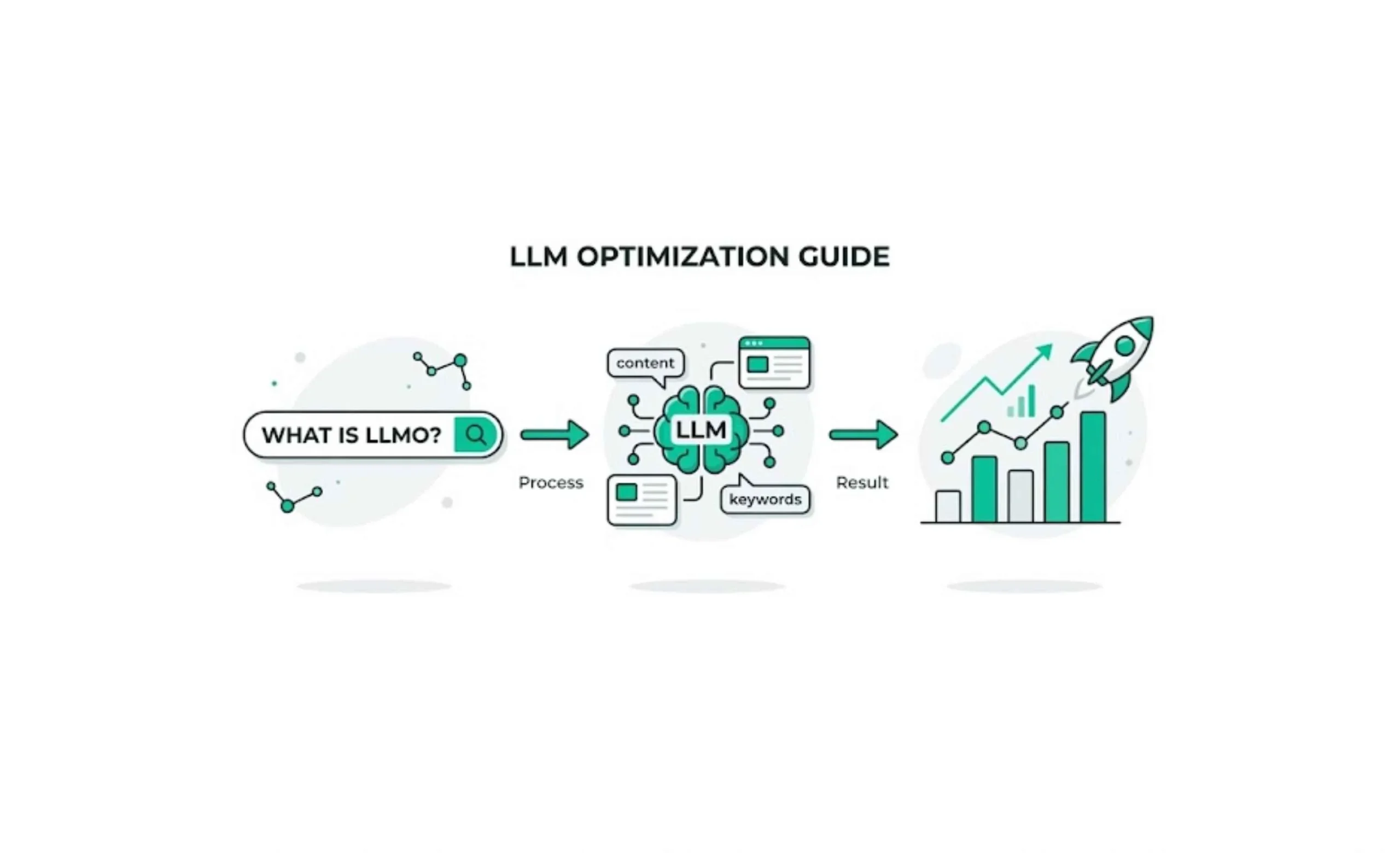
Search is changing fast. People are no longer relying only on Google’s traditional results. They are also using ChatGPT, Google AI features, Perplexity, and other AI tools to find answers, brands, products, and recommendations. This shift has created a new area of optimization called LLMO (Large Language Model Optimization).
So, what is LLMO? In simple terms, LLMO is the process of making your website and content easier for large language models to understand, trust, retrieve, and mention in AI-generated answers. It overlaps with traditional SEO and Generative Engine Optimization (GEO), but its focus is specifically on improving visibility across AI-powered systems.
What Is LLMO (Large Language Model Optimization)?
Large Language Model Optimization (LLMO) is the strategic discipline of structuring, verifying, and publishing digital content and brand entity signals so that machine learning models and generative AI systems select, comprehend, and cite your assets within AI-generated answers.
Traditional SEO Pipeline:
Web Crawl ──> Inverted Index ──> PageRank / BM25 ──> 10 Blue Links

LLMO Pipeline:
Web Data ──> Vector Embeddings ──> Knowledge Graph / RAG ──> Neural Synthesis ──> AI Citation
While traditional search engine optimization focuses on positioning uniform resource locators (URLs) atop search engine results pages (SERPs), LLMO operates on information synthesis and entity retrieval. LLMs are not index databases; they are high-dimensional probabilistic engines trained to understand language semantics, predict token sequences, and synthesize complex contextual queries.
LLMO encompasses:
- Pre-training Ingestion Alignment: Structuring publicly accessible digital assets so foundational models can ingest and contextualize your domain expertise during training.
- Retrieval-Augmented Generation (RAG) Targeting: Engineering web documents with precise semantic boundaries, authoritative data density, and schema definitions that retrieval engines extract to ground real-time generative responses.
- Entity Relationship Optimization: Establishing unequivocal semantic relationships between your brand, proprietary methodologies, executive profiles, and specific industry solutions within global machine-readable knowledge bases.
Read more:AI Citations vs Backlinks: What’s the Difference and Why Do They Matter for SEO
How Does LLMO Work?
Large language models do not parse web content as human readers or keyword-matching crawlers do. They process language through a computational sequence of vector embeddings, neural transformers, and augmented retrieval protocols.
+-----------------------------------------------------------------------------------+
|                           THE LLMO OPERATIONAL ENGINE                             |
+-----------------------------------------------------------------------------------+
|  1. VECTOR EMBEDDING                                                              |
|     Text chunks converted to high-dimensional mathematical coordinates.           |
|                                                                                   |
|  2. SEMANTIC DISTANCE MAPPING                                                     |
|     Cosine similarity measures conceptual relevance beyond exact keywords.       |
|                                                                                   |
|  3. RETRIEVAL-AUGMENTED GENERATION (RAG)                                          |
|     Live search fetches top-ranked context blocks to ground model outputs.        |
|                                                                                   |
|  4. PROBABILISTIC ATTENTION & SYNTHESIS                                           |
|     Transformer layers weigh source credibility and extract cited sentences.      |
+-----------------------------------------------------------------------------------+
1. Tokenization and Vector Embeddings
When an AI crawler (such as GPTBot, ClaudeBot, or Google-Extended) parses a webpage, it tokenizes the textual strings into sub-word representations. These tokens pass through dense neural networks that map each concept into a multi-thousand-dimensional semantic vector space.
Words, sentences, and propositions that share conceptual proximity occupy nearby coordinates in this mathematical space. If your content presents clear, unambiguous semantic statements, its coordinate clustering aligns closely with user intent vectors.
2. Retrieval-Augmented Generation (RAG)
Modern conversational engines rarely generate answers purely from static pre-trained memory. They use RAG to eliminate hallucinations and integrate current information:
- User Query Analysis: The engine reformulates conversational user queries into contextual search parameters.
- Dense Vector & Lexical Retrieval: The engine queries real-time retrieval indexes via vector similarity and hybrid BM25 algorithms, extracting specific text passages (“chunks”) across high-ranking nodes.
- Context Injection: These extracted chunks are injected directly into the model’s inference context window as authoritative reference materials.
- Grounded Synthesis: The transformer processes the prompt alongside the retrieved chunks, assigning attention weights to authoritative data, and outputs an answer that cites the source.
3. Entity Resolution and Knowledge Graph Grounding
LLMs reference structured semantic networks—such as Google Knowledge Graph, Wikidata, and specialized ontologies to confirm entity validity. When an LLM generates a response, it runs entity disambiguation algorithms. If your brand entity possesses unambiguous, verified relationships across trusted third-party repositories, the generative engine surfaces your claims with high statistical confidence.
Why Is LLMO Important for SEO in 2026?
Organic discovery has shifted permanently into zero-click environments. Users no longer scan multiple domains to synthesize comparisons; generative search engines perform this synthesis directly inside the interface.
2016-2020 Search Experience:
Query ──> 10 Blue Links ──> User Clicks Link 1 ──> User Visits Site

Modern Generative Search Experience:
Query ──> AI-Generated Answer (Direct Synthesis + Embedded LLM Citations) ──> Zero-Click / Targeted Citation
- The Decline of Traditional Click-Through Rates: As Google AI Overviews and native conversational AI engines occupy the primary viewport on mobile and desktop devices, organic click distributions for standard informational keywords have shifted toward inline AI summaries. Capturing traffic requires appearing as an embedded citation within the AI response.
- The Rise of Conversational and Compound Queries: Searchers now submit multi-clause, highly specific conversational queries rather than static keyword fragments. Where a 2018 searcher entered “best b2b crm,” modern users ask: “Compare top mid-market B2B CRMs offering open API architectures for healthcare compliance, highlighting specific pricing tiers.” Traditional keyword targeting fails on these zero-volume, high-intent variations; only robust topical authority and semantic chunking capture them.
- Algorithmic Verification of Factual Consistency: Modern AI models penalize contradictory, superficial, or unsupported claims. Search engines prioritize websites demonstrating high digital authority, verified first-hand experience, and strict factual accuracy.
LLMO vs SEO: What’s the Difference?
While traditional SEO and LLMO share the objective of increasing organic visibility, their underlying mechanics, ranking criteria, and success metrics differ significantly.
| Strategic Parameter | Traditional SEO | Large Language Model Optimization (LLMO) |
| Primary Target | Web search engine crawlers (Googlebot, Bingbot) | LLM inference layers, RAG pipelines, training corpus scrapers |
| Algorithmic Focus | Keywords, page-level PageRank, backlink quantity, URL structure | Semantic relevance, entity resolution, information gain, vector alignment |
| User Interaction | SERP listings, organic click-through rate (CTR), session pageviews | AI-generated answers, synthesized summaries, direct brand citations |
| Content Mechanics | Keyword density, header frequency, search volume targeting | Information density, semantic chunking, factual accuracy, extractable data |
| Conversion Focus | Driving raw site visits to dedicated landing pages | Establishing brand authority to secure direct AI recommendations and citations |
Traditional search engine optimization treats the webpage as a monolithic entity indexed for specific keyword strings. LLMO treats content as modular, verifiable data propositions that can be disassembled, evaluated for veracity, and reassembled inside generative responses.
LLMO vs GEO: How Are They Different?
Digital marketers often conflate Generative Engine Optimization (GEO) with Large Language Model Optimization (LLMO). While their goals overlap, they operate at different architectural layers.
┌─────────────────────────────────────────────────────────────┐
│          Large Language Model Optimization (LLMO)           │
│  (Deep Layer: Vector Embeddings, Entity Ontologies,         │
│   Knowledge Graphs, Training Data Ingestion, Semantic HTML) │
│                                                             │
│   ┌─────────────────────────────────────────────────────┐   │
│   │     Generative Engine Optimization (GEO)            │   │
│   │  (Surface Layer: RAG Citation Mechanics, UI/UX      │   │
│   │   Outputs, Perplexity / Copilot / ChatGPT Search)    │   │
│   │                                                     │   │
│   │   ┌─────────────────────────────────────────────┐   │   │
│   │   │   Answer Engine Optimization (AEO)          │   │   │
│   │   │  (Featured Snippets, Voice Query Units)     │   │   │
│   │   └─────────────────────────────────────────────┘   │   │
│   └─────────────────────────────────────────────────────┘   │
└─────────────────────────────────────────────────────────────┘
- LLMO (The Architectural Layer): Encompasses the underlying data formats, entity modeling, linguistic structuring, and knowledge graph mapping that make information machine-readable and semantically interpretable by neural language models. It addresses both pre-training corpus utility and real-time inference viability.
- GEO (The Interface Layer): Focuses specifically on the search engine interfaces built on top of these models—such as Google AI Overviews, Perplexity, and ChatGPT Search. GEO optimizes for citation inclusion, brand mentions, and referral click-throughs within generative search environments.
- AEO (The Extraction Layer): Targets immediate, direct answers for zero-click queries, voice assistants, and single-source featured snippets.
In practice: LLMO establishes the structural authority and machine interpretability of your data; GEO leverages that foundation to capture visibility inside generative search results.
How Do Large Language Models Choose Information?
Large language models prioritize information through distinct algorithmic, mathematical, and architectural filtering mechanisms:
Step 1: Hybrid Retrieval ──> Step 2: Information Gain ──> Step 3: Entity Authority ──> Step 4: Coherence Check
(BM25 + Dense Vectors)      (Novel data vs duplicates)      (Knowledge Graph match)       (Linguistic clarity)
1. Hybrid Retrieval Scoring (BM25 + Dense Vectors)
Search-integrated LLMs do not rely exclusively on traditional keyword matching or vector retrieval; they use hybrid search algorithms. The system cross-references lexical scoring (BM25) with vector similarity (cosine distance). Content that matches both the exact technical terminology and the underlying contextual intent ranks highest in the initial candidate pool.
2. Information Gain Scoring
Generative models penalize redundant content. When an AI engine evaluates dozens of pages covering the same subject, it uses natural language processing algorithms to calculate information gain. Pages that merely rehash consensus knowledge receive lower retrieval weights. Pages that introduce unique empirical data, proprietary case studies, primary research, or distinctive procedural frameworks receive higher weights and are selected as grounding context.
3. Entity Graph Verification
Before an LLM presents an assertion as fact, its architecture verifies entity validity against authoritative data sets (such as Google’s Knowledge Graph, Wikidata, and industry-standard databases). If an author or organization lacks a verifiable entity footprint, the model treats its claims with higher skepticism, favoring established platforms with verified E-E-A-T credentials.
4. Cross-Document Corroboration
Generative models use multi-source cross-referencing to mitigate hallucinations. If your page makes an extraordinary technical assertion that contradicts every established domain source, the engine’s probabilistic filters typically exclude it. Content thrives when it combines corroborated baseline truths with novel, proprietary empirical findings.
What Are the Key Benefits of LLMO?
Deploying a structured LLMO framework delivers several measurable competitive advantages:
┌─────────────────────────────────────────────────────────────────┐
│                     CORE BENEFITS OF LLMO                       │
├───────────────────────────────┬─────────────────────────────────┤
│ High-Intent Discovery         │ Reaches buyers at the final     │
│                               │ point of comparative evaluation │
├───────────────────────────────┼─────────────────────────────────┤
│ Brand Authority Moats         │ Establishes indelible entity    │
│                               │ placement across industry topics│
├───────────────────────────────┼─────────────────────────────────┤
│ Multi-Platform Reach          │ Powers visibility in Google,    │
│                               │ ChatGPT, Perplexity, and Claude │
├───────────────────────────────┼─────────────────────────────────┤
│ Zero-Click Brand Dominance    │ Secures implicit endorsement in │
│                               │ direct synthesized summaries    │
└───────────────────────────────┴─────────────────────────────────┘
- Access to High-Intent Decision Queries: Users who ask conversational engines for software, vendor, or architectural recommendations are often close to a purchase decision. Securing an unprompted, authoritative recommendation inside ChatGPT or Perplexity delivers qualified traffic with high conversion rates.
- Protection Against Zero-Click Traffic Attrition: Traditional publishers and websites lose traffic when AI-generated answers satisfy the user query entirely. High LLMO visibility ensures that even when users do not click, your brand captures full mindshare as the foundational source supporting the answer.
- Cross-Engine Resilience: Unlike traditional SEO campaigns targeting minor updates to Google’s core ranking algorithms, LLMO aligns your content architecture with foundational transformer principles. Optimizing for entity clarity, semantic coherence, and information density improves visibility across Google AI Search, ChatGPT Search, Perplexity, Claude, and internal enterprise discovery engines.
- Compound Algorithmic Authority: When an LLM repeatedly references your digital content as an authoritative source in real-time RAG operations, it reinforces your brand entity’s semantic association with those topics, creating long-term visibility that is difficult for competitors to displace.
How Does LLMO Help Websites Get Cited by AI?
Securing citations within generative engines requires understanding how RAG systems extract and attribute text passages.
When an AI engine processes a query, its retrieval model extracts modular blocks of text typically 150 to 300 words from candidate documents. The generator model evaluates these candidate chunks, selects those with the highest contextual relevance, and synthesizes them into an answer while appending a source footnote.
Incoming Web Document
│
├── Chunk 1: Fluffy Introduction ──> (Discarded by Extractor)
│
├── Chunk 2: Independent Definition + Numerical Data Point ──> [Selected by RAG Pipeline]
│                                                                        │
│                                                                        ▼
└── Chunk 3: Generic Marketing Prose ──> (Discarded)              Synthesized AI Answer
                                                                  + Embedded Citation Link
To secure this citation placement, your content must be structured for machine extraction:
- Self-Contained Informational Units: Every section beneath an H2 or H3 must function as an independent, context-rich knowledge chunk. Avoid ambiguous pronouns (e.g., “This tool helps with that”); explicitly restate the entity, the action, and the outcome (e.g., “Large language model optimization improves RAG chunk retrieval by embedding clear entity markers”).
- Clear Propositional Density: The sentence directly following a sub-heading should define, answer, or resolve the topic explicitly before expanding into supporting context.
- Data Attribution Anchors: Machine learning models favor citations with verifiable empirical metrics, distinct percentages, and attributed primary sources. Including clear, quantitative findings increases the probability of attribution.
What Are the Main LLMO Ranking Factors?
Traditional ranking algorithms prioritize signals like external PageRank, domain age, keyword placement, and user click logs. LLMO ranking factors, by contrast, focus on semantic clarity, entity validity, and information architecture.
        ┌─────────────────────────────────────────────────────────┐
        │                 CORE LLMO RANKING FACTORS               │
        └────────────────────────────┬────────────────────────────┘
                                     │
         ┌───────────────────────────┼───────────────────────────┐
         ▼                           ▼                           ▼
┌──────────────────┐       ┌──────────────────┐       ┌──────────────────┐
│ Entity Authority │       │ Semantic Chunking│       │ Information Gain │
│ E-E-A-T Footprint│       │  & Co-Occurrence │       │ & Proprietary Data│
└──────────────────┘       └──────────────────┘       └──────────────────┘
         │                           │                           │
         └───────────────────────────┼───────────────────────────┘
                                     │
         ┌───────────────────────────┼───────────────────────────┐
         ▼                           ▼                           ▼
┌──────────────────┐       ┌──────────────────┐       ┌──────────────────┐
│ Factual Veracity │       │ Machine-Readable │       │ Sentiment & Brand│
│  & Cross-Checks  │       │  Data & Schema   │       │ Co-Citation Net  │
└──────────────────┘       └──────────────────┘       └──────────────────┘
1. Entity Disambiguation and Authority
The depth and validity of your entities within global knowledge graphs. Search engines verify whether an author, organization, or brand exists as a verified entity with consistent attributes across trusted networks (such as Wikipedia, Wikidata, industry registries, and LinkedIn).
2. Semantic Chunk Density
How cleanly your content segments into independent, self-contained sections. Pages structured with clear H2/H3 tags, concise explanatory paragraphs, and contextual stability allow retrieval models to extract chunks without semantic distortion.
3. Information Gain and Empirical Originality
The proportion of net-new information your asset introduces relative to the existing training corpus. Documents offering primary survey results, proprietary lab tests, original diagrams, or unique case studies receive priority over generic summaries.
4. Factual Veracity and Claim Corroboration
The degree to which your core claims align with authoritative, established literature. If an asset features uncorroborated, inaccurate, or pseudoscientific statements, modern natural language models filter it out to prevent hallucinated answers.
5. Structured Data and Machine-Readable Encodings
The presence of valid, comprehensive JSON-LD schema markup. Implementing TechArticle, AboutPage, Organization, Dataset, and ItemPage schemas gives LLMs an explicit blueprint of the content’s structural hierarchy.
6. Brand Co-Occurrences and Sentiment Footprint
The context and sentiment of unlinked brand mentions across the web. LLMs track where your brand entity appears alongside category keywords across Reddit, Hacker News, industry publications, and academic papers.
How to Optimize Content for Large Language Models
Content optimization for LLMs requires moving beyond basic keyword placement. It requires re-architecting your writing for clarity, semantic relevance, and entity-rich natural language processing.
Step 1: Inverted Pyramid Structure (Direct definition immediately under heading)
Step 2: Semantic Triple Formulation (Subject ──> Predicate ──> Object)
Step 3: High LSI / Entity Integration (Industry standards, components, context)
Step 4: Structured Data Tables & Ordered Steps (High parsing readability)
1. Structure via the Inverted Pyramid
Structure every section so the core takeaway appears first:
- Bad (Filler / Low Density): “When considering the broader implications of modern digital marketing strategies across diverse industries, one must acknowledge that artificial intelligence has altered how we approach search optimization forever.”
- Good (High Density / LLMO Optimized): “Large language model optimization (LLMO) is a digital content framework designed to make web pages extractable and citable by generative AI engines. It focuses on entity recognition, semantic HTML, and dense factual data.”
2. Write in Subject-Predicate-Object (SPO) Semantic Triples
LLMs process semantic triples to build internal knowledge graphs. Using clear subject-predicate-object sentence structures simplifies the extraction of core propositions:
- Subject: Generative search engines
- Predicate: retrieve
- Object: semantically chunked text blocks
Avoid convoluted parentheticals, excessive passive voice, and run-on sentences that fragment vector representations during tokenization.
3. Integrate NLP Entities and LSI Keyword Systems Naturally
Avoid stuffing identical keyword strings across a document. Instead, build a comprehensive semantic web around your core topic:
- Core Topic: Machine Learning Model Optimization
- Semantic Vector Co-Occurrences: Neural embeddings, RAG pipelines, transformer context window, cosine distance, schema validation, entity resolution, information retrieval, knowledge graphs.
When you discuss a subject through its related sub-disciplines, methodologies, and technical terminology, vector similarity algorithms classify the asset as an authoritative node.
4. Format Data with Tables, Ordered Lists, and Definition Blocks
LLMs parse structured tabular data and chronological steps with high accuracy. Tabular comparisons simplify comparative evaluation across key variables, while ordered sequences provide explicit step-by-step instructions that generative engines can quote directly.
How to Make Your Website More AI-Friendly
Technical SEO for LLMO ensures that conversational AI scrapers can crawl, parse, and mathematically process your infrastructure without friction.
Standard Crawl Optimization:
robots.txt: Allow Googlebot ──> XML Sitemap ──> Render Complex JS Frameworks

Advanced AI-Friendly Optimization:
robots.txt: Allow AI Crawlers (GPTBot, ClaudeBot, PerplexityBot)
Sitemaps: Priority-Sorted XML Feeds + Clear Lastmod Tags
Static HTML Delivery: Server-Side Rendering (SSR) bypassing heavy client-side JS
Knowledge Architecture: JSON-LD Schemas + /llms.txt Machine Documentation
1. Explicitly Configure Your robots.txt for AI Crawlers
Do not inadvertently block the infrastructure powering generative discovery. Configure your robots.txt file to allow access to AI agents:
Plaintext
User-agent: Googlebot
Allow: /

User-agent: Google-Extended
Allow: /

User-agent: GPTBot
Allow: /

User-agent: ClaudeBot
Allow: /

User-agent: PerplexityBot
Allow: /

User-agent: Amazonbot
Allow: /

Sitemap: https://yourdomain.com/sitemap.xml
2. Deploy Server-Side Rendering (SSR)
While Googlebot can execute client-side JavaScript, many LLM-specific web crawlers and RAG scrapers operate with strict execution timeouts. If your primary content renders through heavy client-side JavaScript frameworks, AI crawlers may capture an empty page. Use server-side rendering (SSR) or static site generation (SSG) so raw HTML delivers all textual assertions instantly.
3. Implement Comprehensive JSON-LD Schemas
Schemas translate unstructured text into explicit, machine-readable ontologies. Implement nested, interconnected JSON-LD schemas across all primary assets:
JSON
{
  "@context": "https://schema.org",
  "@graph": [
    {
      "@type": "Organization",
      "@id": "https://example.com/#organization",
      "name": "Enterprise Marketing Group",
      "url": "https://example.com",
      "logo": "https://example.com/assets/logo.png",
      "sameAs": [
        "https://www.wikidata.org/wiki/Q00000000",
        "https://www.linkedin.com/company/example"
      ]
    },
    {
      "@type": "TechArticle",
      "@id": "https://example.com/llmo-guide/#article",
      "headline": "Large Language Model Optimization: Technical Blueprint",
      "description": "A comprehensive operational analysis of LLMO, generative retrieval, and AI citation frameworks.",
      "author": {
        "@type": "Person",
        "name": "Jane Doe",
        "jobTitle": "Principal AI Architect",
        "sameAs": "https://example.com/authors/jane-doe"
      },
      "publisher": {
        "@id": "https://example.com/#organization"
      },
      "about": [
        {
          "@type": "Thing",
          "name": "Natural Language Processing",
          "sameAs": "https://en.wikipedia.org/wiki/Natural_language_processing"
        },
        {
          "@type": "Thing",
          "name": "Information Retrieval",
          "sameAs": "https://en.wikipedia.org/wiki/Information_retrieval"
        }
      ]
    }
  ]
}
4. Provide a Structured /llms.txt File
Adopt modern machine-readability conventions by publishing an /llms.txt file in your root directory. This Markdown standard provides generative scrapers with a curated, lightweight index of your core documentation, authoritative articles, and brand facts, allowing AI engines to digest your site’s core expertise without navigation friction.
How Do Backlinks and Brand Mentions Affect LLMO?
In traditional SEO, backlinks pass PageRank to help URLs rank higher in search results. In Large Language Model Optimization, links and mentions serve as semantic verification nodes.
Traditional Backlink Model:
Domain A (DR 80) ──── Dofollow Anchor ("best crm") ────> Domain B (Boosts PageRank)

LLMO Co-Citation & Verification Model:
Review Site: [Brand X] + [High Reliability] + [SOC-2 Certified]
Industry Blog: [Brand X] + [Automated Workflow Engine]
Academic Paper: [Brand X] + [Novel Data Pipeline]
         │
         ▼
LLM Inference Layer recognizes:
Entity "Brand X" = Industry Authority in Enterprise Data Pipelines
1. Unlinked Brand Mentions and Entity Co-Occurrence
LLMs do not require an active HTML hyperlink (<a href="...">) to associate your brand with authority. Through natural language processing, neural networks identify entity co-occurrences. When respected industry publications, discussion forums, and technical platforms mention your brand alongside terms like “enterprise security,” “market leader,” or “fault-tolerant architecture,” the model strengthens the semantic association between your brand and those concepts.
2. Digital PR and Third-Party Consensus
When an LLM prepares a recommendation, it synthesizes perspectives across multiple trusted platforms:
- Peer Reviews: Platforms like G2, Capterra, and TrustRadius provide structured, sentiment-rich reviews that AI engines parse to evaluate real-world product reliability.
- Community Discussions: Platforms like Reddit, Hacker News, and GitHub discussions provide conversational, unfiltered feedback that LLMs reference to confirm real-world sentiment.
- Industry Publications: Unbiased editorial reviews and coverage validate organizational claims, signaling that a brand’s assertions are broadly accepted within its sector.
3. Referring Domain Authority and Contextual Alignment
A backlink from an irrelevant domain adds little value to an LLM’s understanding of your site. AI engines prioritize contextual relevance and topical authority. A link from a niche-specific publication that discusses your methodology in detail carries far more weight in RAG evaluations than generic directory links.
Common LLMO Mistakes to Avoid
Many digital marketing teams undermine their visibility by applying outdated SEO tactics to generative AI environments:
❌ Traditional Mistake: Keyword Stuffing
   Result: Fragments vector representations; rejected by natural language models.

❌ Traditional Mistake: Generic AI Summaries
   Result: Zero information gain; excluded from RAG candidate chunks.

❌ Traditional Mistake: Client-Side Heavy JS
   Result: RAG scrapers time out; content is indexed as an empty page.

❌ Traditional Mistake: Detached Brand Claims
   Result: Fails cross-entity validation; dismissed as uncorroborated marketing.
- Publishing Low-Effort, Paraphrased AI Summaries: Generating thousands of superficial, automated articles creates uniform, low-information-gain pages. LLMs easily identify redundant text and deprioritize it during retrieval.
- Over-Optimizing for Exact Match Keywords: Forcing exact-match keywords into every header disrupts natural sentence flow and harms semantic coherence. Focus on answering queries thoroughly using natural, industry-standard language.
- Isolating Content in Client-Side JavaScript Frameworks: Heavy, unrendered Single Page Applications (SPAs) often fail to expose their text to fast-moving AI crawlers. Ensure critical informational assets are fully rendered server-side.
- Neglecting Third-Party Verification Channels: Focusing solely on on-page content while ignoring your broader digital footprint limits authority. If external platforms do not corroborate your claims, conversational models are unlikely to cite you as a trusted source.
- Writing Ambiguous, Pronoun-Heavy Headings and Passages: Using vague subheadings (like “Why This Matters” or “The Next Step”) strips away context. Use descriptive, entity-grounded subheadings (like “Why LLMO Matters for Enterprise B2B Discovery”) to help RAG systems extract clear meaning.
How to Measure and Track LLMO Performance
Measuring LLMO performance requires specialized metrics designed for generative and conversational search environments:
┌─────────────────────────────────────────────────────────────────┐
│                      LLMO METRIC FRAMEWORK                      │
├───────────────────────────────┬─────────────────────────────────┤
│ Share of Model Voice (SoMV)   │ % of brand citations across     │
│                               │ target conversational queries   │
├───────────────────────────────┼─────────────────────────────────┤
│ Citation Inclusion Rate       │ Frequency of hyperlinked URLs   │
│                               │ in RAG-synthesized answers      │
├───────────────────────────────┼─────────────────────────────────┤
│ Entity Sentiment & Alignment  │ Semantic tone and accuracy of   │
│                               │ brand descriptions across LLMs  │
├───────────────────────────────┼─────────────────────────────────┤
│ Referral Traffic from AI      │ Visits originating from AI      │
│ Discovery Interfaces          │ search engines and chat systems │
└───────────────────────────────┴─────────────────────────────────┘
1. Share of Model Voice (SoMV)
Measure how frequently your brand appears within synthesized outputs across targeted prompts:
- Define a core benchmark of 50 to 200 conversational, high-intent prompts in your niche.
- Query these prompts systematically across ChatGPT, Claude, Gemini, and Perplexity.
- Calculate the percentage of responses where your brand is mentioned or recommended:$$\text{SoMV} = \left(\frac{\text{Total Mentions Across Queries}}{\text{Total Queries Tested}}\right) \times 100$$
2. Citation and Referral Tracking
Track incoming organic sessions from AI search surfaces within your analytics platform. Monitor referral traffic and User-Agent patterns from sources such as:
chatgpt.com/openai.comperplexity.aiclaude.ai- Google AI Overview referral nodes
3. Entity Sentiment and Attribution Accuracy
Evaluate how generative engines describe your organization. Are your product capabilities, pricing models, and core differentiators conveyed accurately? Tracking entity attribution helps you identify and correct common misconceptions or outdated facts circulating within training and retrieval corpora.
What Is the Future of LLMO and AI Search?
The trajectory of search points toward deeper integration between multi-modal models, personalized inference, and autonomous AI agents:
Evolutionary Timeline:
Indexed Search (1998-2022) ──> Hybrid RAG Search (Present) ──> Autonomous Agent Discovery (Future)
(Manual link selection)        (Synthesized answers + links)     (AI agents research & act directly)
- Autonomous Agent Optimization (Agentic Search): Searchers will increasingly deploy personal AI agents to execute tasks on their behalf—such as researching vendors, comparing enterprise pricing, or completing purchases. LLMO will evolve into optimizing for these agent workflows, requiring clean API endpoints, machine-readable specifications, and unambiguous operational criteria.
- Multi-Modal Retrieval Integration: Future search interfaces will seamlessly synthesize text, high-resolution visual diagrams, tabular data, and video streams. Content assets that combine clear explanations with structured data and annotated diagrams will secure multi-modal citations.
- Real-Time Dynamic Consensus Engines: Pre-training cycles will shorten, and retrieval mechanisms will update continuously. Brands that maintain up-to-date documentation, clear structured data, and consistent cross-platform consensus will lead organic discovery across all AI environments.
The Strategic Path Forward
Succeeding in the era of generative discovery requires rethinking how you create and distribute content:
- Conduct an LLM Audit: Review how leading conversational models depict your brand across key queries, identify source gaps, and address inaccuracies.
- Upgrade Technical Infrastructure: Implement comprehensive JSON-LD schemas, ensure clean server-side rendering, and publish an
/llms.txtfile. - Restructure for Extraction: Organize content into self-contained, data-rich chunks that lead with direct answers, supported by empirical research and clear semantic triples.
- Expand Your Authority Footprint: Build third-party consensus across industry publications, review platforms, and knowledge communities to reinforce your entity profile.
Treat your digital assets not merely as pages for human eyes, but as verified, structured knowledge designed for both human readers and machine intelligence.
FAQS
What does LLMO stand for?
LLMO stands for Large Language Model Optimization. It involves optimizing content so AI systems can better understand, retrieve, reference, and cite information from your website.
How is LLMO different from SEO?
SEO focuses mainly on improving visibility in traditional search engines, while LLMO focuses on visibility within AI-powered answers and large language models. Both can work together as part of a broader search strategy.
Is LLMO the same as GEO?
No. LLMO and GEO (Generative Engine Optimization) overlap, but they are not necessarily identical terms. LLMO focuses specifically on optimization for large language models, while GEO generally covers visibility in generative search experiences.
How can I optimize my website for LLMs?
Create accurate and well-structured content, demonstrate expertise, use clear language, strengthen topical authority, maintain consistent brand information, and earn credible mentions and links from relevant websites.
Does LLMO replace traditional SEO?
No. LLMO does not replace SEO. Traditional SEO remains important for search visibility, while LLMO can help your content become more understandable and useful to AI-powered search and answer systems.
Conclusion
LLMO is becoming an important part of modern search optimization. Large Language Model Optimization focuses on helping AI systems understand your content, recognize your expertise, and use your website as a reliable source when generating answers.
While LLMO does not replace traditional SEO, it works alongside SEO, GEO, and content optimization. Creating accurate, useful, well-structured, and authoritative content can improve your chances of being mentioned or cited across AI-powered search experiences.
As AI search continues to evolve in 2026, businesses should focus on building genuine topical authority, maintaining factual consistency, earning quality backlinks and brand mentions, and creating content that directly answers users’ questions. LLMO is ultimately about making your content clear, trustworthy, and useful for both people and AI systems.