
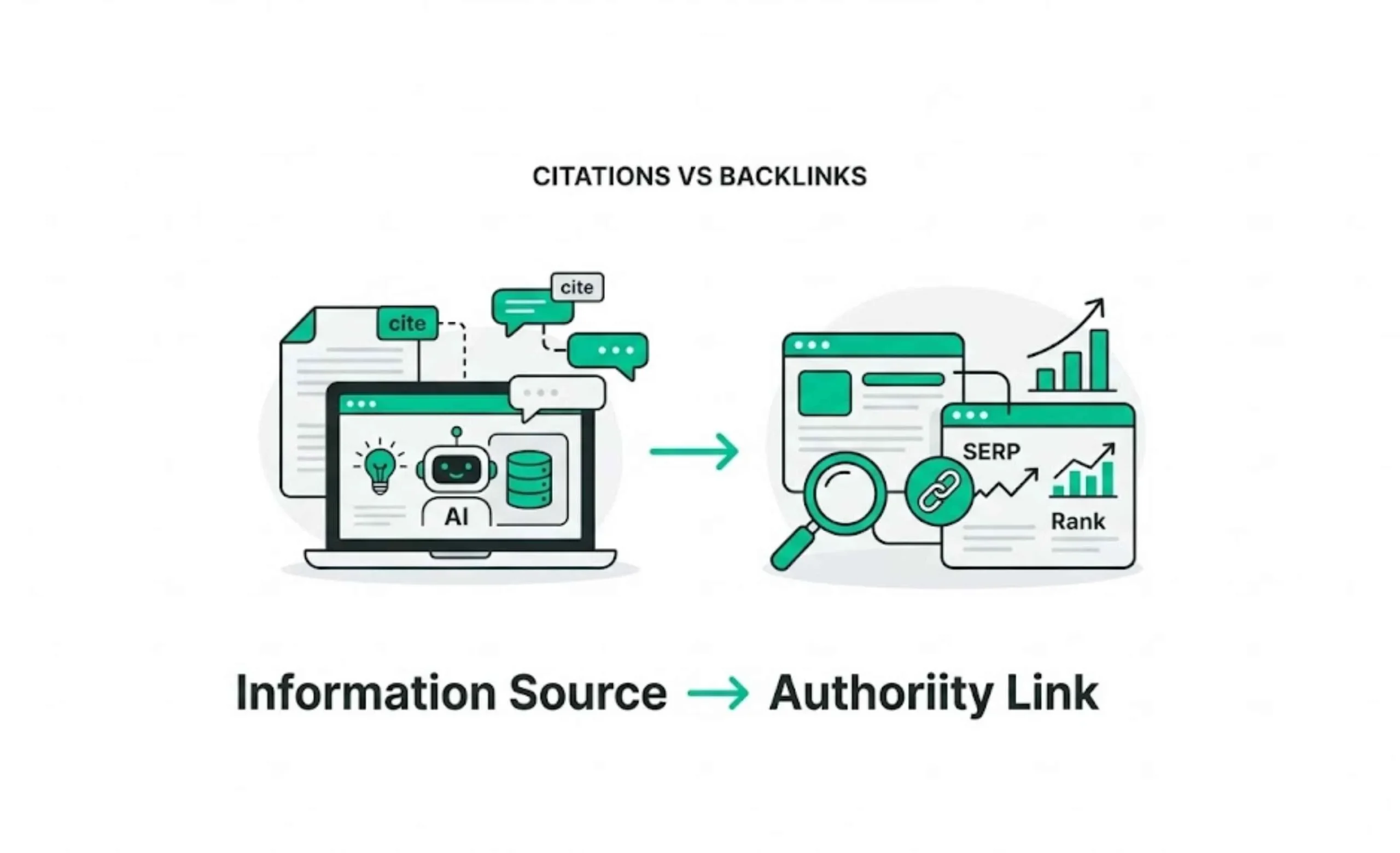
Search is changing fast. People are no longer relying only on traditional Google results. They’re also using AI search engines and answer engines to find information, recommendations, and businesses. This shift has made AI citations an important part of modern search visibility, while backlinks remain a major part of traditional SEO.
But AI citations vs backlinks are not the same thing. A backlink is a link from another website to your site, while an AI citation is a reference to your website or content in an AI-generated answer. Both can help build online visibility, authority, and trust, but they work in different ways.
In this guide, you’ll learn how AI citations and backlinks work, their key differences, how they can support SEO and AI search visibility, and practical ways to earn both. Understanding these differences can help you build a stronger strategy for traditional search and the growing world of AI-powered search.
What Are AI Citations?
An AI citation is a formal source attribution, link reference, or structured entity citation generated within an AI-powered answer engine when a large language model retrieves and synthesizes information from a specific digital property. Unlike a traditional organic search snippet, which presents a list of indexed web pages matching a lexical or semantic query, an AI citation serves as the factual origin, corroborating source, or exploratory link behind an AI-generated answer.
+-------------------------------------------------------------+
|                      User Prompt / Query                     |
+-------------------------------------------------------------+
                              |
                              v
+-------------------------------------------------------------+
|                Query Routing & Intent Expansion             |
|              (Decomposition, Entity Extraction)              |
+-------------------------------------------------------------+
                              |
                              v
+-------------------------------------------------------------+
|               Retrieval-Augmented Generation                |
|           Vector DB Retrieval  <-->  Web Search Engine      |
+-------------------------------------------------------------+
                              |
                              v
+-------------------------------------------------------------+
|                    Context Window Ingestion                 |
|             (Passage Re-ranking, Noise Reduction)           |
+-------------------------------------------------------------+
                              |
                              v
+-------------------------------------------------------------+
|               Synthesized Generative Response               |
|            [Direct Answer Text with Citations/Chips]        |
|                                                             |
|   "According to [Source A], enterprise link equity..."      |
|   Citations: [Source A] | [Source B] | [Source C]           |
+-------------------------------------------------------------+
When systems like Google AI Overviews, Perplexity, or ChatGPT Search process conversational prompts, they do not rely purely on parametric memory (the internal static weights established during training). Doing so leads to hallucinations, stale knowledge, and factually ungrounded claims. Instead, these engines execute a dynamic retrieval process known as Retrieval-Augmented Generation (RAG):
- The engine decomposes the user’s prompt into sub-queries.
- It queries high-speed web search indices and vector databases to retrieve real-time data chunks and web passages.
- The model scores these passages for topical relevance, factual density, semantic clarity, and source trust.
- It extracts relevant context, integrates it into the LLM context window, and synthesizes a direct response.
- Finally, the system appends inline hyperlinked numbers, interactive source cards, or carousel chips directing the user to the underlying cited sources.
AI citations can manifest in several distinct UI formats across modern search ecosystems:
- Interactive Source Chips & Cards: Distinct graphic elements displayed prominently above or alongside generative summaries (e.g., Perplexity’s source carousel or Google AI Overviews’ link cards).
- Inline Anchor Citations: Bracketed or supersubscript numbers ($[1]$, $[2]$) inserted immediately following factual statements within synthesized text, resolving to target URLs.
- Unlinked Brand References: Text-based entity mentions where the LLM explicitly credits a brand, research report, or expert by name without providing an active HTML hyperlink.
- Follow-up Reading Recommendations: Supplementary contextual links presented beneath generated outputs as suggested pathways for exploratory verification.
In Generative Engine Optimization (GEO) and Answer Engine Optimization (AEO), securing an AI citation means your content has surpassed standard indexation: the AI platform has digested your content, deemed it a primary source of truth, and displayed it to substantiate synthesized claims.
What Are Backlinks in SEO?
In conventional search engine optimization, a backlink also known as an inbound link or external link is a clickable HTML hyperlink on one third-party domain that resolves to a web page on your domain. Under the original architecture of the World Wide Web and the foundational principles of Google’s PageRank algorithm, a backlink functions as an organic vote of confidence from one webmaster to another.
The anatomical foundation of a classic backlink resides in the standard HTML anchor element:
HTML
<a href="https://www.example.com/advanced-seo-guide" rel="dofollow">Advanced SEO Frameworks</a>
Every standard backlink transfers data signals and algorithmic value between the origin and destination domains:
[Origin Domain (Referring Domain)]
       |
       |-- Anchor Text: Contextual semantic relevance
       |-- Link Attribute: rel="dofollow", rel="nofollow", rel="sponsored"
       |-- Page Authority & Link Equity (PageRank value)
       v
[Destination Page (Your Domain)]
Backlinks are categorized by their structural attributes and algorithmic permissions:
- Dofollow Links: Standard hyperlinks without restrictive
relattributes. These links directly pass link equity (traditionally referred to as “link juice”), signaling to crawler bots that the destination target is endorsed and contextually relevant. - Nofollow Links (
rel="nofollow"): Introduced by search engines to flag links where an editorial endorsement is explicitly absent. Search engines use them primarily as contextual hints rather than direct pathways for passing link equity. - Sponsored Links (
rel="sponsored"): Links established through commercial transactions, sponsored arrangements, affiliate campaigns, or paid media placements. - UGC Links (
rel="ugc"): Hyperlinks embedded within user-generated content sections, such as forum discussions, community message boards, and blog comment spaces. - Editorial Backlinks: The most valuable links in off-page SEO. These are naturally occurring, unprompted hyperlinks embedded organically by journalists, researchers, and webmasters inside high-quality, authoritative content because your resource provides unique data, exceptional commentary, or proprietary utility.
Beyond raw counts, search engines evaluate an overall backlink profile based on referring domain uniqueness, topical relevance, link placement (contextual body links carry exponentially more weight than footer or sidebar links), anchor text distribution, and the historical trust signals of the linking domain.
AI Citations vs Backlinks: What’s the Difference?
While both AI citations and backlinks serve as validation mechanisms, they operate on divergent mathematical frameworks, exist within distinct interface environments, and address fundamentally different consumption behaviors.
A backlink is a topological path in the physical graph of the web. It is a crawlable bridge connecting two static nodes (URLs) across the global internet. When a search engine crawler like Googlebot discovers an HTML link, it registers an edge in its index graph, evaluates the semantic anchor text, and propagates PageRank through that connection.
An AI citation, conversely, is an informational attribution rendered inside an ephemeral, machine-synthesized knowledge environment. An LLM does not pass PageRank through a citation; instead, it extracts factual vectors from the underlying content, utilizes those vectors to construct an answer, and supplies the citation as source provenance to maintain truth grounding and eliminate hallucination risks.
| Comparative Attribute | Traditional Backlinks | AI Search Citations |
| Primary Environment | Traditional Search Engine Results Pages (SERPs) | AI-Generated Answers, Conversational Interfaces, AI Overviews |
| Underlying Mechanism | Crawling, link graph traversal, PageRank propagation | Retrieval-Augmented Generation (RAG), semantic vector search |
| Primary Structural Goal | Accumulating link equity, authority metrics, and keyword ranks | Ingestion into model context windows, factual source grounding |
| Click-Through Behavior | Navigational routing; users click directly from SERP link lists | Exploratory verification; users read the synthesized answer first |
| Anchor / Trigger Mechanism | Explicit HTML anchor text chosen by external webmasters | Semantic relevance, factual precision, and entity associations |
| Index Persistence | Stable until deleted, modified, or the referring page unindexes | Dynamic; regenerated or altered per prompt, context, and retrieval |
| Primary SEO Discipline | Classic Off-Page SEO, Link Building, Digital PR | Generative Engine Optimization (GEO), AEO, Semantic SEO |
A backlink can exist indefinitely on an unread web page, quietly passing residual link equity through the search engine graph. An AI citation requires real-time programmatic retrieval: your content must be computationally selected as the optimal factual match for a user’s prompt at the exact moment of inference.
How Do AI Citations Work?
To understand how an AI citation is generated, one must analyze the technical pipeline of Retrieval-Augmented Generation (RAG) within platforms like Google AI Overviews, Perplexity, and ChatGPT Search.
                          [USER PROMPT]
                                |
                                v
               [1. Query Formulation & Rewriting]
           (Entity extraction, semantic intent analysis)
                                |
                                v
         +---------------------------------------------+
         |        [2. Multi-Index Retrieval Phase]     |
         |  - Dense Vector Search (Cosine Similarity)   |
         |  - Sparse Lexical Search (BM25 Indexing)     |
         +---------------------------------------------+
                                |
                                v
               [3. Document Filtering & Re-Ranking]
          (Cross-encoders, domain trust, E-E-A-T scoring)
                                |
                                v
              [4. Chunk Extraction & Window Packing]
           (Highest-density semantic text segments)
                                |
                                v
            [5. LLM Synthesis & Source Attribution]
        (Hallucination checks, factual verification, citations)
                                |
                                v
                     [FINAL SERP INTERFACE]
                  Generative Answer + Citation Chips
Step 1: Query Formulation, Expansion, and Entity Parsing
When a user submits a natural language query (e.g., “How does enterprise link building impact domain rating calculations under modern search algorithms?”), the AI system does not merely scan an index for matching words.
The query is passed through an encoding model that maps intent into high-dimensional vector space. The engine extracts named entities, clarifies ambiguity, decomposes complex multi-intent questions into discrete micro-queries, and rewrites the prompt to optimize subsequent retrieval.
Step 2: The Multi-Index Retrieval Phase
The retrieval layer accesses high-speed indexes via hybrid search mechanisms combining:
- Sparse Lexical Search (BM25): Fast exact-match keyword indexing to ensure critical programmatic phrases and proper nouns are retained.
- Dense Semantic Vector Retrieval: Converting web content passages into embedding vectors. Using cosine similarity algorithms, the system identifies documents whose semantic concepts match the mathematical vector of the prompt, even when distinct phrasing is used.
Step 3: Document Filtering, Quality Scoring, and Re-Ranking
The raw retrieval phase yields hundreds of potential web documents. A specialized re-ranking layer (often powered by high-precision cross-encoders) reduces this pool to a select few candidates. During this step, the engine applies heuristics:
- Domain Trust and E-E-A-T: Evaluating historical reliability signals, site-wide content authority, and brand reputation.
- Information Density: Measuring the ratio of unique, factual, claim-substantiating data against boilerplate fluff.
- Structural Readability: Assessing table markup, lists, and direct answer formats that facilitate natural language processing.
Step 4: Chunk Extraction and Context Packing
The selected pages are split into semantic chunks (passages typically ranging between 100 and 500 tokens). The system discards irrelevant navigation menus, footers, and digressions, packing only the most contextually relevant chunks into the LLM’s dynamic context window.
Step 5: Synthesis, Citation Alignment, and Attribution
The LLM generates the final prose. Simultaneously, an internal attribution mechanism links generated statements to the source chunks in its context window. If the model asserts a fact, the attribution model verifies which source URL supplied that fact, appending an anchor citation, source card, or carousel link to the final interface.
How Do Backlinks Work?
The mechanics of backlinks rest on graph theory, web crawler architectures, and algorithmic link equity distribution models pioneered by early search engines and refined over decades.
+-------------------------------------------------------+
|  Authoritative Web Page (Source URL)                  |
|  PageRank Score: High                                 |
|                                                       |
|  "...industry research shows [Anchor Text: Target]..."|
+-------------------------------------------------------+
                           |
                           | Outbound Hyperlink
                           | (Passes link equity, contextual
                           |  relevance, and anchor signals)
                           v
+-------------------------------------------------------+
|  Your Web Page (Target URL)                           |
|  PageRank Recipient: Authority Metric Increases       |
|  Semantic Association: Associated with Anchor Text    |
+-------------------------------------------------------+
Crawl Paths and Link Discovery
Search engines employ automated web crawlers (such as Googlebot) that traverse the web by fetching known pages and parsing all embedded hyperlinks. When a crawler identifies an external link pointing to your site:
- It registers the existence of the destination URL.
- If the destination URL is unindexed, the backlink serves as an architectural discovery pathway.
- If already indexed, the crawler logs the link relationship as a directional edge in the global search graph.
PageRank Formulation and Link Equity Mechanics
The foundational PageRank formula illustrates how equity propagates through interconnected web documents:
$$PR(A) = (1 – d) + d \sum_{i=1}^{n} \frac{PR(T_i)}{C(T_i)}$$
Where:
- $PR(A)$ is the PageRank of the target web page $A$.
- $d$ is the damping factor (conventionally set around $0.85$), representing the probability that a user continues clicking links rather than requesting a new random page.
- $PR(T_i)$ is the PageRank of referring page $T_i$ that links to page $A$.
- $C(T_i)$ is the total count of outbound links originating from referring page $T_i$.
Under this mathematical model, a backlink from a web page with massive authority and few outbound links transfers substantial link equity. Conversely, an inbound link from a spam directory with thousands of outbound links transmits negligible PageRank.
Anchor Text Semantics and Reasonable Surfer Modeling
Beyond mathematical authority, search engines analyze the descriptive anchor text within the hyperlink. Anchor text informs crawler algorithms of the primary topic of the destination resource. If multiple authoritative websites link to your guide using the anchor text “enterprise link building,” search engines establish a strong semantic association between your URL and that topic.
Modern search engines further refine this using the Reasonable Surfer Model. Instead of treating every link on a page identically, machine-learned models predict the statistical probability that a human user will click a specific hyperlink based on its visual prominence, font size, location within the main content body, and contextual relevance. Links placed within high-visibility editorial copy convey significantly more algorithmic weight than links placed in boilerplates, footers, or commercial sidebars.
Why Are AI Citations Important for AI Search?
The shift toward zero-click searches and conversational answer engines has reshaped organic discovery. Securing visibility in AI-generated answers is a primary objective of modern search engine optimization.
Traditional SERP Search Journey:
[Query] --> [10 Blue Links] --> [Click Website] --> [Consume Page Content]

AI Search / Conversational Journey:
[Complex Prompt] --> [AI Overview / Synthesis] --> [Read Immediate Answer]
                              |
                              +--> (If deeper verification needed)
                              |
                              v
                   [Click AI Citation Source]
1. Direct Influence on Zero-Click Surfaces
A large proportion of routine informational searches resolve without the user clicking through to an underlying website. Generative engines fulfill transactional queries, technical definitions, and multi-variable comparisons directly on the search interface.
If your brand is not integrated as an AI citation or cited source within that synthesis, your organic presence for that query drops to near zero. Winning an AI citation ensures that even in zero-click scenarios, your brand, proprietary frameworks, and product mentions are visible.
2. High-Intent, High-Conversion Referral Traffic
While total click-through volumes from generative overviews may be lower than historical top-spot organic rankings, the quality of downstream visitors who click AI citations is exceptionally high.
A user clicking an AI citation has already reviewed a synthesized overview; they are clicking through to inspect raw data, review implementation details, confirm citations, or purchase directly. AI citations drive users who are further along in their evaluation journeys.
3. Reinforcement of Entity Authority
Generative answer engines rely heavily on entity SEO and semantic knowledge graphs. Every time an LLM uses your domain to substantiate a factual assertion, it strengthens your organization’s standing as a verified topical entity. This ongoing citation feedback loop establishes deep brand authority within the model’s predictive weights and external retrieval vectors.
Why Are Backlinks Important for SEO?
Despite the rise of generative search, classic organic search indexing remains grounded in the physical web graph. Backlinks continue to serve as one of the most reliable external trust signals in search engine algorithms.
       +------------------------------------------------+
       |   High-Quality, Diversified Backlink Profile   |
       +------------------------------------------------+
                               |
        +----------------------+----------------------+
        |                      |                      |
        v                      v                      v
+---------------+      +---------------+      +---------------+
|  Link Equity  |      | Domain & URL  |      |   Topical     |
| & PageRank    |      | Trust Signals |      |   Relevance   |
+---------------+      +---------------+      +---------------+
        |                      |                      |
        +----------------------+----------------------+
                               |
                               v
       +------------------------------------------------+
       | Competitive Keyword Rankings in Organic Search |
       +------------------------------------------------+
1. Organic Search Engine Rankings
Empirical ranking studies consistently show that pages ranking in the top three organic positions for competitive, commercial-intent queries maintain deep, diversified backlink profiles from authoritative, contextually relevant domains. High-quality backlinks pass link equity, which directly influences a page’s capacity to compete for primary keywords.
2. Algorithmic Trust and Web Spam Mitigation
Search engines face millions of newly published programmatic web pages every day, much of which is automated content. Algorithmic ranking systems use inbound links as a crucial quality filter. Because acquiring natural, editorial links from trusted third-party websites requires genuine effort, backlinks remain a resilient signal against low-effort spam.
3. Rapid Crawling, Discovery, and Deep Indexation
Crawl budgets are finite computational resources. Search engine bots allocate crawler resources based on the structural authority and activity of a domain. Websites with strong backlink profiles are visited more frequently and deeply by crawlers, ensuring that new content, page updates, and architectural changes are indexed and reflected in search results within minutes rather than weeks.
AI Citations vs Backlinks: Key Differences
To optimize for both search paradigms, SEO practitioners must compare the operational, algorithmic, and performance characteristics of backlinks and AI citations side by side.
Backlink Architecture (Link Graph):
Node A (Page) =================[Hyperlink Path]=================> Node B (Page)
                        (Static, Structural, Algorithmic)

AI Citation Architecture (Knowledge Graph & Vector Synthesis):
Source Chunk (Your Page) ---> [Embedding & Re-Rank] ---> [LLM Context Window] ---> [Synthesized Output + Citation]
                                        (Dynamic, Contextual, Ephemeral)
| Operational Dimension | Traditional Backlinks | AI Citations |
| Algorithmic Foundation | Graph Theory, PageRank, structural link graphs, anchor text distribution. | Vector embeddings, Cosine Similarity, semantic chunking, RAG context injection. |
| Creation Mechanism | Webmaster-driven; manual HTML insertion, editorial outreach, digital PR. | Machine-selected; algorithmic evaluation of information density, factual clarity, and trust. |
| Longevity & Stability | Highly static; remains active indefinitely unless removed by the site owner. | Highly dynamic; citations can vary between search sessions based on retrieval context. |
| Referral Traffic Pattern | Direct navigational click from an external site to yours. | Secondary verification click from a synthesized conversational summary. |
| Optimization Focus | Anchor text diversity, referring domain authority (DR/DA), link placement. | Information density, structured data, schema markup, semantic clarity, direct answers. |
| Measurement Metrics | Referring Domains, Domain Rating, URL Rating, PageRank, Anchor Text Ratios. | Citation Frequency, Share of Model Voice, Context Window Ingestion, AI Impressions. |
| Cost & Acquisition | High resource investment via outreach, digital PR, partnerships, and campaigns. | Content architecture, primary data generation, brand prominence, semantic SEO. |
A core distinction lies in control: while backlinks can be built through active outreach, digital PR campaigns, and content promotion, AI citations are determined by algorithmic relevance matching. You cannot negotiate an AI citation; your content must be computationally superior in clarity and factual precision to win attribution inside the LLM context window.
Do AI Citations Improve SEO Rankings?
A frequent question among search marketers is whether securing AI citations directly boosts traditional Google rankings. The relationship is nuanced: AI citations do not pass PageRank or link equity in the traditional mathematical sense, but they drive an indirect algorithmic feedback loop that lifts organic visibility.
+-------------------------------------------------------+
|  Content Earns Frequent Citations in AI Engines       |
|  (Perplexity, Google AI Overviews, ChatGPT Search)    |
+-------------------------------------------------------+
                           |
                           v
+-------------------------------------------------------+
|  Surge in Unbranded & Branded Navigational Searches   |
|  Direct visits to domain; brand recognition expands   |
+-------------------------------------------------------+
                           |
                           v
+-------------------------------------------------------+
|  Secondary Organic Link Acquisition                   |
|  Writers & researchers use cited source as a primary  |
|  reference, creating traditional editorial backlinks  |
+-------------------------------------------------------+
                           |
                           v
+-------------------------------------------------------+
|  Upward Movement in Traditional Organic SERP Rankings |
+-------------------------------------------------------+
The Indirect Feedback Mechanisms
1. The Researcher Discovery Loop
Journalists, corporate content creators, and academic researchers increasingly use AI answer engines like Perplexity and ChatGPT to conduct baseline background research. When your website is cited as the primary source in an AI-generated answer, those professionals click your link, verify the data, and reference your original work in their own articles. In this way, AI citations directly generate traditional editorial backlinks.
2. Amplified Entity Associations and Brand Mentions
Modern search algorithms—most notably Google’s core ranking architecture—evaluate non-linked brand mentions and semantic entity associations. When an authoritative AI model regularly links your brand to a specific topical entity, that association reinforces your site’s topical authority within search engine knowledge graphs.
3. Increased Branded Organic Search Volume
When users see your brand name cited repeatedly across conversational interfaces, unbranded exploratory prompts often turn into high-intent branded search queries (e.g., “BlessifyToday marketing framework”). An increase in branded organic query volume is a strong signal of real-world authority, correlating with improved traditional search rankings across the entire domain.
Do Backlinks Help Your Website Rank Higher?
Yes. Backlinks remain one of the most reliable and influential ranking signals in search engine algorithms. Despite continuous evolution in natural language processing and user engagement modeling, a domain cannot reliably compete for high-difficulty organic keywords without an authoritative backlink profile.
Low-Authority Site (Few/Weak Referring Domains):
[Query: Competitive Keyword] ---> Search Engine Engine Evaluates Index ---> Sinks to Page 3+

High-Authority Site (Deep, Contextual Backlinks, High Link Equity):
[Query: Competitive Keyword] ---> Algorithm Calculates PageRank & Topical Relevance ---> Top 3 SERP Placement
1. Inbound Links as Validated Endorsements
The foundational premise of PageRank remains intact: a high-quality external link represents a vote of confidence that cannot be easily simulated on-page. While modern algorithms have evolved past raw link counts to focus on quality and topical relevance, an editorial link from a high-authority publication remains a powerful algorithmic endorsement.
2. Contextual Relevance and Topical Clustering
Links do not exist in isolation; they provide context. When an authoritative publication in your industry links to your page from an article addressing a related topic, search algorithms process this link as a thematic bridge. This expands your topical authority, validating that your content is considered a reliable source within its industry cluster.
3. The Relationship Between Backlinks and AI Search Inclusion
A critical insight of modern SEO is that backlinks are a foundational prerequisite for AI citations.
Generative search engines and RAG retrieval pipelines do not extract context chunks from arbitrary, unranked pages across the web. To optimize computational efficiency, retrieval systems pull candidate passages primarily from documents that already occupy top positions in the underlying search engine index. Because backlinks drive top-tier organic rankings, building high-quality backlinks is often the direct pathway to earning AI citations.
How AI Citations Build Brand Visibility and Authority
The rise of generative engine optimization highlights a major behavioral shift: users increasingly consult conversational AI engines as interactive thought partners, industry consultants, and definitive arbiters of truth. Within this paradigm, earning consistent AI citations elevates a business from an indexed website to a recognized market authority.
       +---------------------------------------------------+
       |      AI Citation Placement in Model Outputs       |
       +---------------------------------------------------+
                                 |
         +-----------------------+-----------------------+
         |                       |                       |
         v                       v                       v
+------------------+   +-------------------+   +-------------------+
| Definitive Third-|   |  Positioning as   |   |   Expansive LLM   |
| Party Validation |   |  Market Category  |   | Share of Voice &  |
|  (Implicit Bias) |   |      Leader       |   | Mindshare Dominance|
+------------------+   +-------------------+   +-------------------+
Establishing Third-Party Algorithmic Validation
When an AI search engine presents a direct response to a user’s prompt and explicitly cites your brand or methodology, users view that recommendation as an objective validation. In traditional search results, users recognize that the top listing is simply an indexed link competing for attention.
In an AI Overview or conversational synthesis, the model presents a single unified answer, framing the cited sources as the definitive originators of that knowledge. This shifts user perception from discovery to authoritative validation.
Capturing High-Level Category Mindshare
As conversational search interfaces mature, prospective buyers use them to evaluate market landscapes (e.g., “What are the most reliable white-label SEO platforms for enterprise agencies?”).
Winning an AI citation in these comparative summaries places your brand directly in the consideration set. Being omitted from the model’s synthesized response means being rendered invisible to prospects who rely entirely on conversational search discovery.
Dominating Share of Voice Across Conversational Variants
Unlike traditional search, where an exact-match keyword has a predictable monthly search volume, conversational queries are long-tail, personalized, and highly variable. Winning consistent AI citations across these broad semantic permutations ensures sustained brand visibility across the conversational search landscape.
How Backlinks Build Website Authority and Trust
In off-page search engine optimization, the systematic accumulation of high-quality backlinks serves as the bedrock of your domain’s architectural credibility. Search engines rely on backlink graphs to evaluate the trust, integrity, and safety of web pages.
[Spam Web Ring / Low-Tier Directories]
                 |
                 x (Algorithmic Disregard / Spam Filtering)
                 v
+-------------------------------------------------------+
|                  Your Target Website                  |
+-------------------------------------------------------+
                 ^
                 | (Transfers Verified Link Equity & Trust)
[High-Tier Editorial Outlets, Universities, Trade Journals]
The Mechanics of Trust Signals and E-E-A-T
Google’s Quality Rater Guidelines prioritize Experience, Expertise, Authoritativeness, and Trustworthiness (E-E-A-T). While E-E-A-T itself is an evaluative framework rather than a single algorithmic score, algorithmic systems operationalize trust through backlink verification:
- Seed Sites and Directed Trust: TrustRank frameworks identify a vetted “seed set” of exceptionally trusted internet domains (major academic institutions, government portals, primary global news entities). The fewer link hops your website is separated from these seed domains, the higher your algorithmic trust profile.
- Editorial Selectivity: When high-standard editorial publications link to your content, search engines recognize that your resource has cleared an external, human quality control threshold.
Insulation Against Core Algorithm Volatility
Websites with thin, low-quality backlink profiles are vulnerable to algorithmic turbulence. When search engines deploy core ranking updates or link spam protections, domains lacking substantive external validation often experience ranking drops.
Conversely, domains anchored by diverse backlink profiles built on contextual, editorial inbound links from trusted referring domains demonstrate greater ranking stability across algorithmic cycles.
How to Get More AI Citations
Earning AI citations requires a structured pivot from purely keyword-centric copywriting toward Generative Engine Optimization (GEO) and Answer Engine Optimization (AEO). To be selected by RAG retrieval pipelines, your content must be structured for seamless machine ingestion, semantic parsing, and factual extraction.
The GEO Architecture Framework:
+---------------------------------------------------------------+
|  1. Inverted Pyramid Structure (Direct Factual Answers First) |
|  2. Semantic Chunking (H2/H3 Tags Encapsulating Complete Ideas)|
|  3. Proprietary Data & Quantitative Benchmarks (Unique Truths)|
|  4. Strict Schema & Entity Markup (JSON-LD Semantic Grounding)|
+---------------------------------------------------------------+
1. Structure Content Using the Inverted Pyramid Framework
Large language models prioritize information density. When a RAG pipeline extracts a passage chunk, it looks for immediate, comprehensive answers that minimize extraneous tokens.
- Lead with the Definition: Begin every major section or heading with an authoritative, self-contained definition or direct answer within the first 30–50 words.
- Eliminate Conversational Filler: Avoid prolonged rhetorical introductions or fluff. State the premise, explain the operational mechanism, provide quantitative context, and conclude the point cleanly.
2. Implement Deep Semantic Chunking
RAG chunking mechanisms segment web pages into distinct passages based on structural HTML tags (<h2>, <h3>, <p>, <table>).
- Ensure that every sub-section addresses a single, well-defined query or subtopic.
- Keep each thematic block self-contained so that if the passage is extracted in isolation, it retains its full factual context without relying heavily on neighboring paragraphs.
3. Publish Proprietary Data, Original Research, and Statistics
Language models are engineered to substantiate assertions with concrete, verifiable claims. Pages that present generic, consensus advice are frequently synthesized without direct attribution.
To win persistent AI citations, publish primary research:
- Execute proprietary industry surveys, data studies, and operational benchmarks.
- Formulate unique, named frameworks, taxonomies, or industry formulas.
- Present quantitative statistics clearly in well-formatted Markdown or HTML comparison tables. Models parse tabular data efficiently when synthesizing comparative answers.
4. Optimize Entity Clarity with JSON-LD Schema Markup
Assist AI systems in classifying your site’s entities, authors, and data points through structured schema markup:
- Implement robust
Article,TechArticle, orDatasetschemas. - Use
AboutandMentionsschema properties, mapping your content directly to recognized Wikidata or Wikipedia entity identifiers. - Maintain clear
OrganizationandAuthorschema markup to substantiate E-E-A-T signals.
How to Build High-Quality Backlinks
Building an authoritative backlink profile requires strategic execution focused on natural acquisition, relationship building, and digital PR. Tactical link schemes and low-quality directory spam are penalized by modern algorithms; long-term search engine visibility requires contextually relevant, editorially earned backlinks.
High-Yield Link Acquisition Strategies:
+-------------------------------------------------------------+
|  Digital PR & Data Journalism (Broad Industry Pickups)       |
+-------------------------------------------------------------+
                              |
+-------------------------------------------------------------+
|  Linkable Asset Engineering (Calculators, Guides, Frameworks)|
+-------------------------------------------------------------+
                              |
+-------------------------------------------------------------+
|  Resource Page & Strategic Editorial Placements             |
+-------------------------------------------------------------+
                              |
+-------------------------------------------------------------+
|  Unlinked Brand Mention Reclamation                         |
+-------------------------------------------------------------+
1. Execute Digital PR and Proprietary Data Journalism
The most sustainable method for acquiring top-tier editorial links is producing content that journalists and industry publications actively search for:
- Analyze macro industry datasets and publish reports detailing emerging trends, pricing shifts, or operational inefficiencies.
- Package these findings into clear visual data visualizations and executive summaries.
- Pitch findings directly to trade journalists, columnists, and industry publications seeking verifiable source data.
Read more:How to Get Your Website Cited by AI: 10 Proven Strategies for 2026
2. Develop Utility-Driven Linkable Assets
High-performing link-building campaigns often revolve around functional utility assets:
- Interactive Calculators and Free Estimators: Build specialized web tools (e.g., enterprise ROI calculators, programmatic link valuation models) that naturally attract bookmarks and resource-list references.
- Definitive Taxonomy and Terminology Guides: Authoritative guides that establish official industry terminology serve as perpetual reference anchors for other writers.
3. Systematic Unlinked Brand Mention Reclamation
As a brand grows, industry publications, podcasts, and news outlets will frequently mention your company, executives, or proprietary research without inserting an active hyperlink:
- Monitor brand variations using media monitoring alerts and specialized SEO discovery software.
- Evaluate the context of each unlinked mention. If the reference is positive and editorial, conduct personalized outreach to the journalist or editor, thanking them for the citation and suggesting a contextual hyperlink to the referenced resource.
4. Build Contextually Relevant Guest Contributions
While low-quality mass guest blogging has been devalued by search algorithms, securing high-tier, selective guest editorial columns on authoritative, topically aligned publications remains an effective link-building mechanism. Focus on delivering advanced, practitioner-grade commentary that matches the host publication’s editorial standards.
Should You Focus on AI Citations or Backlinks?
Modern search strategy does not require choosing between AI citations and backlinks. The most effective digital marketing engines recognize that AI citations and backlinks exist in an integrated, self-reinforcing visibility loop.
+-------------------------------------------------------------+
|             THE MODERN HYBRID SEARCH FLYWHEEL               |
+-------------------------------------------------------------+

                  [1. High-Authority Backlinks]
                     (Builds Core PageRank &
                      Topical Domain Trust)
                               |
                               v
                  [2. Top-Tier SERP Indexation]
                     (Content enters the primary
                      RAG retrieval candidate pool)
                               |
                               v
               [3. Structured Information Delivery]
                     (Inverted pyramid, dense data,
                      clear semantic entities)
                               |
                               v
                  [4. Frequent AI Citations]
                     (Captured in Google AI Overviews,
                      Perplexity, ChatGPT Search)
                               |
                               v
               [5. Discovery & Link Attribution]
                     (Journalists & creators reference your
                      data, generating new backlinks)
                               |
                               +--- (Returns to Step 1)
Navigating the Unified Search Ecosystem
Prioritizing one signal at the expense of the other creates strategic vulnerabilities:
- Focusing Exclusively on Backlinks while Ignoring AI Citations: Your site may build domain authority, but you risk losing significant real estate on zero-click SERPs, AI Overviews, and conversational search platforms. If your content is dense, unstructured, or devoid of direct answers, generative models will synthesize answers using your competitors’ content instead.
- Focusing Exclusively on AI Citations while Neglecting Backlinks: Your content may be structured for RAG ingestion, but without the underlying domain authority and PageRank passed through backlinks, your pages may struggle to enter the primary retrieval pool that AI answer engines query.
Strategic Resource Allocation by Organization Maturity
To maximize return on investment, adjust your operational allocation across backlinks and AI citations based on your brand’s market maturity:
- Emerging Brands & New Domains: Allocate 70% of off-page resources toward acquiring foundational, high-quality backlinks and establishing topical relevance. Dedicate the remaining 30% to structured on-page content architecture (GEO) to capture early conversational queries.
- Established Mid-Market Platforms: Target a balanced 50/50 resource allocation. Scale digital PR campaigns that acquire editorial links while re-architecting your core content library into semantic, citation-ready assets.
- Enterprise Category Leaders: Allocate 60% of resources to advanced Generative Engine Optimization, proprietary primary data generation, and Share of Model Voice tracking, maintaining a 40% focus on high-authority link acquisition to defend core category rankings.
What is the difference between AI citations and backlinks?
AI citations reference your content in AI-generated answers, while backlinks are links from other websites to your site.
2. Are AI citations important for SEO?
AI citations can increase brand visibility and help your content appear as a referenced source in AI-powered search results.
3. Do backlinks help with AI citations?
They can contribute indirectly by strengthening your website’s authority, credibility, and discoverability.
4. How can I get more AI citations?
Create accurate, useful, well-structured content and build authority through reputable mentions, links, and consistent information.
5. Which is better: AI citations or backlinks?
They serve different purposes. Backlinks support traditional SEO, while AI citations are more closely related to visibility in AI-generated answers.
Conclusion
AI citations and backlinks both support online visibility, but they work differently. Backlinks help build website authority and support traditional SEO, while AI citations can increase your visibility in AI-generated answers. A strong digital strategy can focus on both by creating valuable content, earning authoritative backlinks, and building a trustworthy online presence.