
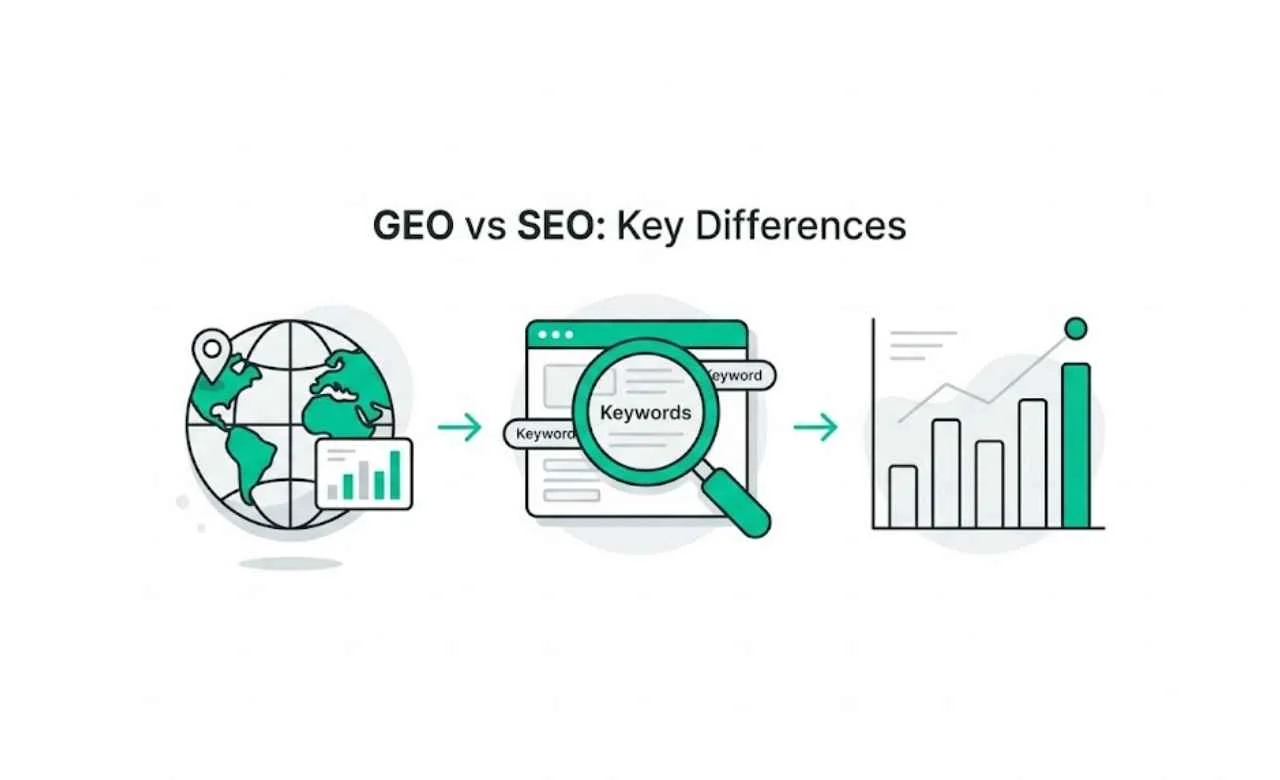
Search is changing fast. People no longer rely only on traditional search engines to find answers. They also use AI tools such as ChatGPT, Google AI features, Microsoft Copilot, and other generative search platforms.This shift has introduced a new term: GEO (Generative Engine Optimization).
While SEO (Search Engine Optimization) focuses on improving your visibility in traditional search results, GEO focuses on increasing the chances that AI-powered search systems will understand, reference, and recommend your content in generated answers.So, what is the difference between GEO vs SEO? Are they competing strategies, or should you use both?In this guide, you’ll learn how GEO and SEO differ, how they work together, their benefits, and the best strategies to use in 2026.
What Is SEO?
SEO, or Search Engine Optimization, is the process of improving a website and its content so it can appear higher in traditional search engine results.
SEO commonly focuses on platforms such as Google and Bing.
The main goal is to attract organic search traffic by matching content with what people search for.
Important SEO activities include:
- Keyword research
- Search intent optimization
- On-page SEO
- Technical SEO
- Internal linking
- Backlink building
- Content optimization
- Website speed optimization
- Mobile optimization
- Structured data
- E-E-A-T signals
For example, if you publish an article targeting “what is link building,” SEO helps you optimize the page so search engines can understand its topic and potentially rank it for relevant queries.
What Is GEO?
GEO stands for Generative Engine Optimization.
It refers to the process of optimizing content so that AI-powered search and answer engines can understand, retrieve, summarize, and potentially cite or mention it in generated responses.
Instead of focusing only on ranking a blue link, GEO focuses on visibility within AI-generated answers.
For example, someone might ask an AI search engine:
“What are the best ways to build backlinks in 2026?”
Instead of displaying only a list of websites, the AI system may generate a summarized answer using information from multiple sources.
GEO aims to make your content easier for these systems to understand and use.
GEO vs SEO: What’s the Difference?
The biggest difference is the search environment and visibility goal.
SEO primarily focuses on visibility in traditional search engine results, while GEO focuses on visibility within AI-generated answers.
| Factor | SEO | GEO |
|---|---|---|
| Full form | Search Engine Optimization | Generative Engine Optimization |
| Main focus | Search engine rankings | AI-generated answers |
| Primary goal | Organic clicks and traffic | AI visibility, mentions, and citations |
| Main platforms | Google, Bing | AI search and generative answer systems |
| Content focus | Search intent and keywords | Clear, useful, authoritative information |
| Keywords | Highly important | Useful but not the only focus |
| Backlinks | Major authority signal | Can contribute to credibility |
| Structure | Important | Extremely important for machine understanding |
| User behavior | Clicks search results | Often receives an answer directly |
| Measurement | Rankings, clicks, traffic | Mentions, citations, visibility, referral traffic |
The two strategies overlap significantly. GEO does not replace SEO.
SEO vs GEO: How Do They Work Together?
SEO and GEO should generally be treated as complementary strategies.
A strong SEO foundation can also make content easier for AI systems to discover and understand.
For example, high-quality content can benefit from:
- Clear headings
- Accurate information
- Strong topical relevance
- Author expertise
- Reliable sources
- Internal links
- Natural language
- Descriptive titles
- Structured content
- Good technical performance
Instead of creating completely separate content for SEO and GEO, you can create search-first, AI-friendly content that serves both purposes.
Key Differences Between GEO and SEO
GEO and SEO both help improve online visibility, but they work in different ways. SEO focuses on ranking websites in traditional search engines, while GEO helps content appear in AI-generated answers. Understanding the key differences between GEO and SEO can help you create a more effective digital marketing strategy.
1. Search Engines vs Generative Engines
Traditional SEO is designed primarily for search engines that return ranked results.
GEO is designed around systems that generate answers from information gathered from different sources.
This changes how content visibility works.
2. Rankings vs AI Citations
SEO commonly measures success through:
- Keyword rankings
- Organic traffic
- Impressions
- Click-through rate
- Backlinks
- Conversions
GEO introduces additional visibility signals, such as:
- AI mentions
- Brand references
- Citations
- Inclusion in generated answers
- AI-driven referral traffic
3. Keywords vs Context
Keywords remain important for SEO.
GEO places greater emphasis on context, entities, relationships, factual clarity, and comprehensive answers.
Instead of repeatedly using one keyword, your content should clearly explain the subject and related concepts.
4. Blue Links vs Direct Answers
Traditional search often requires users to click a result.
Generative search can provide an answer directly on the search interface.
This means your content may influence an answer even when the user doesn’t immediately visit your website.
5. Page Optimization vs Information Optimization
SEO involves optimizing pages for search engines and users.
GEO places additional emphasis on making information easy for AI systems to extract, interpret, summarize, and attribute.
Benefits of SEO
SEO continues to provide several important benefits.
Increased Organic Traffic
Ranking for relevant keywords can bring consistent organic visitors to your website.
Long-Term Visibility
Well-optimized content can continue generating impressions and traffic long after publication.
Brand Awareness
Search visibility can put your brand in front of users who are actively looking for information, products, or services.
Better User Experience
Many SEO practices, such as improving page speed, navigation, readability, and mobile usability, also improve the user experience.
Higher Conversion Opportunities
SEO can target users at different stages of the buying journey, from informational searches to transactional queries.
Benefits of GEO
GEO offers additional opportunities as AI-powered search becomes more common.
Increased AI Visibility
Your brand or content may appear within AI-generated answers.
More Brand Mentions
AI systems can mention companies, websites, products, or experts when generating answers.
Greater Visibility Beyond Traditional Rankings
A website can potentially gain exposure through AI-generated answers in addition to conventional search results.
Builds Topical Authority
Creating accurate, well-supported content around a subject can strengthen your overall topical presence.
Helps Adapt to Search Changes
As users increasingly ask conversational questions, content optimized around entities, context, and complete answers becomes more useful.
Best SEO Strategies for 2026
1. Focus on Search Intent
Don’t create content simply because a keyword has high search volume.
Understand what the user actually wants.
Search intent can be:
- Informational
- Navigational
- Commercial
- Transactional
Your content should satisfy the intent behind the query.
2. Build Topic Clusters
Create comprehensive coverage around important topics.
For example, a website about SEO might cover:
- Backlinks
- Referring domains
- Link building
- Internal linking
- Anchor text
- Link insertion
- Technical SEO
- On-page SEO
Connect related pages with relevant internal links.
3. Improve On-Page SEO
Optimize:
- Title tags
- H1 and H2 headings
- URLs
- Meta descriptions
- Images
- Internal links
- Content structure
Avoid keyword stuffing. Use keywords naturally.
4. Earn Quality Backlinks
Backlinks remain an important part of SEO.
Focus on earning relevant links from trustworthy websites instead of building large numbers of low-quality links.
5. Improve Technical SEO
Make sure search engines can efficiently crawl and understand your website.
Pay attention to:
- Indexing
- Crawlability
- Canonical URLs
- Core Web Vitals
- Mobile usability
- HTTPS
- XML sitemaps
- Structured data
Best GEO Strategies for 2026
1. Answer Questions Directly
AI systems need clear information.
Don’t hide the answer behind unnecessary introductions.
For example:
Question: What is a backlink?
Start with a concise definition before expanding into examples and details.
2. Use Clear Content Structure
Use:
- H2 headings
- H3 subheadings
- Bullet points
- Numbered lists
- Tables
- Definitions
- FAQs
A logical structure makes your content easier for both humans and machines to process.
3. Provide Original Information
Generic content is less useful than content that provides something genuinely valuable.
Consider adding:
- Original research
- First-hand experience
- Case studies
- Expert quotes
- Statistics
- Comparisons
- Examples
- Unique data
4. Demonstrate Expertise
Make it clear who created the content and why they are qualified to discuss the subject.
Useful signals can include:
- Author bios
- Relevant experience
- Sources
- References
- Expert contributions
- Updated information
5. Support Important Claims
When making factual claims, provide trustworthy sources where appropriate.
This helps readers verify the information and gives your content stronger credibility.
6. Optimize for Conversational Queries
People often ask AI systems complete questions rather than short keywords.
Instead of targeting only:
“backlink audit”
also address questions such as:
- What is a backlink audit?
- How do you perform a backlink audit?
- Why is a backlink audit important?
- What should you check during a backlink audit?
7. Strengthen Entity Relationships
Clearly explain how concepts, people, companies, products, and topics relate to one another.
For example, an article about SEO should naturally connect concepts such as:
SEO → Google → keywords → search intent → backlinks → content → rankings
This gives AI systems more contextual information to work with.
How to Optimize Content for Both GEO and SEO
The best approach is not to choose one.
Create content that satisfies traditional search engines and AI-powered search systems.
A practical workflow looks like this:
Step 1: Find the Search Demand
Use keyword research to identify relevant queries.
Step 2: Understand Search Intent
Determine what users expect when they search the keyword.
Step 3: Analyze Existing Results
Review the pages currently ranking and identify what they cover.
Step 4: Identify Related Questions
Find questions users may ask before, during, and after the main query.
Step 5: Create Comprehensive Content
Answer the main query and important related questions without adding unnecessary filler.
Step 6: Add Evidence
Use credible sources, original research, examples, statistics, and expert information where appropriate.
Step 7: Improve Structure
Use descriptive headings, short paragraphs, lists, tables, and concise answers.
Step 8: Strengthen Internal Links
Connect the article with relevant pages across your website.
Step 9: Optimize Technical SEO
Make sure the page can be crawled, indexed, and rendered properly.
Step 10: Monitor Both Search and AI Visibility
Track traditional SEO metrics alongside emerging AI visibility signals.
GEO vs SEO: Which One Should You Focus On?
Rather than treating GEO and SEO as competing strategies, consider them two parts of a broader search visibility strategy.
SEO helps your website compete in traditional search results.
GEO helps prepare your content for AI-generated search experiences.
A strong strategy can combine both:
SEO foundation + high-quality content + structured information + authoritative sources + AI-friendly answers.
Read more:Referring Domains vs Backlinks: What’s the Difference and Why It Matters for SEO?
Common GEO and SEO Mistakes to Avoid
Keyword Stuffing
Repeating the same keyword excessively can make content unnatural and less useful.
Creating Content Only for AI
Don’t write awkward content designed solely to manipulate AI systems.
Human readers should remain the priority.
Publishing Generic AI Content
Simply generating large amounts of similar content doesn’t create authority.
Add original insights, evidence, examples, and experience.
Ignoring Technical SEO
Great content still needs to be accessible and indexable.
Chasing Every New AI Platform
Don’t completely change your strategy every time a new AI search feature appears.
Build strong fundamentals first.
Writing Without Sources
Important factual claims should be supported when credible sources are available.
FAQs
Is GEO replacing SEO?
No. GEO and SEO address overlapping but different search experiences. SEO remains important for traditional organic search, while GEO focuses on visibility in AI-generated answers.
Is GEO part of SEO?
GEO can be viewed as an emerging extension of search optimization. Many fundamentals of SEO, such as quality content, authority, technical accessibility, and clear structure, also support AI visibility.
Does GEO require keywords?
Keywords still matter because they help define the topic and user intent. However, GEO also emphasizes context, entities, natural language, factual accuracy, and comprehensive answers.
How do I optimize my website for GEO?
Create authoritative, well-structured content that answers questions directly, supports important claims, demonstrates expertise, and clearly explains relationships between related concepts.
Can SEO and GEO be used together?
Yes. A single well-optimized page can target traditional search rankings while also being structured for AI systems to understand and potentially reference.
Conclusion
GEO vs SEO isn’t necessarily an either-or decision.
SEO remains focused on traditional organic search visibility, while GEO addresses the growing role of generative AI in how people discover and consume information.In 2026, a strong search strategy should focus on useful content, search intent, technical accessibility, authority, clear structure, original information, and trustworthy sources.
The goal isn’t simply to optimize content for an algorithm. It’s to create information that people find useful and search systems can understand, retrieve, and accurately represent.