
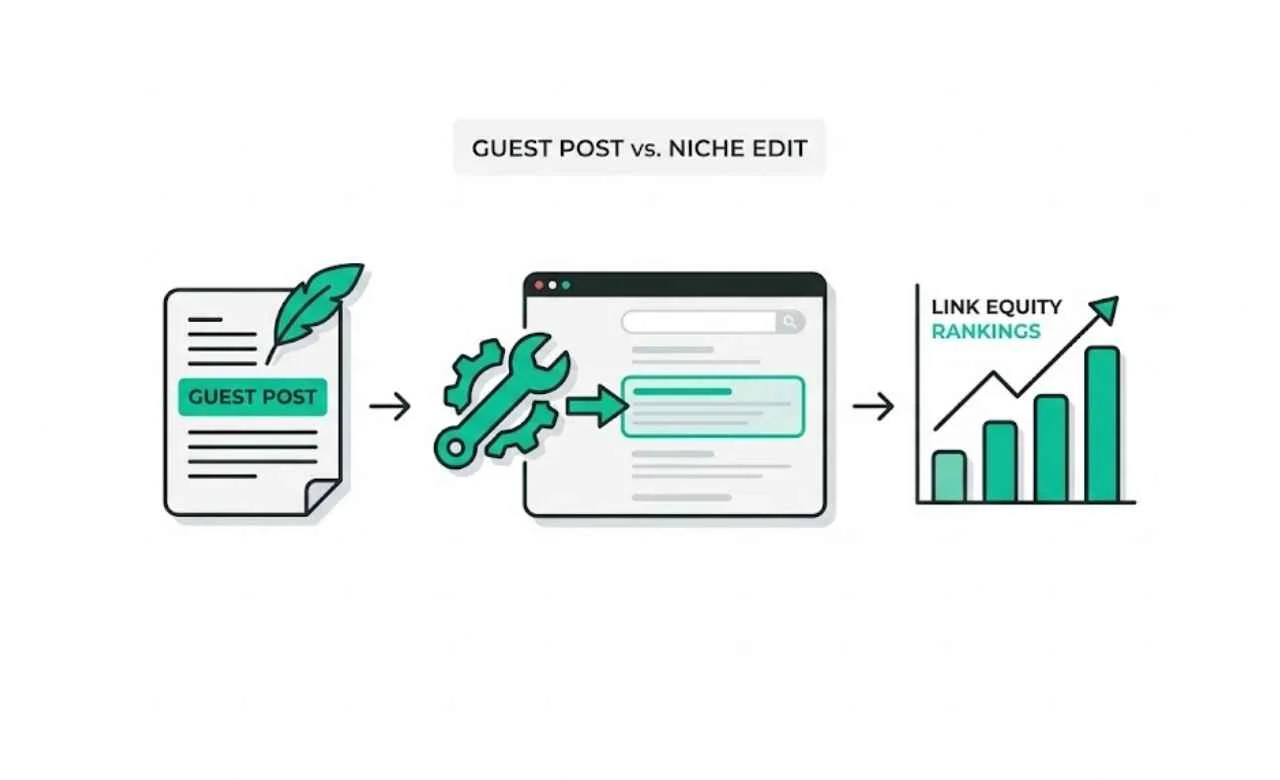
When you’re building backlinks for SEO, two strategies often come up: guest posts and niche edits. Both can place a link on an established website, but the way those links are created, the level of editorial control involved, and the potential SEO value can be very different.
A guest post involves creating a new article for another website and usually including a relevant backlink within the content. A niche edit, also called a link insertion, adds a backlink to an existing article or webpage that is already published and indexed.
So, when comparing guest post vs niche edit, the real question isn’t simply which one is better. You need to consider relevance, editorial quality, website authority, traffic, topical alignment, link placement, content quality, cost, scalability, and your overall link-building strategy.
What Is a Guest Post?
A guest post is an original article written for publication on another website. The website owner publishes your content, and the article may contain one or more links pointing to relevant pages on your website.
For example, imagine you operate an SEO website and want a backlink to an article about link building. You could write an original article about digital PR, publish it on a relevant marketing website, and naturally reference your link-building guide within the article.
The backlink becomes part of a newly created page rather than Guest Post vs Niche Edit being inserted into an article that already existed.
Guest posting is commonly used for:
- Link building
- Referral traffic
- Brand awareness
- Thought leadership
- Content marketing
- Relationship building
- Topical authority
- Audience development
A quality guest post should provide value to the host website’s readers. The backlink should make sense in context rather than being inserted solely for SEO.
What Is a Niche Edit?
A niche edit is a backlink added to an existing article or webpage.
Instead of publishing a completely new article, you identify an existing page that is relevant to your topic and request an editorial link insertion.
For example, suppose a marketing website already has an article titled “How to Build a Strong SEO Strategy.” If your website has a useful resource explaining link-building timelines, an editor might add a relevant sentence and link to your resource.
The key difference is simple:
Guest post = new article + backlink.
Niche edit = existing article + backlink insertion.
Niche edits are also commonly called:
- Link insertions
- Contextual link insertions
- Existing-page backlinks
- Editorial link placements
- Contextual backlinks
However, not every link insertion has the same quality. The quality of the existing page, its relevance, traffic, indexing status, editorial standards, and backlink profile all matter.
Guest Post vs Niche Edit: Quick Comparison
| Factor | Guest Post | Niche Edit |
|---|---|---|
| Content | New article | Existing article |
| Link placement | Usually within newly created content | Added to existing content |
| Content control | Higher | Lower |
| Publishing speed | Often slower | Can be faster |
| Content creation | Required | Usually minimal |
| Topical relevance | Can be built around your topic | Depends on existing page |
| Existing traffic | New page may need time to gain traffic | Existing page may already receive traffic |
| Scalability | Moderate | Potentially high |
| Relationship building | Strong opportunity | Usually more limited |
| Editorial context | Created specifically for placement | Must fit existing context |
| Main SEO value | Contextual backlink + content exposure | Contextual backlink + existing page signals |
| Best use | Brand building and strategic outreach | Relevant existing-page placements |
The table shows why there isn’t one universal answer to guest post vs niche edit.
Each method solves a slightly different link-building problem.
Key Difference Between Guest Post and Niche Edit
The biggest difference is the content environment in which the backlink is placed.
With a guest post, you start with a blank page. You can create the topic, structure the article, write relevant sections, and naturally introduce your target page.
With a niche edit, the page already exists. That means you have to work with the article’s existing topic, structure, language, audience, and editorial context.
This difference affects almost everything else.
Guest Post Gives You More Content Control
When creating a guest post, you can choose a topic closely related to your target page.
For example, if your target page discusses technical SEO, you might create a guest article about:
- Technical SEO mistakes
- Website crawling
- Indexing problems
- Core Web Vitals
- SEO site audits
- Internal linking
- JavaScript SEO
This makes it easier to build a logical relationship between the article and your backlink.
With a niche edit, you cannot completely control the existing article.
The page might be relevant but not perfectly aligned with your target URL.
Niche Edits Use Existing Content
A major advantage of niche edits is that the backlink is placed on a page that already exists.
Depending on the website and page, the article may already have:
- Search visibility
- Organic traffic
- Internal links
- External backlinks
- Social shares
- Search engine history
- Established topical context
That can make an existing-page placement attractive from a link-building perspective.
However, you should never assume that an old page automatically provides a valuable backlink.
A page being several years old does not guarantee quality.
Benefits of Guest Posts
Guest posting remains a useful component of a diversified SEO strategy when the content is genuinely valuable and the placement is editorially appropriate.
1. You Control the Topic
One of the strongest advantages is topic selection.
You can choose a subject that naturally supports your target page.
This allows you to create a stronger semantic connection between:
Host article → contextual paragraph → anchor text → target page
That relationship can make the backlink more natural and useful to readers.
2. You Can Build Topical Relevance
Guest posts give you an opportunity to publish content within your specific niche.
Suppose your website focuses on SEO.
Instead of publishing generic articles, you can contribute content about:
- Link building
- Digital PR
- Content marketing
- Technical SEO
- Keyword research
- On-page SEO
- Local SEO
- SEO analytics
Over time, this can support broader brand visibility Guest Post vs Niche Edit within the industry.
3. Guest Posts Can Generate Referral Traffic
A backlink isn’t useful only because search engines can discover it.
Readers can click it too.
A well-written guest post published on a website with a relevant audience can generate referral traffic to your website.
This is especially valuable when the host publication has an audience that actually needs your product, service, or information.
4. Guest Posts Support Brand Awareness
A guest article puts your name or brand in front of another publication’s audience.
For businesses, this can contribute to:
- Brand recognition
- Industry credibility
- Audience growth
- Lead generation
- Partnerships
That makes guest posting broader than pure backlink acquisition.
5. You Can Build Publisher Relationships
Quality guest posting can create long-term relationships with website owners, editors, journalists, and publishers.
Instead of thinking about each backlink as an isolated transaction, you can build a network of legitimate publishing relationships.
That can create future opportunities for:
- Expert contributions
- Interviews
- Digital PR
- Collaborations
- Industry mentions
- Editorial citations
Benefits of Niche Edits
Niche edits offer a different set of advantages.
1. You Don’t Need to Create a Full Article
The most obvious benefit is efficiency.
With a niche edit, the host article already exists.
You don’t necessarily need to spend hours researching, outlining, writing, editing, and formatting a new guest post.
That can make the process more efficient Guest Post vs Niche Edit when you already have a high-quality target page.
2. The Existing Page May Already Have Traffic
This is one of the most important things to investigate.
If an existing article already receives organic visitors, a relevant link insertion may have a stronger referral-traffic opportunity than a brand-new page that has not yet established search visibility.
But verify traffic rather than relying on a seller’s claim.
Look at:
- Organic traffic estimates
- Ranking keywords
- Traffic trends
- Top pages
- Geographic traffic
- Search visibility
- Page-level backlinks
A website can have strong domain-level metrics while the specific page receives almost no traffic.
3. Existing Pages May Have Established Signals
An existing article can have a history that a newly published guest post doesn’t have.
For example, the page may have accumulated relevant backlinks and internal links over time.
That doesn’t mean every old page has strong SEO value. It simply means page-level history is another factor worth evaluating.
4. Faster Content Placement
Because you’re not starting from scratch, niche edits can sometimes be completed faster than guest posts.
The exact timeline depends on the publisher, editorial review, negotiation, and update schedule.
5. Strong Contextual Opportunities
A good niche edit places your link inside an already relevant discussion.
For example:
“Effective link-building campaigns can take several months to produce measurable results. A consistent outreach strategy can help websites build relevant authority over time.”
A link to a detailed guide about link-building timelines could fit naturally into that discussion.
The important word is naturally.
Guest Post vs Niche Edit: Which Is Better for SEO?
There is no universal winner.
The better option depends on the individual placement.
A relevant, high-quality guest post can be more valuable than a poor niche edit.
Likewise, a highly relevant niche edit on a genuinely useful, established Guest Post vs Niche Edit page can be more useful than a low-quality guest post published solely to obtain a backlink.
The important mistake to avoid is comparing these strategies only by:
- DA
- DR
- Domain age
- Link price
- Number of backlinks
Those metrics can provide clues, but they don’t tell the entire story.
Evaluate the Actual Page
For niche edits, investigate the exact page where your backlink will appear.
For guest posts, investigate the publication quality of the host website and the expected page.
Check:
- Is the website relevant?
- Is the article relevant?
- Does the site publish useful content?
- Does it have real organic visibility?
- Does the page appear indexed?
- Does the site have suspicious outbound-link patterns?
- Are links editorially integrated?
- Does the website have a real audience?
- Is the content readable and useful?
- Does the placement make sense for users?
These questions are often more meaningful than a single third-party authority score.
Guest Post vs Niche Edit: Cost Differences
Pricing varies significantly by industry, website quality, geography, editorial standards, and publisher.
Generally, guest posts require more work because someone must create and publish an entire article.
The total cost can include:
- Content writing
- Research
- Editing
- Outreach
- Publisher fees
- SEO management
- Content revisions
Niche edits may cost less or more depending on the website and page.
Some premium publishers may charge substantial fees for inserting a link into an established page because you’re accessing an existing asset.
Therefore, don’t assume:
Niche edit = cheap
or
Guest post = expensive
Instead, compare the total value of the actual placement.
How to Evaluate a Guest Post Opportunity
Before accepting a guest post placement, perform a basic quality check.
Check Organic Traffic
Use an SEO tool to estimate organic traffic.
Look for consistent visibility rather than a single unusually high month.
A website with declining traffic deserves closer investigation.
Check Ranking Keywords
Look at the keywords for which the domain ranks.
Are they related to your industry?
A domain might have thousands of ranking keywords but still be irrelevant to your business.
Check Traffic Geography
Geographic relevance can matter.
If your business targets customers in the United States, for example, a website whose audience is overwhelmingly from unrelated regions may not provide the same referral value as a publication with a relevant U.S. audience.
Check Outbound Links
Review existing articles.
If every article contains several commercial backlinks with exact-match anchors, that’s a warning sign.
A natural editorial website usually has a broader linking pattern.
Check Content Quality
Read several recent articles.
Look for:
- Original information
- Proper formatting
- Human-readable writing
- Useful examples
- Relevant citations where appropriate
- Consistent editorial standards
If the website publishes hundreds of thin articles solely around commercial keywords, be cautious.
How to Evaluate a Niche Edit Opportunity
Niche edits require an additional layer of page-level analysis.
Check Page-Level Traffic
Don’t stop at domain traffic.
The exact page matters.
If the proposed page has no search visibility, its existing age alone shouldn’t convince you that it is valuable.
Check Page Relevance
The article should be genuinely related to your target page.
For example, a backlink to a cybersecurity guide makes more sense from an article about website security than from an unrelated general-interest article.
Check Existing Backlinks
Look at whether the page has legitimate backlinks.
A page with relevant referring domains may have accumulated Guest Post vs Niche Edit authority independently.
However, evaluate backlink quality rather than counting links blindly.
Check Indexing
Make sure the page is indexed and accessible to search engines.
If a page is blocked, deindexed, redirected, or frequently changed, its value may be different from what the seller suggests.
What Is a Contextual Backlink?
A contextual backlink is a link placed within relevant surrounding content.
Context matters because the link should make sense to the reader.
For example, an article about keyword research might naturally reference a detailed keyword research guide.
A completely unrelated link inserted into the same article would feel unnatural.
Contextual relevance can involve:
- Topic
- Sentence meaning
- Paragraph
- Article
- Website niche
- Audience
- Anchor text
- Destination page
This is why both guest posts and niche edits can potentially provide contextual backlinks.
Guest Post vs Niche Edit: Anchor Text Strategy
Anchor text deserves careful attention regardless of the strategy.
Common anchor types include:
Branded Anchor
Example:
BlessifyNow
Naked URL
Example:
Partial-Match Anchor
Example:
link-building strategies
Exact-Match Anchor
Example:
guest post vs niche edit
Generic Anchor
Examples include:
read more
this guide
learn more
A natural backlink profile generally contains varied anchor text rather than repeating one commercial or exact-match phrase excessively.
Don’t build a campaign around forcing the same keyword into every backlink.
The surrounding content and relevance should come first.
Are Niche Edits Safe for SEO?
A niche edit itself isn’t inherently good or bad.
The quality and acquisition method matter.
A legitimate editorial update that improves an article for readers is different from manipulating pages solely to sell links.
When evaluating a niche edit service, ask:
- Is the publisher legitimate?
- Is the article relevant?
- Is the link editorially appropriate?
- Is the page indexed?
- Does the website have genuine content?
- Are there excessive paid links?
- Is the placement transparent?
- Is the link being added in a useful context?
Avoid treating every link insertion as automatically valuable.
Are Guest Posts Safe for SEO?
Guest posts also need quality control.
Writing useful content for another website is a legitimate marketing activity.
The problem arises when guest posting becomes a large-scale system designed primarily to manipulate search rankings through artificial links.
Quality should therefore remain the priority.
A strong guest contribution should:
- Help the publication’s readers
- Be original
- Fit the website’s audience
- Provide genuine information
- Use links naturally
- Avoid excessive keyword-focused anchors
- Follow the publisher’s editorial standards
Guest Post vs Niche Edit for New Websites
For a new website, both strategies can play a role in a broader marketing plan.
Guest posts can help introduce a new brand to established audiences.
Niche edits can potentially provide placements on existing relevant pages.
But new websites should not focus exclusively on acquiring backlinks.
Build the underlying asset first.
That means creating:
- Useful landing pages
- Original guides
- Strong informational content
- Helpful tools
- Research
- Case studies
- Data-driven resources
- Clear author information
- Trust signals
The best backlink strategy has something genuinely worth referencing.
Guest Post vs Niche Edit for Established Websites
Established websites can benefit from both approaches too.
At this stage, you may have many pages that deserve references from other websites.
Niche edits can make sense when an existing article is highly relevant to your resource.
Guest posting can make sense when you want to reach a new audience or develop relationships with publishers.
An established website can also combine both strategies with:
- Digital PR
- Resource-page outreach
- Expert contributions
- Journalist outreach
- Partnerships
- Original research
- Linkable assets
Common Guest Posting Mistakes
Mistake 1: Choosing Websites Only by DR
Domain Rating is a third-party metric.
It can help with prospecting, but it shouldn’t be your only qualification.
A high-DR website can still have poor topical relevance or questionable traffic.
Mistake 2: Publishing Generic Content
If your article could be published on hundreds of unrelated websites without modification, it probably isn’t tailored enough.
Create content specifically for the host publication’s audience.
Mistake 3: Overusing Exact-Match Anchors
Repeated commercial anchors can make your backlink profile look unnatural.
Use anchors that fit the sentence and provide useful context.
Mistake 4: Ignoring the Audience
A backlink from a website with an audience that doesn’t need your content may provide little referral value.
Audience relevance matters.
Common Niche Edit Mistakes
Mistake 1: Buying Links From Random Pages
Don’t accept a placement simply because someone says the page is “old.”
Page quality matters more than age alone.
Mistake 2: Ignoring Page Traffic
A website may receive significant traffic while the proposed article receives almost none.
Check the page itself.
Mistake 3: Accepting Irrelevant Context
A link should make sense in the article.
If an editor has to force an unrelated sentence into the page, the placement isn’t strong from a user perspective.
Mistake 4: Buying Too Many Placements From One Domain
Multiple links from the same domain can have diminishing strategic value compared with building relationships across relevant publications.
Guest Post vs Niche Edit: Which Is More Scalable?
Scalability depends on your process and publisher network.
Guest posting requires:
- Prospecting
- Outreach
- Topic approval
- Content creation
- Editing
- Publication
- Link verification
Niche edits can remove some of the content-production steps.
A typical process may involve:
- Prospecting
- Finding relevant existing pages
- Contacting the publisher
- Approving the target URL and anchor
- Editorial insertion
- Verification
This can make niche edits operationally efficient.
However, scaling either method without quality control can create a low-quality backlink profile.
Guest Post vs Niche Edit for Referral Traffic
If referral traffic is a major goal, the difference becomes more interesting.
A guest post gives you an entire article designed to attract readers.
You can structure the article around a problem and introduce your website as a useful resource.
A niche edit relies on the existing article’s readership.
If that article receives consistent traffic, the link may generate clicks without requiring a new article.
Therefore, ask a simple question:
Does the specific page have an audience that would actually click my link?
That question is often more useful than asking whether the domain has a high authority score.
Guest Post vs Niche Edit for Brand Building
Guest posts generally provide more space for brand exposure because you control an entire piece of content.
You can demonstrate:
- Expertise
- Experience
- Original opinions
- Examples
- Case studies
- Methodologies
Niche edits typically provide much less brand exposure because your website may appear through a single contextual link.
If brand awareness is a major objective, publishing valuable contributions can provide benefits beyond the backlink itself.
How to Build a Balanced Link-Building Strategy
Instead of choosing only one tactic, consider using several legitimate methods.
Your strategy can include:
1. High-Quality Guest Contributions
Create genuinely useful content for relevant publications.
2. Editorial Link Outreach
Contact websites that already discuss topics related to your resources.
3. Digital PR
Create stories, research, surveys, statistics, or expert commentary that journalists and publishers may want to reference.
4. Linkable Assets
Build resources that naturally attract citations.
Examples include:
- Original studies
- Free tools
- Statistics pages
- Templates
- Comprehensive guides
- Calculators
- Visual resources
5. Content Partnerships
Collaborate with relevant brands, communities, and publications.
This produces a more diversified acquisition strategy than relying entirely on paid placements.
How I Compare a Guest Post and Niche Edit
When reviewing a backlink opportunity, I use a simple evaluation framework.
Relevance
Does the website belong to the same or a closely related topical area?
Page Quality
Is the actual page useful, well-written, and maintained?
Organic Visibility
Does the site and proposed page have genuine search visibility?
Traffic
Is there evidence of real organic or referral traffic?
Editorial Quality
Does the publication maintain meaningful editorial standards?
Link Context
Will the backlink naturally fit the surrounding paragraph?
Anchor Text
Does the proposed anchor read naturally?
Outbound Link Profile
Does the website appear to sell excessive numbers of backlinks?
Audience
Would the publication’s readers actually benefit from your resource?
Long-Term Value
Would you still want the link if search engines were not involved?
That last question is powerful.
If the answer is no, reconsider the placement.
Guest Post vs Niche Edit: A Practical Decision Framework
Use a guest post when:
- You have strong content expertise.
- You want brand exposure.
- You want to reach a new audience.
- You want to build publisher relationships.
- You can create a genuinely useful article.
- You have a topic that fits the publication.
Consider a niche edit when:
- You have a strong existing resource.
- You find a highly relevant existing article.
- The target page has genuine value.
- The placement fits naturally.
- You want to avoid creating another full article.
- The publisher has an established editorial environment.
You can also use both as part of a diversified strategy.
Should You Buy Guest Posts or Niche Edits?
If you’re paying for a placement, don’t buy based solely on the label.
A seller may advertise:
“DA 70 guest post.”
Another may advertise:
“DR 70 niche edit.”
Those numbers don’t tell you enough.
Ask for the actual website and page.
Then evaluate:
- Relevance
- Organic traffic
- Ranking keywords
- Page history
- Content quality
- Existing links
- Outbound links
- Audience
- Indexation
- Editorial standards
The placement should be evaluated as an individual asset.
What Makes a High-Quality Backlink?
A strong backlink opportunity usually has several positive characteristics.
Relevant Website
The website’s topic is related to your industry.
Relevant Page
The specific article is relevant to your target URL.
Natural Context
The link makes sense within the surrounding text.
Useful Destination
Your page provides additional information that readers actually need.
Real Audience
The publication has evidence of genuine readership.
Editorial Quality
The website publishes content with meaningful standards.
Natural Anchor
The anchor text fits naturally into the sentence.
Sustainable Value
The link remains useful even if SEO metrics change.
This is a better framework than simply chasing the highest available domain metric.
Does Google Prefer Guest Posts or Niche Edits?
Search engines don’t provide a simple rule saying that one format is universally better.
The important distinction is between useful editorial links and manipulative link schemes.
The format itself isn’t enough to determine quality.
A newly written article can contain a valuable editorial reference.
An existing article can also contain a valuable editorial reference.
The key consideration is the quality, relevance, purpose, and circumstances surrounding the link.
That’s why an SEO strategy should focus on earning or placing links in ways that provide genuine value rather than trying to exploit a specific backlink format.
Guest Post vs Niche Edit: Long-Term Perspective
SEO isn’t just about obtaining a backlink today.
You want assets that continue to provide value months or years later.
A high-quality guest post can continue generating:
- Referral traffic
- Brand awareness
- Leads
- Search visibility
- Industry recognition
A useful niche edit can continue sending:
- Referral traffic
- Relevant visitors
- Contextual authority
- Brand exposure
But websites change.
Pages can be deleted.
Links can be removed.
Domains can lose traffic.
Content can be rewritten.
That’s why backlink monitoring should be part of your ongoing SEO process.
Read more:How Long Does Link Building Take? A Complete Timeline & What to Expect
How to Monitor Your Backlinks
After obtaining a backlink, track it.
Record:
- Referring domain
- Referring URL
- Target URL
- Anchor text
- Link type
- Date acquired
- Domain authority metrics
- Organic traffic
- Indexation status
- Link status
Periodically check whether the link remains live.
Also watch for major changes to the referring website.
If a website changes from a legitimate publication into a low-quality link network, reassess the relationship.
Guest Post vs Niche Edit: The Biggest SEO Lesson
The biggest lesson is simple:
Don’t optimize for the backlink format. Optimize for the quality of the opportunity.
A great guest post can be excellent.
A great niche edit can also be useful.
But a poor guest post and poor niche edit can both waste your budget.
Instead of asking:
“Which one is better?”
Ask:
“Which specific placement is more relevant, useful, credible, and valuable for my website?”
That change in thinking produces better SEO decisions.
Frequently Asked Questions
Is a guest post better than a niche edit?
Neither format is universally better. The value depends on the specific website, page relevance, content quality, audience, and editorial context.
What is the main difference between a guest post and a niche edit?
A guest post creates a new article containing a backlink, while a niche edit adds a backlink to an existing article or webpage.
Are niche edits good for SEO?
A relevant editorial link insertion can be useful, especially when placed naturally on a high-quality existing page. The specific page and website should be evaluated before placement.
Are guest posts still effective for link building?
Guest contributions can support SEO, referral traffic, brand exposure, and publisher relationshi
Final Thoughts
The guest post vs niche edit debate doesn’t have a one-size-fits-all answer.
Guest posts provide control over the content, topic, messaging, and brand exposure. They’re particularly useful when you want to contribute expertise to another publication and build relationships with publishers.
Niche edits work differently. They place a link inside existing content, which can be efficient and may provide access to pages that already have search visibility, backlinks, or readership.
Neither strategy should be judged by the label alone.
Before investing in a backlink, evaluate the website, specific page, relevance, traffic, content quality, editorial environment, anchor text, and overall link profile.
For a sustainable SEO campaign, I recommend thinking beyond individual backlinks. Build useful content, create resources worth referencing, develop relationships with relevant publishers, and Guest Post vs Niche Edit diversify how your website earns visibility.
The strongest link-building campaigns aren’t built around shortcuts. They’re built around relevance, useful content, editorial context, and long-term value.