
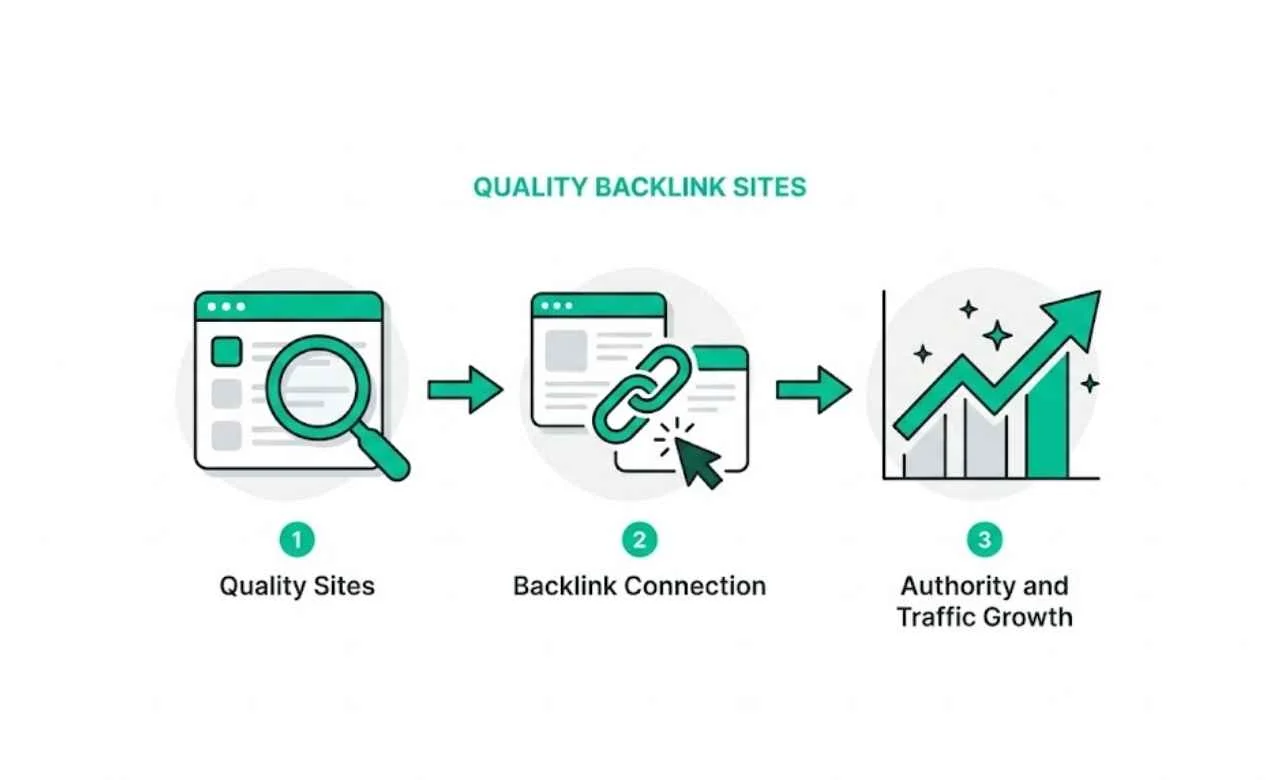
Getting backlinks is easy. Finding quality backlink sites that are actually worth your time is the hard part. You can build dozens of links and still see little improvement if those links come from irrelevant, low-quality, or spammy websites. On the other hand, a few relevant links from trusted websites can support your SEO, bring referral traffic, and put your content in front of the right audience.
So, how do you know whether a backlink site is genuinely valuable? Should you focus on DR, DA, organic traffic, or topical relevance? And how can you avoid websites that look powerful on the surface but have poor-quality content or suspicious link profiles?
In this guide, you’ll learn how to find quality backlink sites step by step. We’ll cover the SEO metrics that matter, how to check organic traffic and relevance, how to analyze a site’s backlink profile, where to find strong link opportunities, and the warning signs you should check before building a backlink.
What Is a Quality Backlink Site?
A quality backlink site is a legitimate website that can naturally and meaningfully link to your website because your content provides value to its audience.
For example, imagine you have a website about digital marketing. A link from an established SEO publication discussing link building is highly relevant. A link from an unrelated website that publishes hundreds of random articles about casinos, loans, health, technology, and fashion may not provide the same value.
Quality is not determined by one number.
Instead, consider several factors:
- Topical relevance
- Organic search traffic
- Content quality
- Backlink profile
- Referring domains
- Website reputation
- Editorial standards
- Link placement
- Audience relevance
- Outbound link quality
- Website history
- Overall user experience
A quality backlink should make sense from a user’s perspective.
If someone reads an article and sees a link to your website that helps them understand the topic better, that link is much more natural than a link inserted only because someone wanted to manipulate search rankings.
Ahrefs identifies authority, relevance, anchor text, placement, and destination as important concepts when evaluating backlink quality. In particular, editorial links placed naturally within useful content can be stronger prospects than links buried in sidebars or footers.
Quality Matters More Than Raw Backlink Numbers
It is tempting to think that 1,000 backlinks must be better than 20 backlinks.
That isn’t necessarily true.
A website can have thousands of backlinks from low-quality domains while another website has a smaller number of links from reputable and relevant websites.
The second site may have a much stronger link profile.
This is why your goal should not simply be:
“How many backlinks can I get?”
Instead, ask:
“Can I earn backlinks from websites that are relevant, trustworthy, useful, and valuable to my audience?”
That change in approach can make your link-building strategy much more sustainable.
Why Quality Backlink Sites Matter for SEO
Backlinks can help search engines understand the authority and relationships between websites. They can also send referral traffic and introduce your brand to new audiences.
Research from Ahrefs has found a positive correlation between the number of backlinks from unique websites and organic search traffic, although correlation does not prove that backlinks alone cause higher rankings.
Quality backlinks can contribute to your SEO strategy in several ways.
1. They Can Strengthen Your Website’s Authority
When reputable websites reference your content, your site can become more credible within its topic.
For example, a finance website receiving a relevant editorial mention from an established financial publication has a more meaningful relationship than receiving dozens of unrelated links.
2. They Can Send Referral Traffic
Not every backlink should be judged only by its potential ranking value.
A link can be valuable simply because real people click it.
Suppose a popular industry blog publishes an article that receives thousands of monthly visitors. If that article naturally recommends your resource, some readers may visit your website.
That traffic can potentially lead to:
- New readers
- Leads
- Subscribers
- Customers
- Brand searches
- Social shares
- Additional backlinks
3. They Can Increase Brand Visibility
A backlink puts your brand in front of another website’s audience.
Even if a visitor does not click immediately, seeing your company or website mentioned on trusted publications can improve brand recognition over time.
4. They Can Help You Build Industry Relationships
Good link building is often relationship building.
When you work with relevant publishers, bloggers, journalists, businesses, and website owners, you can create opportunities for:
- Expert quotes
- Interviews
- Collaborations
- Digital PR
- Guest contributions
- Research partnerships
- Resource mentions
The strongest link-building campaigns often produce benefits beyond the backlink itself.
How to Identify High-Quality Backlink Sites
Before contacting a website, create a simple quality checklist.
Do not immediately purchase a placement or send an outreach email simply because a site has a high DR.
Start by checking whether the website is actually worth associating with.
Check 1: Is the Website Relevant?
Relevance should be one of your first filters.
Ask:
“Would this website’s audience genuinely care about my content?”
If the answer is yes, the site may be a strong prospect.
For example:
- A fitness site linking to a nutrition guide makes sense.
- A marketing site linking to an SEO guide makes sense.
- A travel website linking to a hotel guide makes sense.
- A parenting website linking to family activities makes sense.
But a random website with no connection to your topic may be a poor prospect.
Topical relevance can exist at different levels.
A website does not need to cover exactly the same subject as yours. It can also be relevant to your target audience.
For example, an article about small-business accounting could naturally receive a link from an entrepreneurship website even if that website is not specifically about accounting.
Check 2: Does the Website Have Real Organic Traffic?
Organic traffic is one of the most useful signals when evaluating a backlink site.
A website may have a high DR but receive very little traffic.
That should make you investigate further.
Use an SEO tool such as Ahrefs or Semrush to examine:
- Estimated organic traffic
- Organic keywords
- Traffic trends
- Top-ranking pages
- Countries receiving traffic
- Traffic distribution
- Historical growth
Look for a website that appears to have genuine search visibility.
Do not automatically reject a site because its traffic is small. New websites, highly specialized websites, and local publications can have limited traffic but still be valuable because of their relevance and audience.
The important point is to avoid using traffic as your only metric.
Check 3: Look at the Website’s Content
Open the website and read several pages.
Ask:
- Is the content useful?
- Is it original?
- Is it well written?
- Does it appear to be created for readers?
- Are articles updated?
- Are authors identified?
- Does the website have clear categories?
- Are pages properly organized?
- Does the site have obvious editorial standards?
A website that publishes genuinely useful articles is usually a better prospect than a site filled with thin pages created mainly to sell links.
Check 4: Examine the Website’s Backlink Profile
A site’s own backlinks matter.
A website with a strong backlink profile is generally more interesting than a website whose authority comes from hundreds of suspicious or irrelevant links.
Look at:
- Referring domains
- Quality of referring domains
- Anchor text
- Followed links
- Top linked pages
- Historical backlink growth
- Relevant referring websites
Ahrefs’ backlink tools allow SEOs to examine backlinks, referring domains, anchor text, traffic, and other link data.
Do not focus only on the total number of backlinks.
One website might have 100,000 backlinks but only a small number of unique referring domains.
Another might have 5,000 backlinks from hundreds of legitimate websites.
The second profile could be much more meaningful.
Check Website Authority and SEO Metrics
SEO tools provide metrics that make backlink research easier.
Some of the most commonly used metrics include:
- Domain Rating (DR)
- Domain Authority (DA)
- URL Rating (UR)
- Organic traffic
- Referring domains
- Traffic value
- Keyword rankings
- Spam indicators
These metrics are useful for filtering prospects, but they are not the same thing as Google’s own ranking system.
Read more:What Is DR in SEO? A Complete Guide to Domain Rating
What Is Domain Rating?
Domain Rating, or DR, is an Ahrefs metric that measures the relative strength of a website’s backlink profile on a 0–100 scale. It is a third-party metric, not a Google ranking score.
A higher DR can indicate a stronger backlink profile.
However, a high DR does not automatically mean a website is high quality.
A DR 70 site with no meaningful organic traffic, poor content, and thousands of unrelated outbound links may be a worse prospect than a highly relevant DR 35 website with real visitors.
What About Domain Authority?
Domain Authority, commonly called DA, is a Moz metric designed to estimate how likely a domain is to rank in search results.
Like DR, DA can be useful for comparing websites, but it should not be treated as an official Google score.
Don’t Chase a Specific DR Number
There is no universal rule saying:
“Only get backlinks from DR 50+ websites.”
Your target should depend on your niche, competitors, budget, and available opportunities.
Ahrefs specifically notes that DR should be evaluated comparatively rather than treated as an absolute measure of website quality.
A practical evaluation might look like this:
| Factor | What to Look For |
|---|---|
| Relevance | Strong connection to your topic or audience |
| Organic traffic | Genuine and consistent search visibility |
| DR/DA | Useful authority signal, not the only metric |
| Content | Original, useful, reader-focused |
| Referring domains | Quality and diversity |
| Outbound links | Natural and reasonable |
| Website history | Stable, legitimate presence |
| Audience | Relevant to your target customers |
| Link placement | Contextual and editorial |
| Reputation | No obvious spam signals |
The best backlink opportunities usually perform well across several categories rather than just one.
Look for Real Organic Traffic and Rankings
One of the biggest mistakes in link building is looking at a website’s authority metric without checking its search visibility.
A site may have accumulated authority over many years but later lost most of its organic traffic.
That’s why traffic trends matter.
Check Traffic History
When evaluating a prospect, look at its historical traffic.
Ask:
- Was traffic stable?
- Has it recently dropped?
- Did rankings disappear?
- Is traffic growing?
- Are the site’s top pages still ranking?
- Is most traffic coming from branded searches?
A sudden traffic collapse does not automatically mean you should reject the website, but it deserves investigation.
Check Ranking Keywords
Look at the keywords for which the site ranks.
A good backlink site often ranks for terms that are relevant to its niche.
For example, if a website claims to be about SEO but ranks almost entirely for unrelated coupon, casino, or pharmaceutical terms, something may be wrong.
Look at its top pages too.
If most of its organic traffic comes from one strange page, the overall domain may not be as strong as its headline metrics suggest.
Check Traffic by Country
This is especially important if you are targeting a particular market.
Suppose your business targets customers in the United States.
A website may show significant traffic, but most of that traffic could come from countries that are irrelevant to your business.
That doesn’t automatically make the site bad.
However, if your goal is to reach a U.S. audience, a relevant U.S.-focused publication may be more useful.
Check Topical Relevance Before Building a Backlink
Relevance is one of the most important factors in backlink prospecting.
Think about it from the reader’s perspective.
Would the link feel natural inside the article?
If yes, the opportunity may be valuable.
For example, imagine you run a website about personal finance.
Good prospects might include:
- Finance blogs
- Business publications
- Investment websites
- Entrepreneurship blogs
- Tax resources
- Real estate publications
- Career websites
- Small-business sites
You can also find adjacent topics.
For example, a career website may naturally reference a budgeting guide.
Page-Level Relevance Matters
You should not only evaluate the domain.
Look at the actual page where your link would appear.
A highly relevant page on a moderately authoritative website can be a strong opportunity.
For example:
Website: Business publication
Article: How to Start a Small Business
Your resource: Small Business Tax Checklist
That is a logical connection.
Compare that with:
Website: General entertainment blog
Article: Celebrity News
Your resource: Small Business Tax Checklist
The second link has little topical justification.
The first is much more natural.
Analyze a Site’s Backlink Profile
A website’s backlink profile can reveal whether its authority is genuine or potentially manipulated.
Start by examining referring domains.
Referring Domains vs. Backlinks
A backlink is an individual link.
A referring domain is a unique website that links to you.
For example:
- Website A links to you 10 times.
- Website B links to you 5 times.
- Website C links to you 2 times.
You have 17 backlinks but only 3 referring domains.
That distinction matters because a large number of links from the same domain does not necessarily mean you have broad authority.
Examine Anchor Text
Look at the anchor text used by other websites.
Natural backlink profiles usually contain different types of anchors, including:
- Brand names
- Website names
- Naked URLs
- Generic phrases
- Partial-match phrases
- Descriptive anchors
Be careful when a website’s backlink profile contains large numbers of highly optimized commercial anchors.
That can be a warning sign.
Ahrefs recommends using a natural variety of anchor text rather than forcing the same keyword into every backlink.
Examine Outbound Links
You should also look at the links going out from the website.
Open several articles.
Are there reasonable references?
Or does every article contain multiple links to unrelated commercial websites?
A website that links excessively to unrelated sites may be operating primarily as a link-selling platform.
This does not mean every website with outbound links is bad.
Editorial websites naturally link to other resources.
The issue is whether the links appear useful and natural.
Avoid Low-Quality and Spammy Backlink Sites
Finding quality backlink sites also means knowing which websites to reject.
A backlink opportunity should make you pause if you notice several of these warning signs.
1. The Site Covers Too Many Unrelated Topics
One website publishing high-quality content about a clear niche can be valuable.
A site publishing:
- Casino articles
- Cryptocurrency
- Health
- Loans
- Dating
- Gambling
- Technology
- Fashion
- Legal services
- Travel
- SEO
all on the same domain may deserve closer inspection.
Broad publications can be legitimate, but extreme topic mixing is often a sign that the website is being used for SEO placements.
2. The Website Publishes Huge Volumes of Guest Posts
Guest posting itself is not automatically bad.
The problem occurs when a site becomes a collection of low-quality articles created mainly to place backlinks.
Look for:
- Poorly written articles
- Generic author names
- Repetitive article structures
- Unrelated topics
- Keyword-stuffed anchors
- Multiple commercial links
- Thin content
3. The Website Has No Real Audience
A website with strong metrics but almost no visible audience deserves investigation.
Look at:
- Organic traffic
- Social presence
- Branded searches
- Comments where appropriate
- Returning content
- Publication frequency
- Overall reputation
4. The Website Has Obvious Link-Selling Patterns
If every article contains several paid-looking links to unrelated businesses, be cautious.
Google’s spam policies specifically identify buying or selling links for ranking purposes, excessive link exchanges, automated link creation, and certain paid articles or guest posts that pass ranking credit as spam-related practices.
That is why a sustainable link strategy should prioritize genuine editorial value rather than simply buying as many followed links as possible.
5. The Website Looks Abandoned
Check when the site was last updated.
A website that has not published anything useful in years may not be a strong long-term prospect.
However, don’t automatically reject old websites. Some authoritative resources are intentionally updated infrequently.
Look at the entire picture.
Where to Find Quality Backlink Opportunities
Once you know how to evaluate websites, you need a system for finding them.
Here are some of the most useful methods.
1. Analyze Your Competitors’ Backlinks
Competitor backlink analysis is one of the fastest ways to find relevant opportunities.
Start with websites already ranking for your target keywords.
Put a competitor’s domain into Ahrefs or another backlink analysis tool.
Then review its referring domains.
Look for websites that:
- Link to competitors
- Publish content in your niche
- Have real traffic
- Accept relevant contributions
- Mention industry resources
- Publish research or statistics
Ahrefs recommends analyzing competitor backlinks to identify link opportunities that may be replicable.
2. Use Link Intersect Research
Link intersect analysis helps you find websites that link to several competitors but not to your site.
For example:
Competitor A → Website X
Competitor B → Website X
Competitor C → Website X
Your website → No link
Website X is worth investigating.
It has already demonstrated an interest in your industry.
That makes it a potentially strong prospect.
3. Search for Resource Pages
Resource pages are created to help users find useful information.
Search Google for phrases such as:
- Your topic + useful resources
- Your topic + resource page
- Your topic + helpful links
- Your industry + resources
- Your niche + recommended websites
If your content genuinely adds value, you can contact the website owner and suggest it.
4. Look for Industry Publications
Industry-specific publications can be valuable because they already have an audience interested in your subject.
For example:
- Technology → technology publications
- SEO → digital marketing publications
- Finance → financial publications
- Education → education publications
- Travel → travel publications
- Health → reputable health publications
Focus on relevance first.
5. Use Digital PR
Digital PR can help you earn backlinks by creating something worth mentioning.
Potential linkable assets include:
- Original research
- Surveys
- Industry statistics
- Expert commentary
- Data studies
- Useful calculators
- Free tools
- Detailed guides
- Original reports
Google itself recommends creating unique and compelling content that people want to reference naturally.
6. Find Broken Link Opportunities
Broken link building involves finding relevant pages containing dead links and suggesting a useful replacement.
The process is simple:
- Find a relevant resource page.
- Identify broken external links.
- Create or identify a useful replacement on your site.
- Contact the publisher.
- Explain the broken link.
- Suggest your resource if it genuinely fits.
This works best when your replacement is genuinely useful rather than created only to obtain a backlink.
How to Build Powerful Backlinks Safely
Finding good backlink sites is only half the process.
You also need to acquire links in a way that makes sense.
Create Content Worth Linking To
Before doing outreach, ask:
“Why would another website want to link to this?”
If the answer is unclear, improve the content first.
Linkable content can include:
- Original research
- Statistics
- Comprehensive guides
- Templates
- Calculators
- Checklists
- Case studies
- Visual resources
- Expert interviews
- Original data
The better the resource, the easier it becomes to explain why someone should reference it.
Prioritize Editorial Placement
A contextual link within a useful article is generally more valuable than a link hidden in a footer or unrelated site section.
For example:
“For a detailed explanation of technical SEO, see this guide…”
That can be a natural editorial reference when the linked page genuinely helps the reader.
Use Natural Anchor Text
Don’t make every backlink use the exact keyword you want to rank for.
Natural anchors can include:
- Your brand
- Your website name
- The article title
- A descriptive phrase
- A partial keyword
- “This guide”
- “Learn more”
- A naked URL
The goal is to make the link look like something a real publisher would naturally write.
Don’t Buy Links Solely to Manipulate Rankings
There is an important distinction between legitimate advertising and buying links specifically to pass ranking credit.
Google’s current spam documentation states that exchanging money, goods, or services for links intended to manipulate rankings can violate its spam policies. It also addresses paid articles, guest posts, and advertorial links that pass ranking credit.
If a paid placement is advertising, it should be appropriately qualified rather than disguised as an organic editorial endorsement.
Don’t Use Automated Link-Building Systems
Avoid tools or services promising thousands of backlinks automatically.
Large numbers of irrelevant or low-quality links are not a substitute for a strong link profile.
Google specifically lists automated programs or services used to create links as a spam tactic.
Build Links Gradually
You do not need to acquire hundreds of links overnight.
A better strategy is to build a diverse set of relevant opportunities over time.
For example, your campaign might include:
- Industry publications
- Resource pages
- Digital PR
- Competitor link opportunities
- Expert contributions
- Useful directories
- Partnerships
- Original research
This creates a more diversified link profile.
A Simple Quality Backlink Site Checklist
Before contacting any website, use this checklist.
Website Quality
- Does the website look legitimate?
- Is the content useful?
- Is the site active?
- Does it have a clear niche?
- Is the website easy to navigate?
SEO Quality
- Does it have organic traffic?
- Does it rank for relevant keywords?
- Are traffic trends stable?
- Does it have legitimate referring domains?
- Is its DR/DA reasonable compared with similar sites?
Relevance
- Is the website related to your niche?
- Is the target page related to your topic?
- Would your audience benefit from your link?
- Would the link make sense contextually?
Backlink Profile
- Are referring domains legitimate?
- Does the site have suspicious anchor text?
- Does it receive links from reputable websites?
- Does it have excessive low-quality links?
- Does it link to too many unrelated websites?
Editorial Quality
- Are articles written for readers?
- Are there real authors?
- Are sources cited?
- Are articles edited?
- Does the site publish useful information?
If a website passes most of these checks, it can become a strong prospect.
A Practical Way to Score Backlink Sites
If you are reviewing dozens or hundreds of websites, create a simple scoring system.
For example:
| Factor | Score |
|---|---|
| Topical relevance | 0–10 |
| Organic traffic | 0–10 |
| Content quality | 0–10 |
| Backlink profile | 0–10 |
| Audience relevance | 0–10 |
| Website reputation | 0–10 |
| Editorial quality | 0–10 |
| Outbound link quality | 0–10 |
| Traffic stability | 0–10 |
| Overall trust | 0–10 |
A website scoring 85/100 deserves more attention than one scoring 45/100.
This isn’t a Google formula.
It is simply an internal decision-making framework that helps you prioritize your time.
You can also add your own minimum requirements.
For example:
Minimum organic traffic: 500+ monthly visits
Minimum DR: 30
Topical relevance: Required
Spam signals: None
Content quality: Good or excellent
These numbers should be adjusted for your niche.
Don’t reject a perfect niche publication simply because it has DR 28 instead of DR 30.
Likewise, don’t accept a spammy DR 70 site simply because the number looks impressive.
Common Backlink Mistakes to Avoid
Mistake 1: Choosing Sites Only by DR
DR is useful, but it is not a complete quality measurement.
Ahrefs itself recommends not using DR as a standalone metric and suggests combining it with other indicators such as traffic and page-level strength.
Mistake 2: Ignoring Relevance
A backlink from a relevant website is often more logical than a random link from a high-metric domain.
Mistake 3: Buying Large Packages
Packages promising hundreds or thousands of backlinks may prioritize quantity instead of quality.
Mistake 4: Using Exact-Match Anchors Everywhere
Natural backlink profiles contain different anchor types.
Mistake 5: Ignoring Traffic Trends
A website’s current metric may hide a major decline in search visibility.
Mistake 6: Not Checking the Actual Page
Don’t evaluate only the homepage.
Look at the page where your backlink would appear.
Mistake 7: Accepting Every Guest Post Opportunity
A guest post is valuable when it contributes something useful to a relevant audience.
It becomes risky when the primary purpose is manipulating rankings.
Mistake 8: Ignoring User Experience
A website can have strong SEO metrics but still be poor from a user’s perspective.
Look at the actual website before pursuing the link.
Most importantly, build links that make sense for people. Create useful resources, promote original research, contribute genuinely valuable information, and look for websites where your content can improve the reader’s experience.
Google’s Search Essentials emphasize helpful, reliable, people-first content, while its spam policies warn against manipulative link schemes.
The goal isn’t to collect the biggest number of backlinks.
The goal is to build a backlink profile that looks natural, relevant, trustworthy, and useful.
When you consistently choose quality over quantity, your link-building campaign becomes more sustainable and much easier to scale.
FAQs
1. What makes a backlink site high quality?
A quality backlink site is relevant to your niche, has genuine content and audience, and ideally has consistent organic search visibility. It should also have a healthy backlink profile and natural outbound linking behavior.
2. What metrics should I check before getting a backlink?
Check organic traffic, keyword rankings, referring domains, DR or DA, topical relevance, content quality, and backlink history. Don’t make your decision based on a single SEO metric.
3. How can I find quality backlink sites for my website?
You can find quality opportunities through competitor backlink analysis, link intersect research, resource pages, industry publications, digital PR, broken-link opportunities, relevant directories, and genuine outreach.
4. Are high-DR websites always good for backlinks?
No. A high DR does not automatically mean a website is trustworthy or relevant. Examine traffic, content, backlinks, topical relevance, outbound links, and overall website quality before choosing a site.
5. How do I avoid bad backlink sites?
Avoid websites with obvious spam, unrelated content, excessive commercial links, unnatural anchor text, suspicious traffic, thin articles, and large-scale link-selling patterns. Always review the actual website before pursuing a backlink.
Conclusion
Finding quality backlink sites is not about collecting as many links as possible. It’s about finding relevant, trustworthy websites that can genuinely add value to your SEO strategy and your audience. A backlink from a relevant site with real traffic and useful content can be far more valuable than dozens of links from weak or spammy domains.
Before building a link, check the website’s organic traffic, topical relevance, content quality, referring domains, backlink profile, DR or DA, and outbound linking patterns. Most importantly, look at the website as a real user would. If it provides useful information and has a legitimate audience, it’s more likely to be a worthwhile backlink opportunity.