
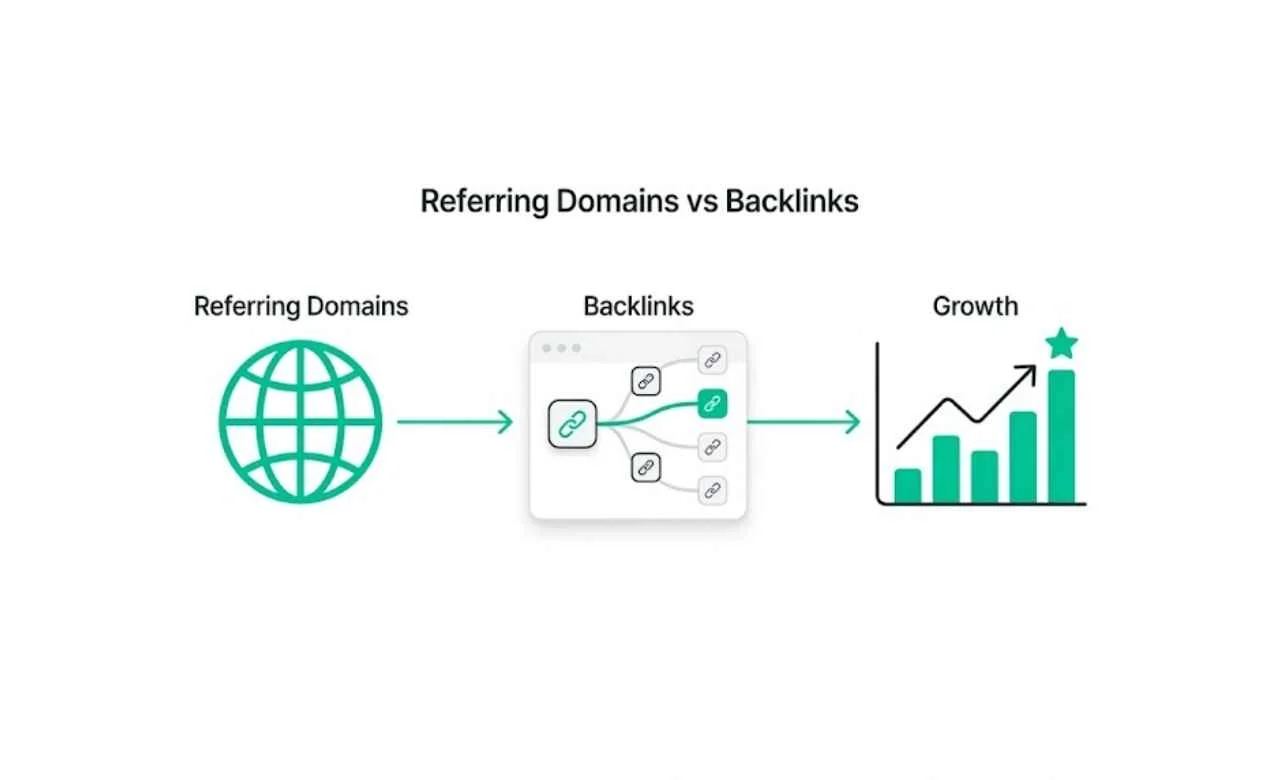
When diagnosing why one URL outranks another on search engine results pages (SERPs), search engine optimization professionals inevitably examine off-page signals. At the epicenter of Google’s foundational PageRank algorithm sits the hyperlink. Yet, modern link analysis frequently trips up practitioners on two foundational metrics: referring domains and backlinks.
Understanding the nuances between these two link metrics is critical. Misinterpreting link profile data can lead to skewed key performance indicators (KPIs), misallocated marketing budgets, and ineffective Referring Domains vs Backlinks link-building campaigns. Whether auditing an existing portfolio, conducting competitor link analysis, or constructing a long-term organic growth strategy, mastering referring websites and inbound links dictates your path to sustainable organic rankings.
What Are Referring Domains in SEO?
A referring domain (also called a linking domain or unique referring domain) is an individual, distinct website that hosts at least one outbound hyperlink pointing to your website.
Regardless of whether that external website links to your domain once, ten times, or five thousand times, search engine crawlers register it as a single referring domain. In technical networking terms, referring domains correspond directly to distinct root domains or unique domain names registered under a specific Top-Level Domain (TLD) or Domain Name System (DNS) entry.
External Website (example.com)
       │
       ├── Link to your /blog/post-1  ──┐
       ├── Link to your /about        ──┼──> Registered as ONE (1) Referring Domain
       └── Link to your /pricing      ──┘
Search engine algorithms treat referring domains as unique institutional entities. If nytimes.com publishes twelve articles across three years that reference your research, your total backlink count climbs by twelve, but your referring domain count from that source remains exactly one.
In Google’s architectural model, unique domains represent independent endorsements. When assessing domain diversity and overall website credibility, search engines measure how many unique voices across the web vouch for your content, rather than simply summing total link instances.
What Are Backlinks and How Do They Work?
A backlink (variously termed an inbound link, incoming link, or external link) is a specific HTML hyperlink located on an external web page that navigates the user and search engine web spiders directly to a target URL on your website.
Backlinks are page-level occurrences constructed using standard anchor tags:
HTML
<a href="https://yourwebsite.com/target-page" rel="dofollow">descriptive anchor text</a>
The Underlying Mechanics: Crawlers and Link Equity
When search bots (such as Googlebot) crawl the web, they discover new documents and re-evaluate established ones by traversing these hyperlinks. Backlinks act as digital conduits that transmit context, authority, and ranking signals between separate URLs.
- Discovery and Indexation: Backlinks serve as fundamental pathways for search bots. A newly published piece of content with zero internal or external links risks becoming an “orphan page.” When high-authority domains link to that asset, web crawlers discover the URL faster and integrate it into the primary search index.
- Transmission of Link Equity: Informally called “link juice,” link equity is the mathematical flow of ranking strength from a source page to a target page. The volume of link equity passed depends heavily on the source page’s Page Authority, the topical relevance of the linking content, the number of other outbound links present on the page, and the link’s technical attributes.
- Anchor Text Context: The clickable text framing the hyperlink gives search engine algorithms explicit semantic clues about the target page’s core subject matter. Balanced anchor text diversity—containing a blend of branded, exact-match, partial-match, and natural contextual phrases—validates topical authority without triggering algorithmic spam filters.
- Rel Attributes (
dofollowvs.nofollow): Standard links pass PageRank directly. Conversely, links flagged withrel="nofollow",rel="sponsored", orrel="ugc"instruct crawlers to treat the link as an unendorsed or paid connection. While Google updated its handling ofrel="nofollow"in 2019 to serve as an algorithmic “hint” rather than a hard directive, standard followed links remain the core vehicle for passing raw link equity.
Referring Domains vs Backlinks: Key Differences
While interconnected, referring domains and backlinks measure fundamentally different dimensions of your off-page profile.
┌─────────────────────────────────────────────────────────────┐
│                    Referring Domain                         │
│                    (Domain Level)                           │
│  ┌───────────────────────────────────────────────────────┐  │
│  │ Backlink 1 (Page A)  Backlink 2 (Page B)  Backlink 3  │  │
│  │                     (Page-Level Instances)            │  │
│  └───────────────────────────────────────────────────────┘  │
└─────────────────────────────────────────────────────────────┘
The difference between referring domains and backlinks boils down to scope, frequency, and algorithmic treatment:
| Evaluation Dimension | Referring Domains | Backlinks |
| Architectural Level | Domain-level metric (root domain or unique hostname) | Page-level metric (individual HTML hyperlink instance) |
| Counting Logic | Counted once per unique domain, irrespective of link volume | Counted incrementally for every single link found across all pages |
| Algorithmic Weight | Primary trust signal for domain authority and brand credibility | Primary contextual signal for granular page authority and relevance |
| Diminishing Returns | Low diminishing returns; each new quality domain adds fresh authority | High diminishing returns when originating repeatedly from the same domain |
| Vulnerability to Manipulation | Difficult to artificially inflate across distinct, aged domains | Easy to inflate artificially (e.g., site-wide footer or sidebar links) |
| Primary SEO Impact | Broad, site-wide organic visibility and competitive domain strength | Target URL keyword rankings, internal link juice distribution, referral traffic |
Referring Domain vs Backlink: A Real-World Example
To see this distinction in practice, consider an industry case study involving an enterprise B2B software company, CloudSecure.io.
Scenario A: The Single-Domain Link Surge
A tech publication, TechDigestHub.com, writes an in-depth review of CloudSecure.io.
- The review includes 3 contextual backlinks within the article body.
- The publication adds
CloudSecure.ioto its sitewide sidebar under “Recommended Cloud Tools,” generating an additional 1,200 links across every blog post and category archive onTechDigestHub.com. - In the footer, an attribution link points to
CloudSecure.io, generating another 1,200 links.
The Metrics:
- Backlink Count: 2,403 backlinks
- Referring Domain Count: 1 referring domain (
TechDigestHub.com)
Scenario B: The Diverse Domain Portfolio
Instead of a sitewide footer placement, CloudSecure.io publishes a research whitepaper on cloud vulnerability benchmarks. Over the next quarter, 30 distinct cybersecurity blogs, industry portals, and university tech departments each link to the whitepaper once or twice in their editorial coverage.
The Metrics:
- Backlink Count: 45 backlinks
- Referring Domain Count: 30 referring domains
Algorithmic Reality
Although Scenario A yielded 2,403 backlinks, search engines quickly recognize those links as originating from a single source host. The first few links pass link equity, but the subsequent 2,400 sitewide links offer sharply diminishing returns.
Conversely, Scenario B provides 30 distinct, independent endorsements from unique Class-C IP blocks across the web. To Google’s core ranking algorithms, Scenario B represents vastly superior domain diversity and trust, resulting in stronger upward pressure on organic search rankings.
Why Referring Domains Matter for SEO
Referring domains serve as one of the most reliable external trust signals in search engine optimization. Here is why the unique referring domain count is critical to your SEO performance:
[Referring Domain Portfolio]
       │
       ├─► Independent Trust Signals (Validates Brand Authority)
       ├─► Mitigates Algorithmic Devaluation (Diversified IP footprints)
       ├─► Builds Topical Footprint (Cross-industry topical consensus)
       └─► Protects Against Volatility (Broad-based link equity distribution)
1. Verification of Independent Consensus
Search engines rely on external verification to determine which content deserves top placement. If only three domains point to your website—even if they generate 10,000 combined backlinks—Google lacks broad consensus on your authority. A high volume of unique domains demonstrates that a wide spectrum of independent publishers, webmasters, and content creators find your content authoritative.
2. High Correlation with Organic Visibility
Every comprehensive industry correlation study (analyzing millions of search results across platforms like Ahrefs, Semrush, and Moz) reveals a direct, linear relationship between the number of quality referring domains and top-tier organic search performance. Sites with broad, varied linking domains consistently outrank those with narrow, repetitive link sources.
3. Protection Against Algorithmic Filtering
Relying on a small pool of domains exposes a site to volatility. If a single domain passing thousands of links gets penalized, de-indexed, or changes its editorial policy to strip outbound links, your backlink profile collapses overnight. A broad distribution of quality referring domains creates a resilient link profile that easily absorbs algorithmic adjustments.
Why Backlinks Matter for Search Rankings
While referring domains establish broad domain authority, individual backlinks handle the specific transmission of contextual link equity to targeted URLs.
1. Granular URL PageRank Allocation
Google calculates PageRank at the individual URL level, not just the root domain level. If you are trying to rank a competitive commercial page such as an enterprise CRM software landing page you need contextual backlinks pointing directly to that specific URL. Ten powerful, page-specific incoming links can elevate a target product page far faster than general homepage links from broad referring domains.
2. Deep Context via Anchor Text and Surrounding Content
Individual backlinks pass nuanced relevance through anchor text and surrounding semantic text. When an author places an editorial link within a paragraph comparing specific software features, the lexical data surrounding that hyperlink clarifies your page’s exact topic. This contextual relevance helps search engines rank the page for long-tail keywords and semantic variations.
3. Referral Traffic and Commercial Value
Beyond pure search engine rankings, backlinks are practical navigation paths for humans. An authoritative backlink placed prominently in a high-traffic editorial post drives qualified referral visitors straight to your conversion funnel. In this context, the quality and placement of the individual link matter far more than aggregate domain metrics.
Can One Referring Domain Give You Multiple Backlinks?
Yes. One referring domain can provide dozens, hundreds, or even thousands of backlinks to your website.
This occurs naturally through several mechanisms:
- Multiple Editorial Mentions: An industry publication frequently references your original research, tools, or commentary across different articles over time.
- Sitewide Hyperlinks: A partner company places your logo or platform link in their global header, sidebar, or footer, instantly generating an inbound link on every indexed URL across their site.
- Syndicated Content: A single media group publishes your guest contribution across hundreds of localized sub-pages or network-wide category archives under the same root domain.
How Google Algorithmically Evaluates Multiple Links from the Same Host
While multiple links from a single domain are completely normal, they follow a law of diminishing marginal returns:
Link Equity Value
 ▲
 │   ┌────────┐
 │   │ Link 1 │ (Maximum PageRank & Trust Passed)
 │   └────────┘
 │        ▼
 │   ┌────────┐
 │   │ Link 2 │ (Moderate Contextual Value)
 │   └────────┘
 │        ▼
 │   ┌────────┐
 │   │ Link 3 │ (Minimal Incremental Equity)
 │   └────────┘
 │        ▼
 │   ┌───────────────────────┐
 │   │ Links 4 to 1,000+     │ (Approaches Zero Incremental Equity)
 │   └───────────────────────┘
 └────────────────────────────────────────────────────────► Time / Link Count
The first followed contextual backlink from an external website passes the largest bolus of link equity and domain-level trust. The second and third links from that same domain continue to pass page-level equity—provided they live on entirely different source pages targeting different URLs on your site—but they do not increase your overall referring domain count.
Once links scale to sitewide placements (thousands of links across navigation menus or footers), Google’s link-processing systems typically collapse them into a single aggregate signal, discounting the redundant instances to prevent anchor text manipulation and PageRank gaming.
Are 100 Backlinks From One Domain Better Than 10 From Different Domains?
In almost every standard SEO scenario: Ten high-quality backlinks from ten different domains are significantly better than 100 backlinks from a single domain.
Option A: 100 Backlinks from 1 Domain
[ Domain A ] ──(x100 Links)──► [ Your Website ]
Result: 1 Vote of Confidence (High redundancy, rapid drop-off in marginal PageRank)

Option B: 10 Backlinks from 10 Different Domains
[ D1 ] [ D2 ] [ D3 ] [ D4 ] [ D5 ] [ D6 ] [ D7 ] [ D8 ] [ D9 ] [ D10 ]
  │      │      │      │      │      │      │      │      │      │
  └──────┴──────┴──────┴──┬───┴──────┴──────┴──────┴──────┴──────┘
                          ▼
                   [ Your Website ]
Result: 10 Independent Votes of Confidence (Broad domain diversity, maximum unique equity)
Why Domain Diversity Outweighs Repetitive Volume
- Diverse Network Validation: Ten independent webmasters choosing to link to your content represents ten distinct editorial decisions. Search algorithms heavily favor this multi-source validation over a single entity linking repeatedly.
- Mitigation of Spam Patterns: Unnatural link-building schemes historically relied on footprint-heavy tactics—such as buying a single blog network site and blasting thousands of sitewide links to a client. Modern algorithms treat massive link spikes from single domains with skepticism unless accompanied by broad natural growth elsewhere.
- Broader Topical Footprint: Ten distinct websites invariably possess varying audiences, content categories, and semantic keyword associations. This distributes link equity across a broader cluster of topics, reinforcing your topical authority across diverse SERP verticals.
The Single Exception
The only scenario where 100 backlinks from one domain could outperform 10 backlinks from distinct domains is when the single domain possesses extraordinary authority and topical alignment (e.g., an active resource section on mit.edu or a major national news desk), while the ten distinct domains are zero-authority, spammy, or completely unrelated scrapers.
When comparing sites of comparable quality and relevance, domain diversity always wins.
Referring Domains vs Backlinks: Which Metric Should You Track?
To run an elite SEO campaign, you must track both metrics concurrently, but through different operational lenses:
┌──────────────────────────────────────┐  ┌──────────────────────────────────────┐
│       Track Referring Domains        │  │           Track Backlinks            │
├──────────────────────────────────────┤  ├──────────────────────────────────────┤
│ • Macro-Level Domain Authority       │  │ • Micro-Level URL PageRank           │
│ • Long-Term Organic Growth Health    │  │ • Granular Anchor Text Distributions │
│ • Competitive Gap Benchmarking       │  │ • Lost Link Recovery & 404 Audits    │
│ • Overall Backlink Profile Diversity │  │ • Referral Traffic Conduits          │
└──────────────────────────────────────┘  └──────────────────────────────────────┘
Prioritize Referring Domains When:
- Benchmarking Domain Competitiveness: Evaluating whether your website has the raw link authority to compete against entrenched industry leaders for broad, high-volume head terms.
- Evaluating Link-Building Campaign Performance: Assessing your digital PR, outreach, or unlinked brand mention efforts. The true KPI of a link-building agency is rarely total backlinks; it is the acquisition of net-new, authoritative referring domains.
- Tracking Velocity and Health: Measuring the steady, organic acquisition rate of unique websites linking to your brand month-over-month.
Prioritize Backlinks When:
- Optimizing Specific High-Value Landing Pages: Monitoring how many contextual links point directly to a core money page or commercial service hub.
- Auditing Anchor Text Ratios: Analyzing exact, partial, and branded anchor text percentages across your entire link profile to evade automated spam penalties.
- Performing Link Maintenance and Technical Audits: Identifying broken inbound links (
404 Not Found), toxic link spikes from scraper networks, or unwanted negative SEO attacks.
How to Check Referring Domains and Backlinks
Auditing and tracking your link profile requires using native webmaster consoles alongside dedicated SEO platforms.
Step 1: Google Search Console (Primary Truth for Indexation)
        └─► Links Report ──► Top Linking Sites (Domains) & Pages (Backlinks)

Step 2: Third-Party SEO Suites (Deep Competitive Intelligence)
        └─► Ahrefs / Semrush / Moz ──► Live/Historic Index, Metrics, Toxicity

Step 3: Execution & Synthesis
        └─► Identify Link Velocity, Domain Authority, Broken Inbound Paths
1. Google Search Console (GSC)
Google Search Console provides the most authentic, first-party view of which links Google has crawled and credited to your property:
- Log in to your GSC property and navigate to the Links report in the left-hand navigation menu.
- Under the External Links module, you will observe two primary analytical panels:
- Top Linked Pages: Shows your individual URLs sorted by total incoming links (Backlink perspective).
- Top Linking Sites: Displays the exact root domains pointing to your property, alongside the specific volume of target pages they link to (Referring Domain perspective).
- Export these tables regularly to capture link data directly from Google’s index.
2. Third-Party SEO Platforms (Ahrefs, Semrush, Moz)
While GSC provides authoritative first-party data, it lacks historical trendlines, competitive intelligence, and third-party authority metrics. Dedicated link checkers bridge this gap:
- Ahrefs Site Explorer: Input any target URL or root domain to view live counts of referring domains, total backlinks, Domain Rating (DR), URL Rating (UR), and historical link velocity charts. You can filter by dofollow/nofollow status, link health, and traffic tiers.
- Semrush Backlink Analytics: Offers comprehensive domain-vs-domain gap tooling, tracking Authority Score (AS), unique referring IPs, toxic link markers, and categorized anchor text profiles.
- Moz Pro Link Explorer: Focuses on Page Authority (PA), Domain Authority (DA), and Moz Spam Score, mapping out linking domain distributions across distinct Class-C networks.
How to Increase the Number of Referring Domains
Acquiring links from brand-new referring domains requires a systematic link-building strategy centered around digital PR, thought leadership, and value creation.
1. Execute Original Research and Data-Driven Assets
High-authority domains link out to verify facts, statistics, and methodology. If your team publishes industry benchmarks, primary consumer surveys, proprietary platform data, or market analysis, journalists and bloggers will naturally reference your data points as an authoritative source.
- Execution: Publish an annual “State of the Industry” report filled with proprietary data points, downloadable charts, and citable statistics. Ensure the asset is indexed and easily discoverable by writers researching statistics in your niche.
2. Digital PR and Proactive Journalist Outreach
Leverage media platforms (such as Connectively/HARO, Featured, SourceBottle, and direct editorial outreach) to serve as a verified subject matter expert for writers facing tight publication deadlines.
- Execution: Monitor daily queries in your vertical. Provide concise, expert commentary without corporate marketing jargon. Securing quotes in tier-one news outlets regularly earns authoritative referring domains that cannot be obtained through standard cold outreach.
3. Competitor Link Gap Interception
Analyze where your primary SERP competitors earn links, identify overlapping referring domains, and pitch superior alternatives.
- Execution: Run a Link Intersect analysis across the top three ranking URLs for your target commercial terms. Identify domains that link to two or more of your competitors, but not to you. Reach out to those editors offering an updated perspective, a functional tool, or more comprehensive resource data.
How to Build High-Quality Backlinks
Building high-quality backlinks demands strict vetting criteria. Prioritizing quality over quantity protects your site from algorithmic link depreciation and manual actions.
High-Quality Backlink Vetting Matrix:
┌──────────────────────────────┬──────────────────────────────┐
│ Topical Relevance            │ High                         │
│ Real Organic Traffic         │ > 1,000 visits/month (Stable)│
│ Link Placement               │ Editorial / In-Content Body  │
│ Outbound Link Profile        │ Natural, Non-Spammy          │
│ Technical Status             │ Clean Dofollow Anchor        │
└──────────────────────────────┴──────────────────────────────┘
The Anatomy of a High-Quality Backlink
- Topical and Contextual Alignment: The linking website must operate within a niche semantically relevant to your business. A backlink from an authoritative culinary site provides negligible link equity and potentially anomalous signals to an industrial automation software vendor.
- Genuine Organic Traffic: Ensure the prospective linking domain receives verified organic search traffic from Google. A domain with an artificially inflated Domain Authority but zero organic visits often indicates an expired domain or a private blog network (PBN).
- Contextual In-Content Placement: Links buried deep in forum threads, user profiles, or site footers carry little value. The gold standard remains an editorial link situated within the primary body text of a thorough, topically aligned article.
White-Hat Tactics for Contextual Backlink Acquisition
- The Broken Link Replacement Technique: Use an SEO crawler to scan authoritative resource hubs in your niche for broken external links (yielding
404 Not Founderrors). Contact the webmaster, alert them to the broken user experience, and suggest your live, comprehensive asset as an immediate replacement. - Unlinked Brand Mention Conversion: Search engines index countless editorial mentions of your brand, software, or executive leadership that fail to include an active hyperlink. Run automated alerts for your brand name, evaluate the context, and politely request the editorial team to convert the plain-text citation into an active resource link.
- Guest Contributions on Curated Platforms: Secure guest editorial slots on reputable industry platforms. Avoid low-quality, open-door guest post farms. Focus on platforms with strict editorial guidelines, real readership, and strict spam filtering.
Read more:How to Do a Backlink Audit: A Step-by-Step Guide to Finding and Fixing Bad Links
Common Mistakes When Analyzing Referring Domains and Backlinks
Even experienced search engine optimization specialists can fall into analytical traps when reviewing link data. Watch out for these common missteps:
1. Fixating Solely on Third-Party Proprietary Scores
Metrics like Domain Authority (Moz), Domain Rating (Ahrefs), and Authority Score (Semrush) are third-party approximations, not native Google ranking factors. Treating these proprietary numbers as absolute truth leads to poor link prospecting. Always evaluate the domain’s real organic search traffic, content quality, and topical relevance first.
2. Treating All Backlinks as Value-Additive
Accumulating tens of thousands of automated, low-tier directory submissions, blog comment links, and web 2.0 profile links harms your site more than it helps. Google’s automated spam-prevention systems (including SpamBrain) easily neutralize non-editorial links, rendering that acquisition investment entirely worthless.
Total Backlink Count (Vanity Metric)
          VS.
Topically Relevant Referring Domains with Active Traffic (Impact Metric)
3. Misdiagnosing Unnatural Link Velocity
A healthy backlink profile expands through a steady, natural link velocity. If a site jumps from 20 referring domains to 1,500 over a weekend—often due to cheap outreach packages or scraper networks—algorithmic filters may flag the activity as anomalous manipulation, triggering deeper scrutiny or ranking suppression.
How Referring Domains and Backlinks Affect Link-Building Strategy
A modern, effective link-building strategy must synchronize domain-level expansion with page-level equity distribution.
                    Comprehensive Link-Building Architecture
                                       │
        ┌──────────────────────────────┴──────────────────────────────┐
        ▼                                                             ▼
[Domain-Level PR / Top-of-Funnel]                             [Targeted Page-Level Content]
• Strategy: Data Studies, Infographics, Digital PR             • Strategy: High-Intent Landing Pages, Comparison Guides
• Objective: Attract Net-New Referring Domains                • Objective: Acquire High-Intent Contextual Backlinks
• Impact: Elevates Overall Domain Authority                   • Impact: Converts Direct Equity into Target URL Rank
        │                                                             │
        └──────────────────────────────┬──────────────────────────────┘
                                       ▼
                       [Strategic Internal Linking]
                • Cascades macro-authority down to mid-tier URLs
                • Controls exact anchor text distribution safely
1. Balance the Upper Funnel and Lower Funnel
Structure your link prospecting to satisfy two distinct demands:
- Top-of-Funnel Link Magnets (Referring Domain Driver): Assets like free utilities, original research reports, and interactive tools naturally attract net-new referring domains at scale.
- Middle-to-Bottom-of-Funnel Assets (Backlink Equity Driver): Commercial service pages, category hubs, and product guides struggle to attract links naturally. Use targeted guest columns, digital PR pitches, and direct outreach to route contextual backlinks directly to these transactional URLs.
2. Leverage Strategic Internal Linking
You cannot easily direct external white-hat backlinks to every single transactional URL on your website. Solve this by funneling your newly earned referring domain equity into high-performing link magnets (e.g., your annual industry report), then deliberately routing that accumulated PageRank down to commercial product pages through contextual internal links. This internal distribution channels external link equity safely across your entire taxonomy.
Referring Domains vs Backlinks: Key Takeaways for SEO
To build an authoritative backlink profile that withstands core updates and dominates Google search rankings, keep these fundamental principles top of mind:
- Referring domains reflect distinct linking websites; backlinks reflect total hyperlink instances. A site with 10,000 backlinks might only have 10 referring domains, which severely limits its overall authority.
- Domain diversity is a critical trust signal. Search engines prioritize multi-source verification. Ten editorial backlinks from ten distinct, authoritative referring domains consistently outperform 100 links generated across a single website.
- Beware the law of diminishing returns. The initial followed contextual backlink from a unique domain transmits substantial link equity; subsequent links from that same domain continue to pass topical relevance and referral traffic, but contribute diminishing incremental domain authority.
- Track the right metrics for the right goals. Use referring domain counts to assess high-level brand authority and competitive gap targets. Use page-specific backlink counts and anchor text distributions to optimize high-intent commercial URLs.
- Prioritize relevance, authority, and organic traffic. A healthy link profile is built on authoritative referring domains with genuine search visibility, natural anchor text diversity, and clean, contextual placements.
Frequently Asked Questions
1. What is the difference between referring domains and backlinks?
A referring domain is a unique website that links to your site, while a backlink is an individual link. One referring domain can create multiple backlinks to your website.
2. Are referring domains more important than backlinks?
They measure different aspects of your backlink profile. Referring domains show the diversity of websites linking to you, while backlinks show the total number of links.
3. Can one referring domain have multiple backlinks?
Yes. A single website can link to your website from many pages, creating multiple backlinks while still counting as one referring domain.
4. How do I check referring domains and backlinks?
SEO tools such as Ahrefs, Semrush, and Google Search Console can help you analyze backlinks and identify websites linking to your domain.
5. How can I increase my referring domains?
Create useful, original content that other websites want to reference, build relevant relationships, contribute valuable guest content, and earn natural links from different authoritative websites
Conclusion
Understanding referring domains vs backlinks helps you analyze your website’s link profile more accurately. Backlinks measure the total number of links pointing to your site, while referring domains measure the number of unique websites providing those links. A strong SEO strategy should focus on earning relevant, high-quality backlinks from diverse and authoritative referring domains, rather than chasing backlink quantity alone.