
Most link building strategies work perfectly until you try to do more of them.
You might be able to earn five quality backlinks a month without much trouble. But when the goal jumps to 20, 30, or even 50 placements, everything can change. Outreach becomes generic, prospect Scale Link Building quality slips, content gets rushed, and your team starts chasing link volume instead of link quality.
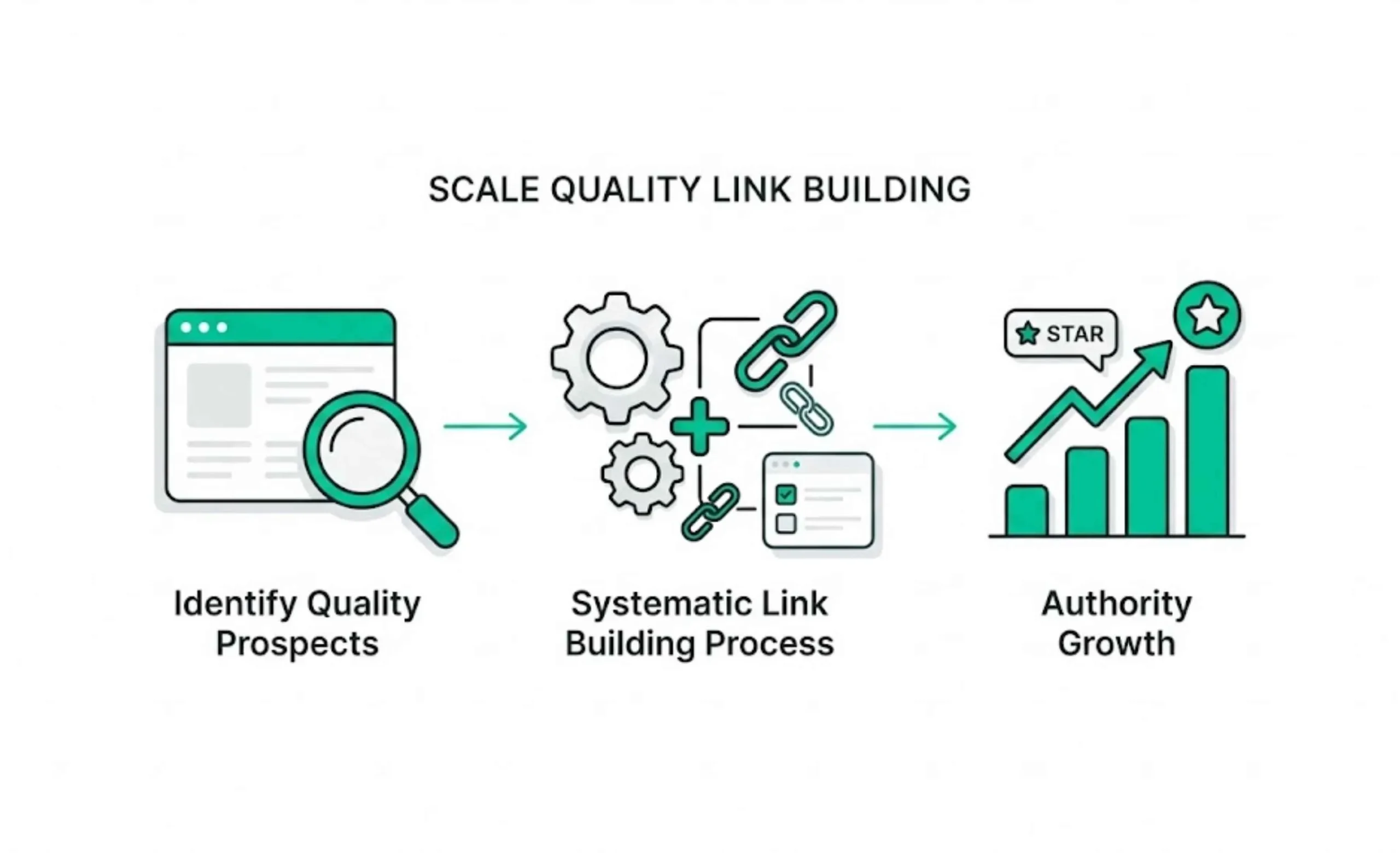
The good news? You can scale link building without turning your campaign into a numbers game. The key is to build a repeatable system that increases capacity while keeping strict standards for relevant websites, useful content, personalized outreach, and high-quality backlinks.
In this guide, you’ll learn how to scale your link building strategy efficiently, identify the bottlenecks holding your campaign back, systematize repetitive tasks, maintain quality control, and measure whether your growing backlink profile is actually producing better SEO results.
What Does Scalable Link Building Actually Look Like?
Scalable link building is a structured approach that allows your team to increase backlink acquisition without a proportional increase in mistakes, low-quality placements, or manual work.
A scalable link building program has several characteristics:
- A documented prospecting process
- Clear website quality standards
- Repeatable outreach workflows
- Defined editorial standards
- Consistent content production
- Personalization rules
- Quality assurance checkpoints
- Reliable reporting
- Clear team responsibilities
- Appropriate automation
- Continuous performance analysis
The difference between ordinary link building and link building at scale isn’t simply the number of backlinks.
It’s the ability to increase link placement volume while keeping the quality of those placements stable.
The scalability equation
Think about your campaign this way:
Scalable link building = Volume × Quality × Relevance × Process Consistency
If you increase volume while quality falls dramatically, you haven’t created a scalable system.
You’ve created a larger problem.
For example, imagine a website earns 10 backlinks per month from highly relevant publications. The team then decides to double output to 20 links.
If the team maintains:
- Similar prospect quality
- Similar topical relevance
- Strong content
- Appropriate anchor text
- Editorial placement standards
- Consistent outreach quality
then the campaign is genuinely scaling.
But if the additional 10 links come from unrelated websites, thin guest-post sites, excessive exact-match anchors, or publishers with obvious spam signals, the campaign is simply increasing link building volume.
That’s an important distinction.
What scalable link building is not
Scalable SEO doesn’t mean:
- Sending thousands of identical emails
- Buying links indiscriminately
- Accepting every website with a high DR
- Publishing AI-generated articles without review
- Using the same anchor text repeatedly
- Chasing backlinks solely because competitors have them
- Measuring success only by the number of links built
A scalable workflow should make your team more efficient without making your judgment weaker.
Why Link Building Quality Drops When You Increase Volume
The biggest challenge in scaling link building is maintaining quality as workload increases.
Most campaigns don’t fail because people suddenly forget how SEO works. They fail because the existing process wasn’t designed for higher volume.
1. Prospecting becomes rushed
When a link building researcher has 500 prospects to review instead of 50, shortcuts become tempting.
A team might check only:
- DR
- Domain authority
- Homepage appearance
and ignore:
- Organic traffic
- Topical relevance
- Indexation
- Content quality
- Traffic trends
- Spam signals
- Outbound link patterns
- Ad density
- Publisher reputation
That creates a larger prospect list but a weaker one.
2. Outreach becomes generic
Personalized outreach takes time.
When outreach volume increases, teams often replace genuine research with:
Hi, I found your website and loved your content…
sent to hundreds of publishers.
The result is predictable: lower outreach response rates, more ignored emails, and fewer qualified placements.
3. Content production becomes a bottleneck
If your campaign requires 40 guest posts per month but your editorial team can reliably produce only 15 high-quality articles, something has to give.
Usually, it’s content quality.
4. Quality assurance gets skipped
At low volume, someone may manually inspect every placement.
At high volume, that same process becomes difficult Scale Link Building unless it’s documented and delegated.
This is why quality assurance must be built into the workflow rather than treated as an optional final step.
5. Teams optimize for the wrong KPI
If a link builder is judged only on:
“How many backlinks did you build?”
they naturally optimize for quantity.
A better performance model considers:
- Qualified placements
- Relevant referring domains
- Average DR
- Traffic quality
- Outreach response rate
- Cost per qualified placement
- Content acceptance rate
- Ranking movement
- Referring domain growth
- Campaign ROI
The goal is to reward useful links, not simply more links.
Build a Repeatable Link Building Workflow Before Scaling
Before you increase link building volume, document the existing process.
You should be able to answer:
- How are prospects found?
- How are prospects qualified?
- Who approves them?
- How are contacts identified?
- How is outreach personalized?
- Who creates content?
- Who reviews content?
- How are links inserted?
- Who verifies placements?
- How are results reported?
If the answer to several of these questions is “it depends,” you’re not ready to scale.
Create a standard operating procedure
A documented link building workflow might look like this:
Step 1: Prospecting
Find relevant websites using competitor backlink research, search operators, industry publications, resource pages, digital PR opportunities, and publisher databases.
Step 2: Qualification
Check traffic, relevance, authority, indexation, content quality, and spam signals.
Step 3: Contact discovery
Find editors, content managers, website owners, or appropriate contributors.
Step 4: Outreach
Send a personalized pitch based on the publication and opportunity.
Step 5: Follow-up
Use controlled follow-up emails rather than unlimited automated messages.
Step 6: Content
Create original, well-researched content that genuinely fits the publication.
Step 7: Editorial review
Check facts, relevance, links, formatting, and editorial standards.
Step 8: Placement
Confirm that the backlink appears naturally within the published content.
Step 9: Verification
Record URL, target page, anchor text, placement date, indexation status, and publisher information.
Step 10: Reporting
Measure backlink quality, referring domain growth, rankings, traffic, and campaign performance.
Build workflow stages
A spreadsheet or project-management system can use statuses such as:
- Prospect identified
- Under review
- Qualified
- Contact found
- Outreach ready
- Outreach sent
- Follow-up 1
- Follow-up 2
- Response received
- Content requested
- Content in production
- Content submitted
- Revision requested
- Approved
- Published
- Placement verified
- Rejected
- Lost
This simple structure makes process consistency much easier.
Identify your bottleneck
Scaling is often a capacity problem.
You might have:
- Enough prospects
- Enough outreach capacity
- Not enough writers
Or:
- Plenty of content
- Plenty of prospects
- Not enough qualified publishers
Find the bottleneck before increasing volume.
Otherwise, you’ll simply push more work into the slowest part of the system.
How to Find and Vet High-Quality Link Building Prospects at Scale
Finding thousands of websites isn’t difficult.
Finding thousands of qualified prospects is much harder.
The objective of prospecting isn’t to create the largest possible Scale Link Building database. It’s to create a reliable pool of relevant websites where a backlink would make sense.
Start with topical relevance
Topical relevance should be one of your first filters.
A backlink from a website closely related to your subject can be more meaningful than a link from a much stronger but completely unrelated domain.
For example, if you’re promoting an SEO software company, relevant prospects could include:
- SEO publications
- Digital marketing blogs
- SaaS publications
- Startup websites
- Marketing agencies
- Business publications
- Technology publications
The exact opportunity depends on the target page and campaign.
Don’t treat DR as quality
Domain rating (DR) can be useful for comparing backlink profiles, but it shouldn’t become your entire quality system.
A website with DR 70 can still have:
- Declining organic traffic
- Poor topical relevance
- Excessive sponsored content
- Hundreds of outbound links
- Thin articles
- Weak editorial standards
Meanwhile, a smaller publication with moderate authority may have excellent relevance, strong readership, and genuine editorial value.
Use authority metrics as one signal, not the final decision.
Build a prospect scoring model
A scalable system can assign points to each prospect.
For example:
| Factor | Suggested Weight |
|---|---|
| Topical relevance | 25 |
| Organic traffic | 20 |
| Content quality | 15 |
| Website authority | 10 |
| Indexation | 10 |
| Editorial quality | 10 |
| Publisher relevance | 5 |
| Spam-risk assessment | 5 |
This isn’t a universal formula. Adjust the weights according to your niche.
The advantage is consistency.
Two link builders should ideally reach similar conclusions when evaluating the same website.
Create a quality checklist
Before a prospect enters your outreach campaign, check:
- Is the website topically relevant?
- Does it receive organic traffic?
- Are important pages indexed?
- Does the site publish original content?
- Does the content appear professionally edited?
- Does it have excessive advertising?
- Does it appear to sell links aggressively?
- Does it contain suspicious outbound links?
- Does the site have obvious spam signals?
- Would the backlink make sense to a real reader?
- Is the publisher relevant to your audience?
This quality checklist is one of the simplest ways to scale backlink acquisition safely.
Use competitor backlinks strategically
Competitor backlink research can reveal:
- Publications
- Resource pages
- Industry blogs
- Guest post opportunities
- Journalist relationships
- Content-driven links
- Partnerships
- Digital PR opportunities
But don’t copy every competitor backlink.
Instead, classify them.
Ask:
“Why did this competitor earn this link?”
Maybe they published original research.
Maybe they created a useful tool.
Maybe a journalist referenced their statistics.
Maybe they contributed expert commentary.
Understanding the reason behind the link gives you a better link building strategy than simply copying URLs.
Create a Content System That Supports Consistent Backlink Acquisition
Content is often the hidden bottleneck behind scalable link building.
You can’t consistently earn high-quality placements without consistently producing useful content.
That means your content workflow needs to scale alongside outreach.
Create reusable content formats
Instead of reinventing every article, develop proven formats such as:
- Expert roundups
- Original research
- Data studies
- Industry guides
- How-to articles
- Expert commentary
- Case studies
- Resource guides
- Statistical articles
- Original frameworks
- Comparison articles
These formats give writers a repeatable structure without forcing them to produce duplicate content.
Build a content brief system
Every article should have a clear brief containing:
- Primary topic
- Search intent
- Target audience
- Recommended angle
- Target keywords
- Supporting keywords
- Internal links
- External references
- Required statistics
- Expert insights
- Word-count range
- Editorial requirements
- Target backlink
- Suggested anchor context
This makes the production process easier to delegate.
Use writers according to specialization
A scalable content team might include:
- Content strategists
- Freelance writers
- Subject matter experts
- Editors
- SEO specialists
- Fact-checkers
You don’t necessarily need all these roles in-house.
But someone must own each responsibility.
Don’t scale content by removing expertise
One of the most common mistakes is assuming that more articles automatically mean more backlinks.
It doesn’t.
Publishers increasingly care about:
- Accuracy
- Originality
- Expertise
- Reader value
- Editorial quality
- Sources
- Useful insights
If content is obviously produced only to place a backlink, acceptance rates can suffer.
Build an editorial approval process
A scalable content system can use three stages:
Stage 1: Writer review
Check structure, research, originality, and completeness.
Stage 2: SEO review
Check search intent, keywords, internal links, and target-page relevance.
Stage 3: Editorial review
Check readability, factual accuracy, tone, formatting, and publisher requirements.
This protects content quality while allowing production volume to increase.
Personalize Outreach Without Slowing Down Your Campaign
The phrase “personalized outreach” is often misunderstood.
Personalization doesn’t mean manually writing every email from scratch.
It means making each message relevant enough that the recipient understands why you’re contacting them.
Use a personalization hierarchy
Not every prospect requires the same level of research.
You can create three levels.
Level 1: Basic personalization
Use:
- Correct name
- Correct publication
- Relevant topic
- Appropriate pitch
Useful for larger campaigns.
Level 2: Content personalization
Reference:
- A recent article
- A specific resource
- An editorial theme
- A content gap
Better for qualified prospects.
Level 3: Deep personalization
For high-value publishers, research:
- Recent articles
- Editorial priorities
- Contributor interests
- Existing coverage
- Audience needs
- Specific content opportunities
Use this for your most valuable targets.
Build modular outreach templates
Instead of one rigid template, create reusable components:
Opening
A genuine observation about the publisher.
Relevance
Why your proposed topic fits their audience.
Value proposition
What useful content or expertise you’re offering.
Credibility
Relevant expertise, research, data, or examples.
CTA
A simple question about whether the topic would be useful.
This gives your team structure while preserving personalization.
Measure response rate by segment
Don’t evaluate all outreach together.
Track response rates for:
- Industry publications
- Blogs
- SaaS websites
- News sites
- Resource pages
- Guest post campaigns
- Digital PR
You may discover that one prospect category produces significantly better results.
Then increase effort there.
Follow-up intelligently
A good follow-up isn’t:
Just following up.
Instead, add value.
For example:
- Clarify the proposed topic
- Offer an alternative angle
- Provide a useful statistic
- Suggest another contributor
- Reference a recent publication
The goal is to improve the outreach response rate, not simply increase the number of emails sent.
Use Link Building Tools to Automate Repetitive Tasks
Automation can make link building at scale much easier.
But automation should remove repetitive administrative work—not replace human quality control.
Tasks worth automating
You can automate or streamline:
- Prospect collection
- Contact organization
- Email scheduling
- Follow-up reminders
- Status updates
- Duplicate detection
- Spreadsheet updates
- Backlink monitoring
- Placement verification
- Reporting
- Task assignment
Tasks that still require human judgment
Avoid fully automating:
- Website quality assessment
- Editorial fit
- Strategic prospect selection
- Final content approval
- Anchor-text decisions
- High-value publisher relationships
- Risk assessment
These decisions benefit from context.
Build a centralized prospect database
Your database should ideally include:
| Field | Purpose |
|---|---|
| Website | Identify prospect |
| URL | Specific opportunity |
| Topic | Determine relevance |
| DR | Authority signal |
| Organic traffic | Visibility signal |
| Contact | Outreach |
| Communication | |
| Status | Workflow tracking |
| Last contact | Follow-up control |
| Target page | Link destination |
| Anchor | Placement tracking |
| Placement URL | Verification |
| Placement date | Reporting |
| Notes | Relationship history |
A structured database prevents your team from repeatedly researching the same sites.
Integrate tools into one workflow
A mature link building program might connect:
Prospecting → CRM → Outreach → Content → Approval → Placement → Monitoring → Reporting
The more cleanly these stages connect, the easier it becomes to expand team capacity.
Set Quality Standards for Every Backlink You Build
If your team doesn’t have a shared definition of a “good backlink,” quality will become subjective.
Document your standards.
A quality backlink should generally have
Topical relevance
The linking website or page should be reasonably related to the subject.
Editorial context
The link should fit naturally within useful content.
Real audience value
The page should provide information readers could genuinely use.
Healthy website signals
The site shouldn’t display obvious spam or manipulation patterns.
Strong content
The surrounding article should meet reasonable editorial standards.
Natural anchor text
Anchors should fit the surrounding sentence and overall backlink profile.
Don’t create arbitrary quality rules
Avoid saying:
“Only accept DR 50+.”
That’s too simplistic.
A better standard might be:
“Prioritize relevant websites with genuine organic visibility, credible content, healthy indexation, and editorially appropriate link opportunities.”
This gives your link building team room to evaluate context.
Create acceptance tiers
You can classify placements as:
Tier A
Highly relevant, trusted, editorial publication with strong audience value.
Tier B
Relevant site with good quality and useful organic visibility.
Tier C
Acceptable but lower-priority opportunity.
Reject
Irrelevant, spammy, manipulated, deindexed, or otherwise unsuitable.
This makes large-scale decision-making easier.
Monitor link quality after publication
A placement isn’t necessarily “done” when it goes live.
Monitor:
- Whether the page remains indexed
- Whether the link remains active
- Whether the page changes
- Whether the website remains healthy
- Whether the link attributes change
- Whether the publication disappears
This is especially important for long-running campaigns.
Choose the Right Link Building Strategy for Your Growth Stage
Not every business needs the same approach.
Your link building strategy should reflect your website’s current authority, content capacity, competition, and resources.
Early-stage websites
Focus on:
- Relevance
- Foundational referring domains
- Industry relationships
- Useful content
- Brand mentions
- Expert contributions
- Smaller publications
The priority is building credibility.
Growing websites
Once your foundation is stronger, expand into:
- Guest posts
- Digital PR
- Data-driven content
- Resource links
- Expert commentary
- Industry publications
- Strategic partnerships
This stage benefits from a more systematic outreach campaign.
Established websites
Larger sites can invest in:
- Enterprise link building
- Digital PR
- Original research
- Journalist relationships
- Industry studies
- Large-scale content campaigns
- Strategic partnerships
At this stage, quality and authority become increasingly important because the site already has significant search visibility.
Competitive niches
In highly competitive industries, don’t simply increase link volume.
Increase the quality and strategic value of your link acquisition.
Ask:
- Which publications influence the industry?
- Which topics attract editorial links?
- What original data can we produce?
- Which experts can contribute?
- Which journalists cover this subject?
- Which competitors are earning high-value links?
That’s how you build sustainable SEO growth.
In-House vs Agency vs Hybrid Link Building: Which Scales Best?
There isn’t one universally best model.
The right choice depends on your team capacity, budget, expertise, and desired control.
In-house link building
In-house link building gives you maximum control.
Advantages include:
- Strong brand knowledge
- Direct communication
- Better internal alignment
- Easier quality control
- Long-term relationship building
The downside is capacity.
You may need to hire:
- Link building researchers
- Outreach specialists
- Content writers
- Editors
- SEO strategists
- Relationship managers
Building the complete team can become expensive.
Agency link building
A link building agency can provide existing systems, relationships, researchers, writers, and outreach specialists.
This can be useful when:
- You need results faster
- Internal hiring is difficult
- You want additional capacity
- You need specialized expertise
However, quality varies significantly between providers.
Don’t choose an agency based only on:
- Price
- Number of links promised
- DR guarantees
- “Guaranteed rankings”
Ask how they qualify prospects, control content quality, manage anchors, and report placements.
Hybrid link building
A hybrid link building model combines internal strategy with external execution.
For example:
Internal team
- Strategy
- Target pages
- Quality standards
- Brand approval
- Reporting
External team
- Prospecting
- Outreach
- Content production
- Follow-ups
- Publisher coordination
This can be an effective approach for companies that want scale without completely outsourcing strategic control.
White-label link building
Agencies may also use white-label link building providers to expand delivery capacity.
If you’re considering this model, quality assurance becomes even more important because multiple layers can exist between your team and the publisher.
Enterprise link building
Large organizations often need:
- Multiple markets
- Multiple websites
- Multiple languages
- Strict approval processes
- Brand compliance
- Legal review
- Larger content operations
Enterprise link building therefore requires stronger systems than simply hiring more link builders.
Track Backlink Quality, Outreach Performance, and SEO Results
You can’t scale what you don’t measure.
But measuring backlinks isn’t as simple as counting them.
Core link building metrics
Track:
- Total backlinks acquired
- New referring domains
- Referring domain growth rate
- Average DR
- Organic traffic of linking sites
- Topical relevance
- Qualified placement rate
- Outreach response rate
- Content acceptance rate
- Guest post acceptance rate
- Cost per qualified placement
- Cost per link
- Link acquisition rate
- Link placement volume
Measure quality, not only quantity
Imagine two campaigns.
Campaign A
- 100 backlinks
- 20 referring domains
- Low relevance
- Low organic visibility
Campaign B
- 40 backlinks
- 35 referring domains
- Strong relevance
- Genuine editorial publications
Campaign B may be far more valuable.
This is why referring domain growth deserves significant attention.
Track ranking movement
Link building isn’t always immediately visible in rankings.
Track:
- Target keyword positions
- Target page rankings
- Organic impressions
- Organic clicks
- Search visibility
- Organic traffic
- Conversion trends
But avoid assuming every ranking improvement was caused by backlinks.
SEO performance is influenced by many variables, including:
- Content quality
- Internal linking
- Technical SEO
- Search intent
- Competition
- Algorithm changes
- Brand demand
- SERP changes
Monitor backlink performance
For important links, track:
Placement date
When did the link go live?
Target page
Which URL receives the backlink?
Anchor text
How was the link referenced?
Indexation
Is the linking page indexed?
Traffic
Does the linking page or site receive meaningful traffic?
Status
Is the backlink still active?
This creates a useful backlink reporting system.
Measure ROI
One of the most important metrics for commercial campaigns is the ROI of link building.
A basic framework is:
Link Building ROI = Incremental SEO/Business Value ÷ Link Building Cost
The exact calculation depends on your business model.
For example, a link that costs more but contributes to a commercially valuable page may be more useful than five cheap links that never produce meaningful results.
How to Scale Link Building Safely Without Creating SEO Risks
The safest approach to scale link building without sacrificing quality is to treat risk management as part of the workflow.
Don’t wait until something goes wrong.
1. Avoid unnatural link patterns
Your backlink profile should develop in a way that makes sense for your industry and website.
Watch:
- Anchor text distribution
- Sudden unexplained spikes
- Large batches of unrelated domains
- Excessive low-quality placements
- Repeated links from similar networks
2. Don’t obsess over link velocity
Link velocity in SEO refers broadly to the rate at which a website gains backlinks.
There is no universal “safe number” of backlinks that every website should acquire per month.
A new site in one industry may naturally earn a few links.
A major newsworthy company could earn thousands in a short period.
So don’t create an arbitrary rule such as:
“Never build more than 20 links per month.”
Instead, evaluate:
- Industry norms
- Existing backlink profile
- Content publishing frequency
- Brand activity
- PR exposure
- Competitive landscape
- Quality of referring domains
The objective is a natural link profile, not an artificial monthly quota.
3. Diversify your acquisition methods
Don’t rely entirely on guest posts.
A strong program can combine:
- Digital PR
- Expert contributions
- Original research
- Resource pages
- Content marketing
- Earned media
- Partnerships
- Industry publications
- Relevant guest posts
- Brand mentions
This diversification makes your backlink profile more robust.
4. Avoid low-quality websites at scale
Large quantities of weak placements can create problems for your brand and SEO strategy.
Watch for sites with:
- No meaningful organic traffic
- Excessive outbound links
- Thin content
- Obvious link-selling behavior
- Irrelevant categories
- Copied articles
- Suspicious publishing patterns
- Poor indexation
- Heavy ad density
- Spam signals
5. Don’t force exact-match anchors
Anchor text should make sense in context.
A healthy strategy usually includes a natural mix of:
- Branded anchors
- Partial-match anchors
- Generic anchors
- Descriptive anchors
- Naked URLs
- Occasional exact-match anchors where genuinely appropriate
The right distribution varies by website and industry.
The important point is to avoid making every placement look engineered around the same keyword.
6. Keep human review in the loop
Automation is powerful.
But operational discipline means knowing where automation should stop.
Use technology for repetitive tasks.
Use humans for:
- Judgment
- Relationships
- Quality control
- Editorial decisions
- Strategic prioritization
That’s one of the most important principles behind sustainable scalable SEO.
How to Build a Scalable Link Building Team
Scaling link building isn’t only an SEO problem.
It’s an organizational problem.
If one person is responsible for prospecting, outreach, content, editing, publishing, and reporting, that person will eventually become the bottleneck.
A specialized team structure
A larger link building team could include:
Link Building Manager
Owns strategy, targets, processes, and quality standards.
Link Building Researcher
Finds and qualifies prospects.
Outreach Specialist
Manages email outreach and publisher communication.
Content Writer
Creates guest posts, expert articles, and supporting content.
Editor
Maintains editorial quality.
SEO Specialist
Maps backlinks to target pages and monitors SEO results.
Relationship Manager
Maintains long-term publisher relationships.
Reporting Specialist
Tracks campaign performance and backlink data.
Not every company needs every role.
Smaller teams can combine responsibilities.
Create ownership for every stage
Each stage should have one clear owner.
For example:
| Workflow Stage | Owner |
|---|---|
| Prospecting | Researcher |
| Qualification | Researcher + Manager |
| Outreach | Outreach Specialist |
| Content brief | SEO Strategist |
| Writing | Writer |
| Editing | Editor |
| Publisher submission | Outreach Specialist |
| Placement verification | Researcher |
| Reporting | SEO Specialist |
This eliminates confusion as the campaign grows.
How to Scale Outreach Without Losing Personalization
A common question is:
How to scale outreach without losing personalization?
The answer is segmentation.
Don’t treat 1,000 prospects as one audience.
Divide them into groups based on:
- Industry
- Website type
- Content topic
- Audience
- Authority
- Relationship stage
- Opportunity type
Then create a message framework for each segment.
Read more: Red flags in link building
Example segmentation
Segment A: Industry publishers
Pitch expert commentary or original research.
Segment B: SaaS blogs
Pitch educational content and data-backed guides.
Segment C: Resource pages
Offer a genuinely useful resource.
Segment D: Journalists
Provide expert insight or original statistics.
Segment E: Existing relationships
Use direct, conversational communication.
This makes your outreach scalable without making it robotic.
How to Scale Quality Link Building Through Publisher Relationships
One of the most overlooked advantages of scaling is relationship management.
A publisher who accepts one strong contribution may accept another later.
Instead of treating every placement as a one-time transaction, build a publisher database.
Track:
- Publisher name
- Website
- Contact
- Topics covered
- Previous placements
- Editorial preferences
- Response history
- Publication dates
- Content requirements
Over time, your team builds an asset that becomes more valuable.
Why relationships improve efficiency
Suppose your team needs 30 placements.
Cold outreach might require hundreds of prospects.
But an established network of trusted publishers can reduce the amount of prospecting needed.
That means your campaign can increase volume while maintaining quality.
This is one of the most sustainable ways to scale backlink acquisition.
How to Use Content Marketing to Earn Links at Scale
Not every backlink needs to come from direct outreach.
The strongest scalable link building campaigns often create assets that naturally attract citations.
Build linkable assets
Examples include:
- Original research
- Industry statistics
- Surveys
- Calculators
- Templates
- Free tools
- Data visualizations
- Comprehensive guides
- Case studies
- Expert studies
- Original frameworks
These assets can support both outreach and earned links.
Combine outreach with content marketing
Suppose you publish a study containing original industry data.
You can:
- Publish the study.
- Identify journalists covering the subject.
- Contact relevant publications.
- Offer expert commentary.
- Share key findings.
- Pitch follow-up articles.
- Repurpose the research into social content.
- Build relationships with publishers.
One strong content asset can therefore support multiple link building efforts.
How AI Can Support Link Building Without Replacing Quality Control
AI can improve the efficiency of a link building campaign when used correctly.
It can help with:
- Prospect categorization
- Email draft generation
- Topic clustering
- Content outlines
- Data organization
- Research summaries
- Follow-up suggestions
- Reporting
- Workflow automation
But AI should not become an excuse to produce thousands of generic articles or spam thousands of publishers.
Use AI as an assistant
A practical model is:
AI handles repetitive analysis → human reviews strategy → expert creates or validates content → editor approves output.
This is particularly important as search evolves toward traditional search results and AI search experiences.
High-quality, original information can support not only organic rankings but potentially visibility in AI citations and answer-based search environments.
The same principle applies:
Create information worth citing.
How Many Backlinks Should You Build Per Month?
There is no universal number.
Anyone who tells every website to build exactly 10, 20, or 100 backlinks every month is oversimplifying SEO.
Your appropriate link acquisition rate depends on:
- Website age
- Existing authority
- Industry
- Competition
- Content production
- Brand popularity
- PR activity
- Existing referring domains
- Available resources
- Quality of opportunities
Instead of asking:
“How many backlinks should I build per month?”
ask:
“How many qualified placements can we acquire while maintaining our quality standards?”
That question leads to a much better scaling strategy.
Example capacity model
Imagine your current system produces:
- 500 prospects
- 200 qualified prospects
- 100 outreach conversations
- 50 content opportunities
- 30 accepted articles
- 25 published placements
If you want 50 placements, don’t simply double outreach.
Find the bottleneck.
Maybe you need:
- Better prospecting
- Better outreach
- More writers
- Faster editing
- More publisher relationships
This is capacity planning rather than blind volume growth.
How to Measure Link Building Success
Successful link building should be evaluated at multiple levels.
Level 1: Operational metrics
Measure:
- Prospects researched
- Qualified prospects
- Emails sent
- Follow-ups
- Responses
- Content assignments
- Articles submitted
- Placements published
These tell you whether the machine is operating.
Level 2: Quality metrics
Measure:
- Average DR
- Topical relevance
- Organic traffic
- Qualified placement rate
- Content quality
- Referring domain quality
- Editorial quality
These tell you whether the machine is producing good outputs.
Level 3: SEO metrics
Measure:
- Ranking movement
- Organic traffic
- Search visibility
- Target keyword performance
- Target page performance
- Referring domain growth
These tell you whether the work is contributing to SEO.
Level 4: Business metrics
Ultimately, connect SEO to:
- Leads
- Sales
- Revenue
- Assisted conversions
- Customer acquisition cost
- ROI
A link building program that produces hundreds of links but no meaningful business impact needs a strategic review.
A Practical Scalable Link Building Framework
Here’s a simplified framework you can implement.
Phase 1: Strategy
Define:
- Target pages
- Target keywords
- Competitors
- Priority topics
- Desired publisher categories
- Quality standards
- Monthly capacity
Phase 2: Prospecting
Build a large database of potential publishers.
Then filter using:
- Relevance
- Traffic
- Authority
- Content quality
- Indexation
- Spam signals
Phase 3: Prioritization
Rank prospects into:
- High priority
- Medium priority
- Low priority
- Reject
Focus your deepest personalization on high-priority publishers.
Phase 4: Outreach
Segment your campaigns.
Use:
- Personalized openings
- Relevant topics
- Clear value propositions
- Appropriate follow-ups
Phase 5: Content
Use structured briefs.
Maintain:
- Originality
- Accuracy
- Expertise
- Relevance
- Editorial quality
Phase 6: Placement
Verify:
- Correct target URL
- Appropriate anchor
- Contextual placement
- Publication quality
- Indexation
Phase 7: Monitoring
Track:
- Backlink status
- Referring domains
- Rankings
- Organic traffic
- Placement quality
Phase 8: Optimization
Analyze what’s working.
Increase investment in:
- High-performing prospect types
- Strong publishers
- Better content formats
- Effective outreach angles
Reduce effort on:
- Low-response segments
- Poor-quality websites
- Expensive placements
- Weak content formats
That’s how a repeatable workflow turns into a genuinely scalable system.
Frequently Asked Questions
What is the 80/20 rule in SEO?
The 80/20 rule means that roughly 20% of your SEO efforts may generate around 80% of your results. In link building, this often means focusing on the most relevant, authoritative opportunities rather than chasing every possible backlink.
Are backlinks still relevant in 2026?
Yes, quality backlinks remain an important part of SEO when they come from relevant, trustworthy websites. However, relevance, editorial value, and overall link quality matter far more than simply increasing backlink volume.
Is link building illegal?
No, link building itself isn’t illegal. However, manipulative practices such as spam, deceptive schemes, or violating search engine guidelines can create SEO risks and potentially harm your site’s visibility.
How to build high quality backlinks in 2026?
Create genuinely useful content, build relationships with relevant publishers, use personalized outreach, and target authoritative websites in your niche. Prioritize relevant and editorially earned links instead of focusing only on link quantity.
Conclusion
The goal of scale link building isn’t to collect the highest possible number of backlinks. It’s to build more quality links without lowering the standards that made your campaign successful in the first place.
Start by identifying your biggest bottleneck, then build systems around prospecting, content production, reporting, and quality control. Keep relationship-driven outreach personalized, invest in the right people or tools, and choose an in-house, agency, or hybrid model that matches your actual volume.
Most importantly, don’t measure growth by links alone. Track backlink quality, topical relevance, outreach response rates, cost per qualified placement, referring domains, and SEO performance. If those metrics remain healthy as your volume increases, you’re scaling the right way.