
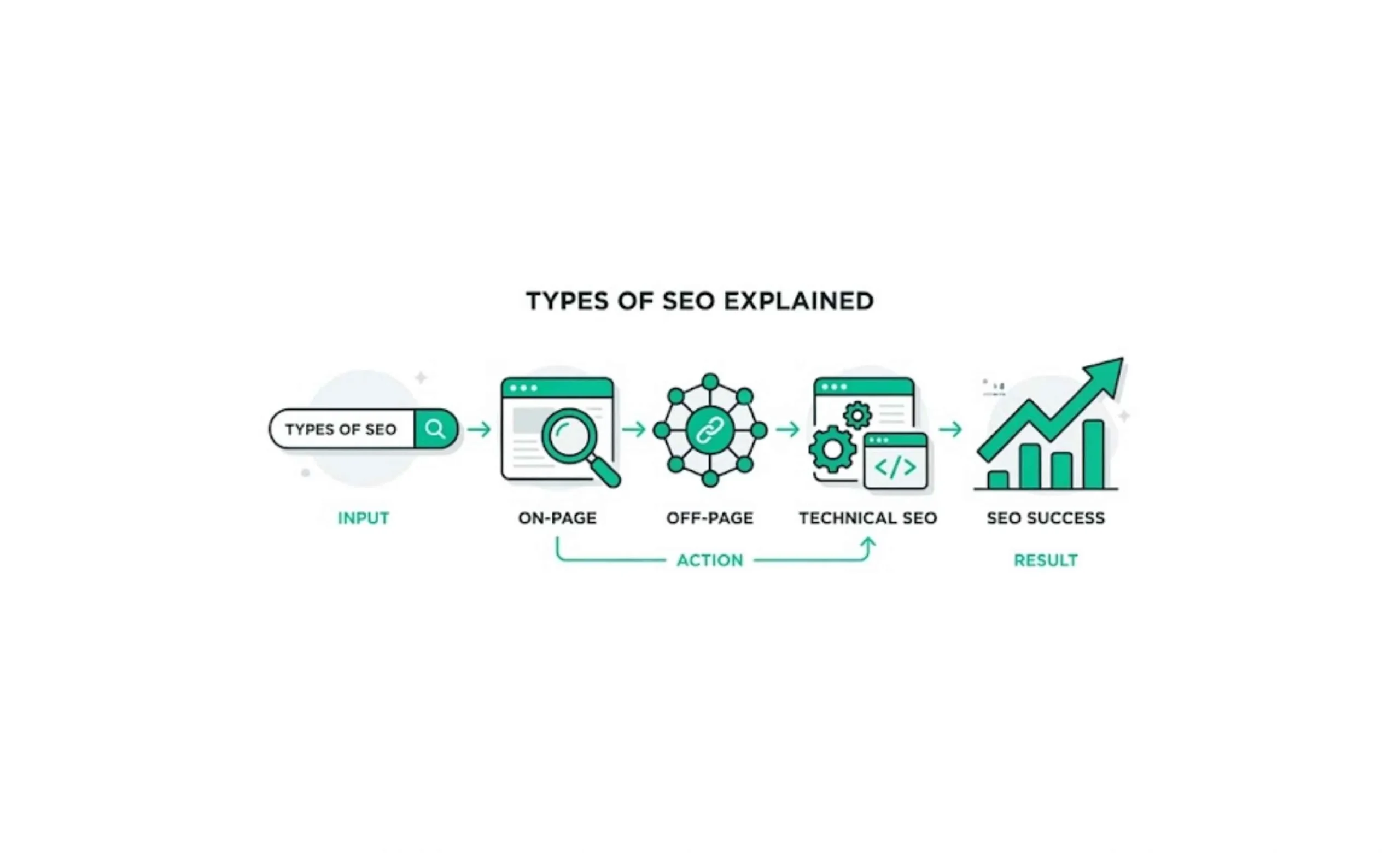
Search Engine Optimization is no longer just about adding keywords and building a few backlinks. Today, understanding the types of SEO is essential if you want to improve search rankings, attract qualified visitors, and build long-term organic growth. From optimizing your content to improving website speed and earning authority, every type of SEO plays a different role in helping search engines understand and rank your website.
In this complete guide, you’ll learn the major SEO types, including On-Page, Off-Page, Technical, Local, Content, and other important types of search engine optimization. We’ll also explain the most effective SEO techniques, how each method works, and when to use them so you can create a stronger SEO strategy and increase your website’s visibility in search results.
Search engine optimization (SEO) is the backbone of organic digital marketing, dictating how brands capture sustainable visibility, acquire qualified leads, and build enduring market authority. With billions of queries submitted to search engines daily, achieving top search engine rankings on search engine results pages (SERPs) demands an understanding of the algorithms that govern Google Search.
Modern search engine optimization is not a singular tactic. Search engine algorithms rely on hundreds of SEO ranking factors, evaluating everything from page experience and site architecture to content depth and backlink equity. Digital marketers and business owners must deploy a multi-layered approach to SEO strategies, combining distinct kinds of SEO to secure sustainable organic search traffic.
12 Types of SEO Optimization
Search engine optimization encompasses a broad set of techniques designed to satisfy varied search intents, technological frameworks, and user contexts. The 12 primary types of SEO include:
- On-Page SEO – Optimization of individual page elements, content, and HTML source code.
- Off-Page SEO – Building external website authority, brand mentions, and backlink profiles.
- Technical SEO – Enhancing crawlability, indexability, site speed, and backend architecture.
- Local SEO – Capturing geographically targeted queries and optimizing Google Maps visibility.
- E-Commerce SEO – Driving discoverability, category structure, and revenue for online stores.
- Video SEO – Optimizing embedded and standalone video assets for SERP video carousels.
- Image SEO – Enhancing image files for visual search, speed optimization, and rich snippets.
- International SEO – Structuring websites for multilingual audiences across global regions.
- Voice SEO – Targeting natural-language, conversational queries on voice-activated devices.
- YouTube SEO – Ranking video content natively within YouTube’s specialized algorithm.
- Social SEO – Optimizing social media profiles and content distribution for discoverability.
- Content SEO – Creating search-intent-aligned, high-quality, comprehensive content.
1. On-Page SEO
On-page SEO involves optimizing individual web pages to rank higher in search engines and attract relevant, organic search traffic. It encompasses all on-site elements you can directly control, from the underlying HTML markup to user-facing content.
Why is On-Page SEO Important?
Search engine crawlers rely on structural and semantic cues to determine page relevance. On-page optimization ensures that search engine algorithms understand your topic, recognize keyword relationships, and deliver pages that resolve specific search intent. Beyond machine interpretation, on-page SEO directly influences click-through rate (CTR), dwell time, and overall user experience. Without structured on-page signals, search engines struggle to index and rank your content effectively.
Elements of On-Page SEO
- Title Tag: The primary HTML title element displayed in SERPs as a clickable headline. It should feature the primary keyword near the beginning and remain under 60 characters to prevent truncation.
- Meta Description: A concise 150–160 character summary that appears beneath the title tag. While not a direct ranking factor, an engaging meta description improves CTR and traffic.
- Header Tags (H1, H2, H3): Structural HTML headings that outline page hierarchy. A single H1 tag defines the core topic, while H2 and H3 subheadings break down contextual subtopics.
- Keyword Optimization & Placement: Strategic placement of primary, secondary, and LSI keywords in titles, introductory paragraphs, headers, and body copy without keyword stuffing.
- High-Quality Content: Comprehensive, original, and search-intent-driven copy that answers user queries thoroughly.
- Internal Linking: Hyperlinks directing visitors to related internal pages, distributing link equity and reinforcing page structure.
- External Links: Outbound links connecting to reputable sources that validate claims and build topical authority.
- Image Optimization & Alt Text: Descriptive alt tags that explain visual media to assistive technologies and search crawlers.
- Page Structure & URL Optimization: Clean, concise URL slugs that clearly indicate content hierarchy.
2. Off-Page SEO
Off-page SEO covers actions taken outside your own website to influence rankings within search engine results pages. It centers on building website authority, trust, and reputation across the broader web.
Elements of Off-Page SEO
- Backlink Building: Securing authoritative inbound links from high-trust domains via digital PR, broken link reclamation, and linkable assets.
- Guest Posting: Writing editorial content for reputable publications to earn contextual backlinks and reach new audiences.
- Brand Mentions: Unlinked and linked mentions across news outlets, forums, and trade journals that signal brand prominence.
- Social Media Engagement: Amplifying content across social platforms to generate shares, likes, comments, and referral traffic.
- Online Reputation Management: Maintaining high ratings, positive customer reviews, and authoritative company profiles across industry directories.
Benefits of Off-Page SEO
- Elevated Domain & Website Authority: Search algorithms view editorial backlinks as third-party votes of confidence.
- Higher Search Engine Rankings: A diverse backlink profile is a strong ranking signal for competitive queries.
- Sustained Referral Traffic: Links placed on high-traffic websites channel qualified prospective buyers directly to your domain.
- Expanded Brand Awareness: Broad digital coverage exposes your company to prospective audiences beyond direct search.
3. Technical SEO
Technical SEO focuses on optimizing the server, code, and infrastructure of a website to help search engine crawlers discover, crawl, render, and index pages efficiently.
Elements of Technical SEO
- Website Speed & Page Speed: Optimizing Core Web Vitals (LCP, INP, CLS) through server response tuning, asset minification, and browser caching.
- Mobile-Friendliness & Mobile Optimization: Adopting a responsive design that adapts smoothly across smartphones and tablets under mobile-first indexing.
- Website Security (SSL Encryption): Enforcing HTTPS via SSL/TLS certificates to protect user data and meet baseline ranking requirements.
- XML Sitemap: Maintaining an updated machine-readable map of all canonical URLs to guide crawler discovery.
- Robots.txt Configuration: Instructing web robots which sections to crawl and which to bypass, conserving crawl budget.
- Site Architecture & Navigation: Establishing a logical, flat internal linking hierarchy where key pages sit within three clicks of the homepage.
- Structured Data Markup (Schema.org): Implementing JSON-LD code to help algorithms interpret entities and display rich snippets on SERPs.
- Canonicalization: Deploying canonical tags (
rel="canonical") to prevent duplicate content issues.
Benefits of Technical SEO
- Flawless Crawlability and Indexability: Eliminates technical roadblocks so search engine crawlers can index every published page.
- Superior Page Experience: Fast loading times and responsive layouts keep bounce rates low and engagement metrics strong.
- Protection Against Algorithmic Penalties: Proper redirect handling and duplicate cleanup protect against index fragmentation.
- Rich SERP Enhancements: Schema implementation enables star ratings, FAQs, and pricing displays in search listings.
4. Local SEO
Local SEO optimizes a business’s online presence to capture foot traffic and geo-targeted queries within specific communities, towns, or metropolitan areas.
Elements of Local SEO
- Google Business Profile (GBP) Optimization: Claiming, verifying, and enriching your GBP with accurate operating categories, hours, photos, and regular updates.
- NAP Consistency: Ensuring your Business Name, Physical Address, and Phone Number match identically across every public directory.
- Local Citations: Securing citations on platforms like Yelp, Apple Maps, Bing Places, and regional business directories.
- Online Reviews & Ratings: Systematically collecting and responding to authentic customer reviews on Google and relevant review aggregators.
- Local Keywords & Localized Content: Integrating neighborhood names, zip codes, and city-specific phrases into website content.
- Local Backlinks: Acquiring links from local chambers of commerce, community newspapers, charity events, and business associations.
Benefits of Local SEO
- Prominence in Local Search Results & Google Maps: Secures placement inside the Google Local Map Pack for high-intent “near me” searches.
- Direct Foot Traffic & Phone Calls: Connects mobile users directly to directions, phone lines, and walk-in locations.
- High Conversion Rates: Local searchers frequently convert within 24 hours of their query.
- Builds Local Community Trust: Prominent reviews establish immediate social proof against competitors.
5. E-Commerce SEO
E-Commerce SEO optimizes an online store to increase product discoverability, drive category-level visibility, and convert browsing shoppers into buyers.
Elements of E-Commerce SEO
- E-Commerce Keyword Research: Uncovering high-intent transactional search terms containing commercial modifiers (e.g., “buy,” “best price,” “discounts”).
- Optimized Category Pages: Structuring category and collection pages with introductory copy, faceted navigation, and internal links.
- Unique Product Descriptions: Writing custom, benefit-focused descriptions for each SKU to prevent supplier duplicate content issues.
- Product Schema Markup: Implementing schema for pricing, stock availability, ratings, and shipping details to generate rich product cards in SERPs.
- User-Friendly URLs: Maintaining short, clean slugs (e.g.,
[store.com/category/product-name](https://store.com/category/product-name)). - Faceted Navigation Handling: Managing dynamic filters via canonical tags or noindex directives to prevent crawl-budget waste.
Benefits of E-Commerce SEO
- Lower Customer Acquisition Costs (CAC): Reduces reliance on paid search and social ads for repeat product traffic.
- Increased Revenue and Sales: Attracts qualified shoppers looking for specific commercial items.
- Better Product Discoverability: Exposes deep inventory to organic search queries.
- Streamlined Customer Experience: Intuitive category architecture helps shoppers locate items quickly.
6. Video SEO
Video SEO optimizes video content to appear in Google search results, Google Video tabs, video carousels, and rich video snippets.
Elements of Video SEO
- Video Title Optimization: Writing clear, keyword-aligned titles that spark curiosity and match search intent.
- Comprehensive Video Description: Drafting detailed descriptions with relevant keywords, chapter timestamps, and contextual summaries.
- Custom Thumbnail Optimization: Designing high-contrast, visually engaging thumbnail images that drive higher CTRs.
- Video Transcripts & Closed Captions: Adding text transcripts and SRT files to help search engines index the spoken dialogue accurately.
- Video Schema Markup (
VideoObject): Embedding structured data containing upload dates, durations, thumbnail URLs, and clip key moments. - Strategic Page Placement: Embedding videos high on the page so search engines recognize them as primary content.
Benefits of Video SEO
- Featured SERP Real Estate: Video carousels stand out among standard blue links on search pages.
- Increased Dwell Time: Embedded videos keep visitors on your website longer, signaling strong engagement.
- Multi-Format Visibility: Expands reach across standard SERPs, video search tabs, and Google Discover feeds.
- Improved Information Delivery: Explains complex concepts visually to suit varying audience preferences.
7. Image SEO
Image SEO involves optimizing images on a website to improve their indexing, rank higher in image search results, and keep page load times fast.
Elements of Image SEO
- Descriptive File Names: Renaming generic files (e.g.,
IMG_001.jpg) to clear, hyphenated keyword descriptions (e.g.,types-of-seo-framework.webp). - Image Alt Text: Writing concise, descriptive alternative text that details image content for screen readers and search bots.
- Image Compression & Sizing: Compressing images using tools like WebP or modern AVIF formats to minimize file weight without degrading visual quality.
- Responsive Images: Using
srcsetand<picture>tags to deliver appropriately sized images based on the user’s screen resolution. - Image Sitemaps: Listing visual media inside XML image sitemaps to accelerate crawler discovery.
- Contextual Placement: Placing images adjacent to relevant body copy to reinforce semantic topical relevance.
Benefits of Image SEO
- Boosted Image Search Traffic: Drives organic traffic from Google Images and visual search tools.
- Faster Page Speed & Core Web Vitals: Lightweight media files reduce Largest Contentful Paint (LCP) times.
- Improved Web Accessibility: Descriptive alt text ensures compliance with WCAG accessibility standards.
- Enhanced Visual Engagement: Relevant imagery breaks up long-form content and improves reader retention.
8. International SEO
International SEO structures a website so search engines can easily identify which countries you want to target and which languages you use for business.
Elements Of International SEO
- Hreflang Tags: Implementing
rel="alternate" hreflang="x"tags to indicate specific languages and geographic variations to search crawlers. - URL Architecture Strategy: Selecting an international domain structure:
- ccTLDs (Country Code Top-Level Domains):
domain.fr,domain.de(strongest local signal, higher maintenance). - Subdirectories:
[domain.com/es/](https://domain.com/es/),[domain.com/de/](https://domain.com/de/)(consolidates domain authority into one root domain). - Subdomains:
fr.domain.com,es.domain.com(flexible hosting, separate indexing profiles).
- ccTLDs (Country Code Top-Level Domains):
- Localized Content & Translation: Creating culturally adapted copy translated by native speakers rather than using unedited automated translations.
- Geotargeting & Local Currency: Displaying regional currencies, address formats, measurement systems, and local support options.
- Regional Hosting & CDNs: Leveraging global Content Delivery Networks (CDNs) to maintain fast server delivery across all target continents.
Benefits of International SEO
- Seamless Global Audience Reach: Directs international searchers to language-appropriate versions of your site.
- Elimination of Duplicate Content Flags: Hreflang attributes tell Google that regional variations (like US vs. UK English) are distinct regional copies.
- Higher Global Conversion Rates: Presenting native languages and local payment options significantly increases checkout completion.
- Competitive Advantage: Captures market share in regions where local search competition may be lower than domestic markets.
9. Voice SEO
Voice SEO focuses on optimizing web content to capture answers spoken by voice-activated devices and virtual assistants like Google Assistant, Apple Siri, and Amazon Alexa.
Elements of Voice SEO
- Natural Language & Conversational Keywords: Targeting long-tail, complete question phrases (who, what, where, when, why, how) used in casual speech.
- Featured Snippets Optimization (“Position Zero”): Formatting definitions, bullet points, and tables that virtual assistants pull from for spoken answers.
- FAQ Sections & Question Headers: Creating dedicated FAQ pages structured around direct user inquiries.
- Local Voice Search Optimization: Maintaining current “open now” hours, addresses, and phone numbers for on-the-go voice queries.
- Concise, Direct Answers: Providing clear answers within 40–50 words immediately following header questions.
Benefits of Voice SEO
- Capture of Spoken Search Results: Virtual assistants typically read out a single result, giving top-ranking answers complete voice visibility.
- Dominance in Featured Snippets: Optimizing for voice improves snippet wins across standard desktop and mobile SERPs.
- Enhanced Mobile Accessibility: Connects with hands-free users searching while driving, cooking, or multitasking.
- Alignment with Modern Search Habits: Natural-language optimization aligns with how searchers interact with AI-driven search models.
10. Youtube SEO
YouTube SEO involves optimizing videos, playlists, descriptions, and channel metadata to rank prominently in YouTube’s native search engine and recommendations.
Elements Of YouTube SEO
- Video Keyword Research: Identifying search phrases users type directly into the YouTube search bar.
- Title & Description Optimization: Writing engaging, keyword-focused titles and descriptions with links, timestamps, and contextual hashtags.
- Custom Thumbnails: Creating branded, clear thumbnails that drive high click-through rates.
- Tags & Categorization: Adding targeted tags to help YouTube classify your video’s niche and topic.
- Transcripts and Closed Captions: Uploading accurate manual SRT files so YouTube can index spoken dialogue.
- Audience Retention & Watch Time Optimization: Structuring videos with hooks and tight editing to maximize view duration and overall watch time.
Benefits of YouTube SEO
- Access to a Massive Video Audience: Optimizes content on the world’s second-largest search platform.
- Cross-Platform Google Visibility: High-ranking YouTube videos frequently secure top positions in Google SERP video carousels.
- Subscriber Growth & Brand Authority: Consistent search optimization drives steady organic channel views and subscribers.
- Long-Term Organic Traffic: Well-optimized YouTube videos continue generating views and leads for years after publication.
11. Social SEO
Social SEO refers to optimizing social media profiles, posts, and video content across platforms like TikTok, LinkedIn, Instagram, and Pinterest so they are discoverable via both in-app search and major web search engines.
Elements Of Social SEO
- Profile & Bio Optimization: Incorporating core industry keywords into account handles, bios, and descriptions.
- Keyword-Driven Captions & Transcripts: Writing captions with relevant search terms and adding on-screen text overlays to short-form video.
- Hashtag Optimization: Using specific, intent-driven hashtags instead of generic tags.
- Content Distribution & Social Signals: Sharing website articles and resources across social channels to drive visits, shares, and brand mentions.
- Link Integration: Adding clean, trackable links within bios, stories, and post bodies to direct referral traffic back to your site.
Benefits of Social SEO
- Brand SERP Real Estate: High-authority social media profiles regularly rank on page one of Google for branded queries.
- Direct Platform Discovery: Captures users who use social apps as search tools for product discovery and reviews.
- Increased Content Amplification: Greater social distribution leads to organic mentions, press coverage, and inbound backlinks.
- Trust & Social Proof: Verified, active social profiles reinforce business legitimacy to prospective customers.
12. Content SEO
Content SEO focuses on planning, writing, structuring, and updating web copy to rank in search engines and satisfy user intent.
Elements of Content SEO
- Comprehensive Keyword Research: Finding primary, secondary, and semantic LSI terms that match audience search queries.
- Search Intent Alignment: Aligning content format and depth with the user’s explicit goal:
- Informational: How-to guides, definitions, and tutorials.
- Commercial Investigation: Comparative reviews and listicles.
- Transactional: Product and checkout pages.
- Navigational: Direct brand portals.
- Structured Readability: Organizing copy using clear header tags, short paragraphs, bulleted lists, callout boxes, and summary tables.
- Topical Depth & Authority: Covering topics thoroughly to demonstrate genuine expertise and satisfy EEAT (Experience, Expertise, Authoritativeness, and Trustworthiness) standards.
- Natural Keyword Integration: Integrating terminology smoothly into titles, intros, and body text without forced repetition or keyword stuffing.
- Content Freshness: Updating statistics, steps, and broken links regularly to maintain search rankings over time.
Read more:What Is SEO
Benefits of Content SEO
- Predictable Organic Traffic: High-quality, informative content attracts consistent organic visits from search engines.
- Featured Snippet Placement: Well-structured answers frequently win Position Zero boxes on search engine results pages.
- Internal Link Equity: In-depth articles serve as hubs to pass link equity to important commercial and product pages.
- Higher Conversion Rates: Content that directly answers customer questions builds trust and guides prospects toward conversions.
Choosing the Right SEO Strategies for Your Website
Implementing search engine optimization effectively requires matching the right types of SEO to your business model, resources, and growth targets:
| Business Type / Primary Goal | Primary SEO Focus Areas | Secondary SEO Strategies |
| Local Service Businesses | Local SEO, On-Page SEO, Content SEO | Voice SEO, Social SEO |
| E-Commerce & Retail | E-Commerce SEO, Technical SEO, Image SEO | Video SEO, Off-Page SEO |
| B2B, SaaS & Enterprise | Content SEO, Technical SEO, Off-Page SEO | YouTube SEO, International SEO |
| Global Media & Publishing | Technical SEO, Content SEO, International SEO | Video SEO, Image SEO, Voice SEO |
Combining technical performance, high-quality content, and off-page authority creates a resilient foundation that improves visibility and drives organic search traffic.
Frequently Asked Questions About SEO
What are the four types of SEO?
The four commonly discussed types are On-Page SEO, Off-Page SEO, Technical SEO, and Local SEO. Together, they cover content, website performance, authority, and location-based visibility.
What are the top 5 SEO tools?
Popular SEO tools include Google Search Console, Google Analytics, Ahrefs, Semrush, and Moz. They can help with keyword research, rankings, backlinks, technical issues, and website performance.
What are the 3 C’s of SEO?
The 3 C’s are commonly described as Content, Code, and Credibility. They represent useful content, a technically sound website, and authority or trust built through quality signals.
What are the 7 types of digital marketing?
Seven common types are SEO, content marketing, social media marketing, email marketing, PPC advertising, affiliate marketing, and influencer marketing. Businesses often combine several of these channels to reach and convert their target audience.
Conclusion
Understanding the different types of SEO is the foundation of a successful search engine optimization strategy. Each type of SEO serves a specific purpose, from improving individual pages with On-Page SEO to building authority through Off-Page SEO and making your website easier for search engines to crawl with Technical SEO.
The best results come from combining the right SEO types rather than relying on a single technique. Whether you’re targeting local customers, growing an online store, publishing content, or reaching an international audience, the right SEO techniques can improve visibility, organic traffic, rankings, and conversions.
By understanding these types of search engine optimization and applying them consistently, you can create a website that is easier for search engines to understand and more valuable for users. SEO is an ongoing process, so continue improving your content, technical performance, authority, and user experience as search behavior evolves.