
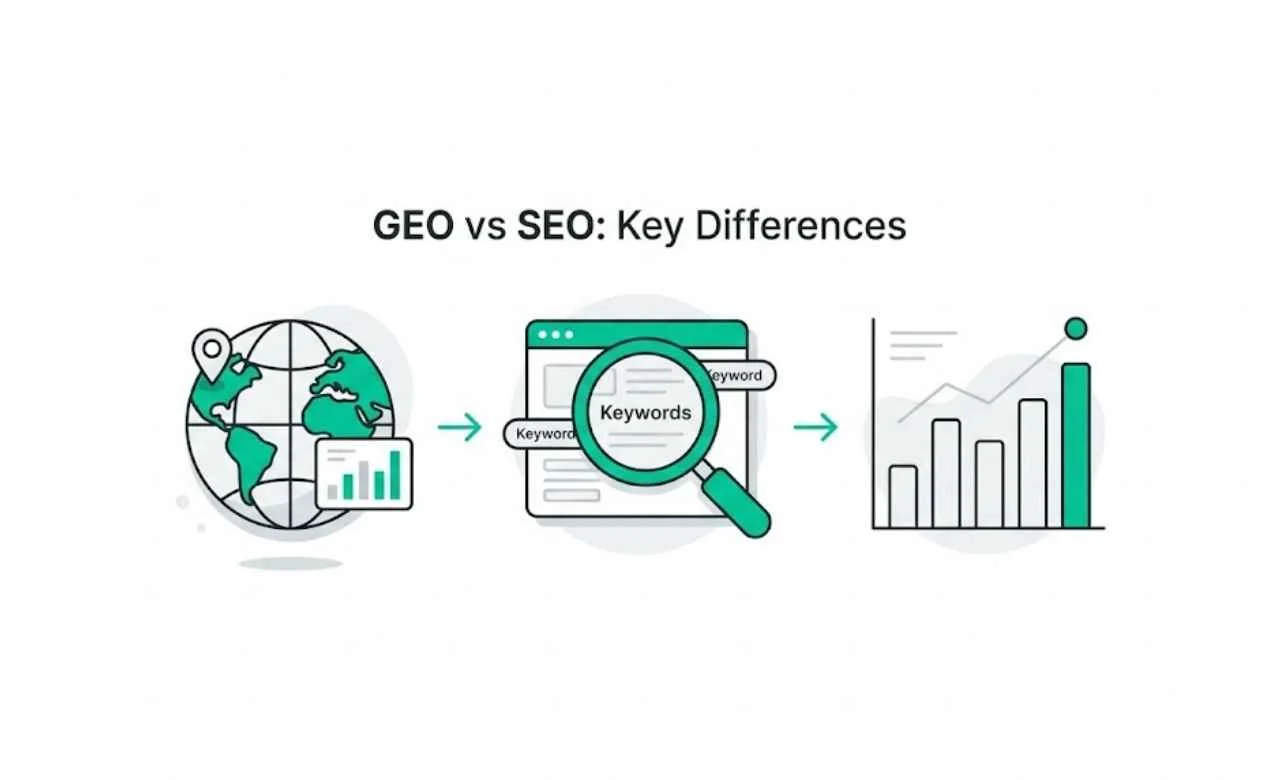
The mechanics of search have fundamentally pivoted. For more than two decades, search engine optimization was governed by a familiar contract: a user typed a fragmented string of keywords into a search bar, an algorithm matched those terms against an inverted web index, and the engine served a list of ten blue links. The website owner’s goal was clear optimize metadata, acquire PageRank through backlinks, align search intent, and capture the top organic click.
Today, that paradigm is being eclipsed by generative search and AI answer engines.
When users query platforms like Google AI Overviews, ChatGPT Search, Perplexity AI, or Microsoft Copilot, they are no longer just looking for a portal to visit; they are demanding a synthesized, conversational answer. In this new ecosystem, simply ranking on page one of Google is no longer the finish line. If an answer engine synthesizes your insights without referencing your brand, your organic visibility evaporates into zero-click searches.
To survive and dominate this landscape, digital marketers, publishers, and enterprise brands must master Generative Engine Optimization (GEO) and Answer Engine Optimization (AEO). The objective is singular: get your website cited by AI.
What Does It Mean to Get Your Website Cited by AI?
Getting cited by AI means that an artificial intelligence platform utilizing a combination of retrieval-augmented generation (RAG) and pre-trained model weights explicitly names, hyper-links, or references your website as an authoritative source in its synthesized response.
In a traditional search engine results page (SERP), visibility means winning real estate among blue links, featured snippets, or local packs. In generative search, visibility takes the form of source attribution. These attributions manifest across various user interfaces:
- Inline Footnotes & Citations: Small numbered anchors or brand pills placed directly after a factual claim (predominant in Perplexity AI and ChatGPT Search).
- Source Cards & Carousels: Visual carousels displayed alongside or directly above synthesized text, showcasing page titles, brand favicons, and direct URLs (such as in Google AI Overviews).
- Direct Entity Mentions: The natural language output explicitly names your publication or study (e.g., “According to a study conducted by [Brand]…”).
+-----------------------------------------------------------------------+
|  User Query: "What is the optimal server architecture for GEO?"       |
+-----------------------------------------------------------------------+
                                  |
                                  v
+-----------------------------------------------------------------------+
|  AI Answer Engine (Retrieval-Augmented Generation / RAG)               |
|  1. Parses conversational prompt & resolves semantic intent           |
|  2. Queries vector/search index for high-confidence candidate chunks  |
|  3. Synthesizes coherent, direct answer across retrieved data         |
+-----------------------------------------------------------------------+
                                  |
            +---------------------+---------------------+
            |                                           |
            v                                           v
+-------------------------------+       +-------------------------------+
|     Synthesized Response      |       |      Source Attribution       |
|  "High-speed edge caching...  |       |  [1] YourDomain.com/geo-guide |
|  reduces TTFB to under 50ms,  | ----> |  [2] CloudArchitecture.org    |
|  enabling LLM web crawlers to |       |  (Direct URLs, Favicons, and  |
|  ingest clean semantic HTML." |       |   Inline Interactive Chips)   |
+-------------------------------+       +-------------------------------+
When your website earns AI citations, you transcend passive indexing. You transition from being an indexed page into becoming a recognized knowledge node.
These citations drive compounding business value. Users who click source links inside an AI-generated answer are rarely casual browsers. They have already consumed an AI-synthesized summary; when they click through to your domain, they are seeking validation, deeper methodologies, actionable tools, or transactional execution. Consequently, AI referral traffic demonstrates significantly higher on-site dwell time, engagement, and conversion intent than legacy search clicks.
Securing website citations by AI also cements your brand’s presence in model training sets and dynamic vector databases, building algorithmic momentum that reinforces your authority across both traditional and generative channels.
Why Do AI Search Engines Cite Websites?
Large language models are probabilistic text prediction engines. At their core, they predict the next most logical token in a sequence based on statistical patterns learned during pre-training. However, this architecture presents critical operational liabilities: knowledge cutoffs and hallucinations.
When an LLM hallucinates, it asserts fictitious claims with syntactic confidence. In casual conversation, a hallucination is an inconvenience; in commercial, medical, financial, or technical search, it destroys platform credibility. AI search engines cite external websites for three structural reasons:
Mitigating Hallucinations via Grounding
To present accurate information, generative engines use grounding mechanisms. Grounding anchors an LLM’s text generation to verifiable, real-world data retrieved dynamically from the live web. When an engine like Perplexity or Google AI Overviews pulls text fragments from external pages into its inference context, it instructs the model to build its output strictly using those retrieved facts. Citing the source provides an auditable paper trail, assuring the user that the answer is anchored in verified data rather than model speculation.
Source Attribution and Legal Compliance
The sustainability of AI answer engines relies heavily on the open web ecosystem. Web publishers produce the primary research, investigative journalism, and analysis that AI models consume. Completely scraping this value without source attribution provokes severe legal, regulatory, and publisher pushback. Citations serve as a digital reciprocity mechanism, providing credit, brand awareness, and referral traffic to content creators while helping platforms navigate fair use doctrines.
Fostering User Trust and Verifiability
Complex, high-stakes queries—particularly those falling into Google’s YMYL (Your Money or Your Life) classifications—require deep verification. Users will not execute financial trades, implement medical protocols, or overhaul software architectures based solely on the word of an anonymous AI interface. Citations empower users to review primary research, inspect author credentials, and verify context directly.
Ultimately, AI search engines cite external domains to enhance the utility, factual accuracy, and safety of their own platforms. They do not cite pages as a favor to publishers; they cite pages because reliable, trustworthy sources protect the integrity of the generative answer.
How Does AI Search Decide Which Websites to Cite?
The algorithmic pipeline behind generative engine optimization diverges sharply from traditional PageRank-dominant search. While backlinks and page speed remain foundational, AI engines rely on semantic parsing, entity mapping, and vector-space evaluations.
                               THE AI CITATION SELECTION PIPELINE

[User Prompt]
      │
      ▼
1. Query Expansion & Decomposition
   ├── Resolves conversational nuance & intent
   └── Generates sub-queries targeting specific knowledge graphs
      │
      ▼
2. Dynamic Search Retrieval
   ├── Crawls real-time web index
   └── Pulls top 30-50 candidate URLs via hybrid search (BM25 + Dense Vectors)
      │
      ▼
3. Content Scraping & Text Chunking
   ├── Strips DOM noise (headers, ads, boilerplate)
   └── Segments text into semantically cohesive passages (chunks)
      │
      ▼
4. Vector Embedding & Cosine Similarity Matching
   ├── Converts passages into high-dimensional vector embeddings
   └── Evaluates cosine distance against the target user prompt
      │
      ▼
5. Reranking via E-E-A-T & Authority Scoring
   ├── Evaluates domain reputation, entity credibility, and consensus
   └── Filters out low-authority or contradictory passages
      │
      ▼
6. In-Context Synthesis & Dynamic Source Attribution
   └── LLM generates final answer, injecting citations directly to selected chunks
Step 1: Query Expansion and Intent Decomposition
AI answer engines do not evaluate queries as static keyword strings. When a query is submitted, the engine decomposes the prompt into semantic sub-intents. For example, a prompt like “Should my SaaS move from AWS to bare metal?” is decomposed into sub-queries evaluating cost thresholds, latency benchmarks, devops overhead, and case studies.
Step 2: Information Retrieval (RAG Pipeline)
The system executes a real-time web search across its index to surface candidate pages. Unlike traditional search, which ranks entire pages, the RAG system ingests the top 30 to 50 search results, strips away DOM noise (navigation menus, sidebars, ad scripts), and converts the body text into discrete semantic chunks (typically 200 to 500 words each).
Step 3: Vector Embeddings and Semantic Proximity
Each text chunk is converted into an embedding a high-dimensional mathematical vector representation of its meaning. The system measures the cosine similarity between the query embedding and the passage embeddings.
Passages that answer the query directly, concisely, and without linguistic fluff achieve higher semantic similarity scores. If your content is buried beneath an overly long narrative or irrelevant introductory prose, the semantic vector gets diluted, degrading its cosine similarity score and eliminating it from the retrieval context.
Step 4: Cross-Referencing and Consensus Verification
Large language models evaluate information consensus. When an engine aggregates content across candidate documents, it cross-references the core assertions. If your site provides an outlier metric that contradicts established industry consensus without supplying verifiable primary research, the model may bypass your page to avoid factual error. Conversely, if your content provides the foundational data point that other authoritative sources cite, your page is tagged as the primary entity origin.
Step 5: Entity Authority and Source Reliability Scoring
Finally, before generating the response, the system applies an authority re-ranking layer. This layer assesses:
- Knowledge Graph Positioning: Does the domain have a verified entity node in Wikidata, Google Knowledge Graph, or industry directories?
- Information Gain: Does this chunk offer new information (original data, distinct quotes, proprietary frameworks) not found in the other candidate documents?
- Topical Focus: Is the domain an authority on this precise entity, or is it a generalist site publishing outside its core expertise?
The chunks that survive this multi-stage pipeline are passed directly into the LLM’s context window. The model synthesizes its response and binds its inline citations directly to the URLs from which those winning chunks were extracted.
Which AI Platforms Can Cite Your Website?
The generative ecosystem is fragmented across multiple platforms, each utilizing distinct retrieval engines, crawling infrastructures, and interface conventions.
| Platform | Primary Retrieval Engine | Target Crawlers | Citation Format | Core Ranking Factors |
| Google AI Overviews | Google Search Core Index | Googlebot | Carousels, inline link cards, text anchors | Top-10 organic ranking, E-E-A-T signals, concise answer blocks |
| ChatGPT Search | Bing Search + OpenAI Web Crawler | OAI-SearchBot, ChatGPT-User | Inline numbered links, source sidebar pills | Semantic similarity, clean markdown headings, factual density |
| Perplexity AI | Hybrid (Perplexity Index + Google/Bing) | PerplexityBot | Numbered bracketed citations [1], side source cards | Real-time freshness, domain consensus, schema markup |
| Microsoft Copilot | Bing Core Index | Bingbot | Numbered interactive footnotes, link cards | Bing web rankings, structured data, indexable clean HTML |
| Claude Search | Integrated Search API partners | Internal Retrieval Bots | Contextual inline links, bracketed attributions | Analytical rigor, comprehensive coverage, clear reasoning chains |
Google AI Overviews (formerly SGE)
Integrated directly into Google’s primary search interface, AI Overviews dominate desktop and mobile SERPs. Because Google’s retrieval infrastructure relies on its massive, continuously updated search index, there is a strong correlation between pages that rank in the top organic results and pages cited in AI Overviews.
However, Google does not merely cite the #1 organic result. It systematically pulls citations from pages ranking across positions 2 through 10 if those pages contain superior semantic extracts, distinct data points, or clear tabular answers.
ChatGPT Search
OpenAI’s search engine shifts ChatGPT from a closed-weights model to an active search engine. ChatGPT Search relies on partnerships with primary index providers (including Bing) combined with OpenAI’s proprietary web crawling infrastructure (OAI-SearchBot).
ChatGPT favors content structured with clean semantic headings, precise definitions, and direct answers that fit cleanly into conversational synthesis.
Perplexity AI
Perplexity functions purely as an answer engine, designed from inception around live-web retrieval and source attribution. It is aggressive in its citation habits, frequently providing multiple citations per paragraph.
Perplexity puts a heavy premium on information density, breaking industry news, academic data, and multi-perspective breakdowns. It prioritizes pages with clear semantic HTML structure and minimal JavaScript bloat.
Microsoft Copilot
Powered by Bing’s foundational search index and OpenAI’s advanced models, Copilot serves corporate enterprise users, Edge browser sessions, and Windows system integrations. To earn citations in Copilot, technical optimization for Bingbot is non-negotiable.
Bing places immense weight on exact entity matches, high-quality backlink anchors, and strict adherence to Schema.org microdata standards.
Claude (Anthropic)
When integrated with web search tools, Claude prioritizes nuanced, highly analytical, and structurally clean long-form documents. Claude’s architecture is exceptionally sensitive to context and reasoning chains, often citing sources that demonstrate deep, multi-variable logic and primary industry documentation rather than basic top-of-funnel summaries.
How Is AI Search Different From Traditional Google Search?
Transitioning from standard SEO to AI SEO requires unlearning several baseline assumptions. While traditional search prioritizes page-level mechanics and keyword densities, AI search operates on passage-level vectors, entity confidence, and synthesis viability.
+-----------------------------------------------------------------------------------+
|                            TRADITIONAL SEO vs. GEO                                |
+-----------------------------------------------------------------------------------+
| Feature               | Traditional Google Search      | Generative Engine Opt.   |
+-----------------------+--------------------------------+--------------------------+
| Optimization Target   | Full webpage / Specific URL    | Discrete passage / Chunk |
| Primary Metric        | SERP rank position (1-10)      | AI citation share / Mentions|
| Keyword Philosophy    | Exact-match & stem frequency   | Semantic context & intent|
| Click Dynamics        | High CTR on top positions      | Zero-click or high intent|
| Content Evaluation    | PageRank, anchor text, UX tags | Consensus, entity data   |
| SERP Real Estate      | Blue links, featured snippets  | Synthesized summaries    |
| Algorithmic Core      | Information Retrieval (IR)     | Retrieval-Augmented Gen. |
+-----------------------------------------------------------------------------------+
Keywords vs. Semantic Vectors
In traditional SEO, pages are built around target keywords, long-tail variants, and keyword density formulas. Content writers strategically inject phrases into H1 tags, meta descriptions, and initial paragraphs to signal relevance to traditional crawling algorithms.
AI search engines bypass keyword strings to evaluate semantic vectors. They analyze the conceptual relationships between entities within your content. An AI engine does not care if you repeat the exact phrase “enterprise cloud cost optimization” six times; it evaluates whether your text analyzes egress charges, reserved instance commitments, multi-tenant billing models, and architectural trade-offs. It seeks conceptual depth, not phrase repetition.
Whole-Page Valuation vs. Passage-Level Extraction
Traditional search engines evaluate a page holistically. If an article features strong Domain Authority, high-quality backlinks, and an engaging layout, the entire URL can rank for dozens of related search queries, even if specific sub-sections are thin.
Generative engines do not cite whole pages; they cite discrete passages. The RAG architecture segments your content into chunks. If your page contains 4,000 words of generic fluff, but features one 150-word section containing an exceptionally clear, mathematically sound breakdown of an industry process, the AI will extract, vectorize, and cite that single passage while discarding the rest of the page.
Conversely, if that brilliant passage is obscured by convoluted grammar or fragmented syntax, the engine will skip it entirely.
Search Intent: Navigation vs. Synthesis
Traditional search intent is categorized into informational, navigational, commercial, and transactional buckets. Users click blue links to browse options, read multiple perspectives, and manually synthesize their own conclusions.
Generative search handles the synthesis for the user. When a user asks an AI engine a complex question, the engine resolves the synthesis within the interface. The only reasons the user clicks a cited source are to:
- Validate an assertion that appears critical or controversial.
- Download a tool, template, dataset, or code snippet.
- Transact or engage with the author behind the expertise.
This fundamentally shifts the objective of content marketing. It is no longer enough to write broad introductory summaries. To earn citations and downstream clicks, your content must provide the high-value foundational data that fuels the AI’s synthesis.
How to Make Your Website Easy for AI to Understand
If an AI engine cannot cleanly crawl, parse, tokenize, and extract the text on your website, it will never cite you. Technical SEO for generative search centers on radical DOM simplification, absolute crawlability, and explicit semantic structure.
Unrestricted Bot Access and Robots.txt Configuration
Many websites inadvertently block the very bots responsible for building AI answers. While you may intentionally block scrapers from training future base models on your proprietary content, you must differentiate between training scrapers and live-retrieval bots.
Ensure your robots.txt file explicitly permits search and retrieval user-agents to crawl your informational assets:
Plaintext
User-agent: Googlebot
Allow: /

User-agent: Bingbot
Allow: /

User-agent: PerplexityBot
Allow: /

User-agent: OAI-SearchBot
Allow: /

User-agent: ChatGPT-User
Allow: /
If you block OAI-SearchBot or PerplexityBot, your domain is immediately excluded from real-time dynamic retrieval in ChatGPT Search and Perplexity, completely eliminating your opportunity for source attribution.
The Perils of Client-Side Rendering (CSR)
Modern web development heavily relies on JavaScript frameworks like React, Next.js (client-side), Vue, and Angular. While search engines like Google have headless browsers capable of rendering JavaScript, client-side rendering creates massive operational friction for AI retrieval pipelines.
RAG engines prioritize speed. When an AI answer engine performs live web retrieval across dozens of potential sources to answer a user prompt in under three seconds, it cannot afford to wait for complex hydration scripts or client-side DOM execution. If your primary content is rendered via client-side JavaScript, the RAG crawler often sees an empty HTML shell, fails to parse any substantive text passages, and excludes your domain from the context window.
- Implement Server-Side Rendering (SSR) or Static Site Generation (SSG): Ensure that the complete textual content of your page is delivered cleanly within the raw initial HTML payload.
- Audit via cURL: Run
curl -A "Mozilla/5.0" [https://yourdomain.com/page](https://yourdomain.com/page)from your terminal. If you do not see your complete article text inside the returned raw HTML string, your site is technically compromised for AI retrieval engines.
Clean Semantic HTML Architecture
AI chunking algorithms rely on standard HTML tags to delineate where one idea ends and another begins. Avoid wrapping your entire document in ambiguous <div> tags. Use explicit semantic HTML:
<article>: Wraps the core informational asset.<header>and<main>: Distinguishes navigation and branding from core content.<h1>,<h2>,<h3>: Establishes strict topical hierarchy. Never skip heading levels (e.g., jumping from an<h1>directly to an<h3>).<p>: Wraps discrete, individual ideas. Avoid mega-paragraphs that span 300 words without a break.<table>: Employs clean<thead>,<tbody>,<tr>,<th>, and<td>tags for tabular data.<ul>and<ol>: Groups related items, process steps, and feature sets.
Structured Data and Schema Markup
Schema markup bridges the gap between unstructured natural language and machine-readable data. By implementing JSON-LD microdata, you explicitly define the entities, relationships, and attributes on your page, mapping them directly into the search engine’s knowledge graph.
To maximize citation viability, deploy comprehensive nested Schema markup:
HTML
<script type="application/ld+json">
{
  "@context": "https://schema.org",
  "@graph": [
    {
      "@type": "Organization",
      "@id": "https://yourdomain.com/#organization",
      "name": "Your Brand Name",
      "url": "https://yourdomain.com",
      "logo": "https://yourdomain.com/assets/logo.png",
      "sameAs": [
        "https://www.wikidata.org/wiki/QXXXXXX",
        "https://twitter.com/yourbrand",
        "https://www.linkedin.com/company/yourbrand"
      ]
    },
    {
      "@type": "Person",
      "@id": "https://yourdomain.com/#author",
      "name": "Jane Doe",
      "jobTitle": "Principal Infrastructure Architect",
      "worksFor": {
        "@id": "https://yourdomain.com/#organization"
      },
      "sameAs": [
        "https://www.linkedin.com/in/janedoe",
        "https://scholar.google.com/citations?user=XXXXXX"
      ]
    },
    {
      "@type": "TechArticle",
      "@id": "https://yourdomain.com/edge-caching-guide/#article",
      "isPartOf": {
        "@type": "WebPage",
        "@id": "https://yourdomain.com/edge-caching-guide/"
      },
      "headline": "High-Performance Edge Caching Architectures for Modern Web Applications",
      "description": "An empirical benchmark and implementation guide analyzing edge caching protocols and their impact on LLM crawlability.",
      "inLanguage": "en-US",
      "mainEntityOfPage": "https://yourdomain.com/edge-caching-guide/",
      "datePublished": "2026-03-15T08:00:00+00:00",
      "dateModified": "2026-09-20T14:30:00+00:00",
      "author": {
        "@id": "https://yourdomain.com/#author"
      },
      "publisher": {
        "@id": "https://yourdomain.com/#organization"
      },
      "about": [
        {
          "@type": "Thing",
          "name": "Content Delivery Network",
          "sameAs": "https://en.wikipedia.org/wiki/Content_delivery_network"
        },
        {
          "@type": "Thing",
          "name": "Retrieval-Augmented Generation",
          "sameAs": "https://en.wikipedia.org/wiki/Retrieval-augmented_generation"
        }
      ]
    }
  ]
}
</script>
By linking your entities directly to authoritative external references like Wikipedia or Wikidata via sameAs arrays, you eliminate entity ambiguity. The engine no longer has to guess what your page is about; the semantic identity is computationally affirmed.
How to Create Content That AI Search Engines Can Cite
AI search engines seek clarity, precision, and information density. Content that is verbose, vague, or filled with marketing buzzwords is routinely bypassed during the vector scoring and re-ranking phases. To make your content consistently citation-worthy, write with structural and factual precision.
The Information Gain Principle
Google holds a patent specifically around calculating Information Gain scores for content. In a generative search ecosystem, this concept is paramount. When an AI engine scrapes the web to answer a user prompt, it often retrieves multiple articles that say the exact same thing using slightly different phrasing.
If your article merely summarizes the existing top five Google search results, your Information Gain score is virtually zero. The AI model has already internalized those common facts from its training data or higher-authority seed pages; it has no incentive to cite your specific URL.
To earn citations, your content must provide novel information:
- Proprietary industry benchmark metrics.
- Unique contrarian viewpoints supported by mathematical or empirical proof.
- Direct case study results with non-public performance figures.
- Original diagrams, frameworks, or process workflows.
When the RAG model identifies a unique data point or a distinct conceptual perspective that does not exist in other candidate chunks, it is forced to cite your page as the exclusive source of that information.
Maximizing Factual Density and Eliminating Fluff
Generative engines prioritize high factual density. Examine these two competing passages explaining cold email deliverability:
Low-Density Passage (Unlikely to be cited):
“Cold email deliverability is something that every modern B2B sales organization really needs to think about carefully. If you don’t take the time to set up your domain the right way, you might find that your emails are going straight into the spam folder, which will completely ruin your sales performance and waste your team’s time.”
High-Density Passage (Prime citation candidate):
“Cold email deliverability relies on three DNS authentication protocols: SPF, DKIM, and DMARC. Maintaining a spam complaint rate below 0.1% (one complaint per 1,000 sent emails) on Google Workspace and Yahoo Mail prevents domain blacklisting. Exceeding a 0.3% threshold triggers automated server-level junk routing.”
The second passage is dense with verifiable entities, exact technical acronyms, quantifiable thresholds, and explicit causality. When an AI answer engine synthesizes a response to the prompt “What are the strict spam complaint thresholds for Google and Yahoo?”, the second passage provides the exact, citable factual extract the model requires.
Writing Answer-First Prose
Adopt the inverted pyramid journalistic format across every single section of your content. Lead with the direct answer, conclusion, or data point in the very first sentence beneath an H2 or H3 heading.
Follow this structural formula for informational sections:
- Sentence 1 (The Direct Answer): State the core fact, definition, or solution without introductory caveats.
- Sentences 2–3 (The Mechanics / Proof): Explain how or why that fact functions, citing specific variables or technical mechanisms.
- Sentences 4–5 (The Context / Nuance): Highlight edge cases, performance trade-offs, or direct real-world implications.
When your content is organized this way, the chunking algorithm extracts a clean, self-contained semantic block that drops into an LLM’s synthesis context without requiring linguistic editing.
How to Build Topical Authority for AI Search
AI models operate on probabilistic trust. If a website publishes content about real estate investing, cryptocurrency trading, enterprise software architecture, and fitness regimes all on the same domain, its topical authority is fractured. The engine cannot establish high confidence regarding the domain’s core area of expertise.
To win generative search citations, you must construct an unshakeable fortress of topical authority.
Comprehensive Semantic Cluster Architecture
Topical authority is achieved when your domain completely answers every primary, secondary, and tertiary question surrounding a specific subject matter. This requires building rigorous content topic clusters.
                      TOPICAL CLUSTER ARCHITECTURE

                      +--------------------------+
                      |       PILLAR PAGE        |
                      |  Enterprise Cloud Security|
                      +--------------------------+
                                   │
         ┌─────────────────────────┼─────────────────────────┐
         │                         │                         │
         ▼                         ▼                         ▼
+-----------------+       +-----------------+       +-----------------+
|   CLUSTER 1     |       |   CLUSTER 2     |       |   CLUSTER 3     |
| Zero-Trust IAM  |       | Kubernetes Pod  |       | Egress Traffic  |
| Implementation  |       | Security Policy |       | Monitoring & DLP|
+-----------------+       +-----------------+       +-----------------+
         │                         │                         │
         └─────────────────────────┼─────────────────────────┘
                                   │
                                   ▼
                      +--------------------------+
                      |   BIDIRECTIONAL LINKS    |
                      | Contextual Semantic Ties |
                      | Exact Entity Anchor Text |
                      +--------------------------+
If your objective is to be cited as the definitive source for “API Rate Limiting Strategies,” you cannot publish a single standalone guide. You must construct an interlinked repository covering:
- Token Bucket vs. Leaky Bucket algorithms (mathematical breakdowns).
- Redis-backed distributed rate limiting architectures.
- HTTP 429 status code handling and exponential backoff implementation.
- Security mitigation strategies against Layer 7 DDoS attacks.
- Rate limiting configurations across AWS API Gateway, NGINX, and Cloudflare.
By covering every facet of the topic, you demonstrate complete topical coverage. When an AI search engine evaluates its knowledge graph, your domain’s entity node is programmatically bound to the parent concept.
Semantic Internal Linking and Entity Anchors
Internal linking is not merely an avenue for distributing PageRank; it is the structural scaffolding that communicates conceptual relationships to AI crawlers.
- Avoid Generic Anchor Text: Never use anchor text like “click here,” “read this post,” or “learn more.” These phrases convey zero semantic information to an embedding model.
- Use Exact Entity Anchors: Use rich, descriptive anchor text that names the target page’s core entity (e.g., “Read our benchmark on [distributed Redis token bucket latency] to analyze edge performance”).
- Establish Bidirectional Topical Loops: Ensure that cluster child pages link back to the core pillar page, and that sibling cluster pages link contextually to one another where logical dependencies exist.
This internal linking structure maps your site’s architecture to mirror an AI’s internal knowledge representation, ensuring that crawlers traverse and index your content repository without hitting dead ends.
How to Use First-Hand Expertise and Original Data
Large language models are pre-trained on billions of words of scraped web text. As a consequence, common knowledge has effectively zero computational value. An AI already knows what an API is, how a firewall functions, or what the basic definition of ROI entails.
To become citation-worthy, you must provide what an LLM does not possess: first-hand experience, empirical data, and original human observation.
+-----------------------------------------------------------------------+
|                 WHAT MAKES CONTENT CITATION-WORTHY?                   |
+-----------------------------------------------------------------------+
|  COMMODITY CONTENT (Ignored by AI)    ORIGINAL RESEARCH (Cited by AI) |
|  - Summaries of existing articles     - Proprietary platform metrics   |
|  - Generic "What is X" definitions    - Rigorous A/B test methodologies|
|  - Broad, non-attributed advice       - Hard benchmarks & failure data|
|  - Stock illustrative examples        - Direct expert practitioner POV |
+-----------------------------------------------------------------------+
The Power of Proprietary Industry Benchmarks
Publishing original research is the single most reliable strategy for acquiring automated AI citations at scale. When you release an industry report containing unique data points, other authoritative websites naturally cite your findings, building a powerful footprint of backlinks and brand mentions.
More importantly, AI answer engines identify your URL as the singular origin of those specific statistics:
- Survey Your User Base: Aggregate anonymized platform usage metrics, conversion performance data, or user behavior trends.
- Quantify the Findings: Do not make vague assertions like “Most engineers struggle with microservices.” State exact metrics: “Our analysis of 450 enterprise engineering teams revealed that 68% experienced a minimum 40% increase in network debugging time after migrating to microservices.”
- Isolate the Metrics in Clean UI Blocks: Present key metrics in clean, visually distinct callout boxes or tables. When an AI engine needs to answer “What percentage of engineering teams struggle with microservice debugging?”, your site is the only domain with the grounded statistical answer.
Documenting Real-World Case Studies and Operational Failures
AI models are inundated with theoretical advice. What is scarce across the web is deep, unvarnished documentation of real-world implementation, edge cases, and catastrophic failures.
Document explicit operational workflows:
- Include sanitized architecture diagrams, configuration files, and code snippets.
- Document the precise metrics before and after an intervention (e.g., “How we reduced AWS Aurora read latency from 45ms to 8ms using Redis read-through caching”).
- Discuss what failed during the process. LLMs heavily value nuanced discussions of trade-offs, performance penalties, and technical constraints, as this reflects genuine human expertise rather than superficial marketing copy.
Read more:How to Rank in Google AI Overviews: A Complete SEO Guide for 2026
How to Structure Content for AI Citations
Content formatting directly determines whether an extracted passage survives the vector search and synthesis process. Content structured as dense walls of text is difficult for chunking algorithms to cleanly isolate. To optimize for AI extraction, format your content for structural clarity.
The Semantic Heading Hierarchy
Structure your content with a logical, nested outline. Treat headings not as visual styling elements, but as programmatic containers that define the topic of the text beneath them.
Markdown
# Pillar Topic: Complete System Architecture (H1)
## Authentication & Authorization Protocols (H2)
### Implementing OAuth 2.0 with PKCE (H3)
#### Token Storage Best Practices: Memory vs. LocalStorage (H4)
Never allow a heading to exist without substantive content directly beneath it. Every sub-heading must be followed immediately by a direct answer or definition before branching into contextual explanations.
High-Density Comparison Tables
AI engines frequently synthesize direct comparisons between products, architectures, methodologies, or protocols. Tables formatted in clean semantic HTML are high-value extraction targets for AI Overviews and ChatGPT Search.
Markdown
| Evaluation Metric | Client-Side Rendering (CSR) | Server-Side Rendering (SSR) | Static Site Generation (SSG) |
| :--- | :--- | :--- | :--- |
| **Initial TTFB** | High (50ms - 150ms) | Moderate (200ms - 500ms) | Low (< 50ms at Edge) |
| **AI Crawler Parsing Risk** | Extreme (Blank HTML Shell) | Zero (Complete HTML Delivered) | Zero (Pre-rendered Static HTML) |
| **Hydration Overhead** | Significant Browser CPU Load | Moderate Client Rehydration | Minimal / Island Dependent |
| **Hosting Complexity** | Static Storage (S3 / CDN) | Dynamic Node.js/Go Containers | Static Global Edge Network |
When a user asks Perplexity or Google AI Overviews to “Compare CSR vs SSR vs SSG for AI web crawlers”, the engine can extract this table directly and project it into the synthesized response, citing your domain beneath the asset.
Bulleted and Numbered Process Lists
When documenting step-by-step procedures, workflows, or programmatic implementations, always use clean ordered lists. Numbered lists communicate sequential dependence, while bulleted lists communicate grouped feature sets.
- Keep list items focused on a single actionable step.
- Bold the primary entity or action at the beginning of each list item.
- Ensure that the lead-in sentence to the list explicitly defines the scope of the items beneath it.
How Backlinks and Mentions Help With AI Visibility
In traditional SEO, backlinks are treated primarily as conduits of PageRank. The more high-authority links pointing to a URL, the higher that URL climbs in organic rankings.
In Generative Engine Optimization, backlinks and mentions serve an expanded, highly sophisticated role: they establish entity authority, cross-document consensus, and vector trust.
The Evolution of Link Value in AI Search
Traditional search algorithms can be gamed through manipulative link-building networks, private blog networks (PBNs), and paid link schemes that artificially inflate PageRank.
AI search engines mitigate this by applying natural language processing to the link context itself. When an AI crawler evaluates a backlink pointing to your site, it analyzes:
- Contextual Semantic Proximity: What is the subject matter of the linking article? Does it share deep semantic vector proximity with your domain’s primary entities?
- Anchor Text Descriptive Realism: Are the anchors natural, entity-rich citations, or are they spammy exact-match commercial keywords?
- Editorial Citation Sentiment: How does the author refer to your brand? Are you referenced as the primary authority, an innovative benchmark study, or an example of a system vulnerability?
TRADITIONAL SEO BACKLINK EVALUATION:
[Domain A (DR 85)] ──────(Follow Link with Anchor)──────> [Your Website]
Result: PageRank transferred; rankings increase.

AI / GEO VECTOR TRUST EVALUATION:
[Domain A (High-Authority Context)]
   │
   ├─ Evaluates surrounding text: "According to a benchmark run by [Your Brand]..."
   ├─ Extracts entity association: [Your Brand] = [High-Performance Caching]
   └─ Cross-references against Knowledge Graph & Digital PR Footprint
Result: Entity confidence validated; brand is prioritized for dynamic AI source attribution.
Unlinked Brand Mentions and Digital PR
One of the most profound shifts in AI SEO is the elevation of unlinked brand mentions.
Traditional search engines struggle to assign PageRank value to a brand name that appears on an external website without an active HTML hyperlink. AI models, however, are language models. They read and process the entire web text natively.
When your brand is mentioned across major industry publications, trade journals, podcast transcripts, and tech forums, the AI registers these occurrences as positive entity validation signals.
If your brand is consistently named alongside industry leaders in discussions regarding “API Security,” the model associates your entity vector with the API Security vector. When an AI engine constructs an answer about top API security solutions, it can retrieve and cite your brand based entirely on the widespread consensus reflected across those unlinked citations.
To build this presence:
- Execute Strategic Digital PR: Pitch original research and proprietary datasets to high-tier industry journalists.
- Secure Podcast and Video Interviews: Video and audio transcripts are indexed and tokenized by major search engines. Speaking on reputable industry podcasts injects your entity name into multi-modal training sets.
- Engage in High-Authority Industry Communities: Participate meaningfully in developer forums, GitHub repositories, Reddit technical communities, and Stack Overflow discussions. AI search engines heavily crawl and retrieve answers from community discussions when addressing real-world problem-solving queries.
How to Optimize Your Website for Google AI Overviews and ChatGPT
While the fundamental rules of Generative Engine Optimization apply across platforms, Google AI Overviews and ChatGPT Search feature distinct algorithmic priorities. Winning citations across both requires platform-specific operational tactics.
Strategic Optimization for Google AI Overviews
Google AI Overviews is inextricably linked to Google’s core ranking infrastructure. To be cited in an AI Overview:
- Secure Page-One Organic Footing: While Google can pull citations from deeper in its index, studies indicate that over 80% of AI Overview citations originate from domains ranking within the top 10 organic search results for that query or its semantic variants. Core technical SEO, fast page loads, and organic authority remain prerequisite hurdles.
- Target the “Featured Snippet” Zone: Content that is formatted to win traditional featured snippets (40–60 word definitional paragraphs directly beneath an
H2heading) is routinely ingested by Google’s Gemini-powered retrieval agents to form the baseline summary of the AI Overview. - Implement Direct Entity Answering: Match the specific phrasing of the user’s conversational sub-queries. Use heading structures that mirror long-tail questions, such as: “How does Redis handle cache invalidation at scale?” followed immediately by an unambiguous, step-by-step technical explanation.
Strategic Optimization for ChatGPT Search
ChatGPT Search places a premium on neutral, journalistic language, logical argumentation, and clean programmatic data ingestion:
- Maintain Strict NPOV (Neutral Point of View): Content written in breathless marketing prose (“We offer the absolute best, most revolutionary platform on the market”) is routinely ignored. ChatGPT’s reward modeling favors objective, balanced analyses that candidly discuss the pros, cons, and performance constraints of various solutions.
- Adopt Clean Markdown Compatibility: Structure your articles so that if you were to convert the entire HTML page into raw Markdown, it would retain clear semantic meaning. Use blockquotes for definitions, bold text for key terminology, and clean hyphens for unordered lists.
- Optimize for Conversational Multi-Turn Inquiries: ChatGPT users engage in multi-turn dialogues. They rarely ask a single question; they ask a question, receive an answer, and immediately follow up with: “What are the trade-offs of that approach?” or “Can you give me an example of how that works in production?” Build your content to answer these natural follow-up questions sequentially down the page.
How to Improve Your Website’s E-E-A-T Signals
Google’s Search Quality Rater Guidelines heavily emphasize E-E-A-T: Experience, Expertise, Authoritativeness, and Trustworthiness. In generative search, E-E-A-T signals serve as the primary algorithmic filter preventing low-quality, AI-generated junk from infiltrating the RAG context window.
                      THE E-E-A-T TRUST PYRAMID FOR GEO

                                  ▲
                                 / \
                                /   \
                               /  T  \
                              / TRUST \
                             /─────────\
                            /     A     \
                           /  AUTHORITY  \
                          /───────────────\
                         /     E     E     \
                        / EXPERIENCE EXPERTISE\
                       /───────────────────────\
Proving Direct Experience
Experience demonstrates that the author has practically used the tool, walked the ground, executed the strategy, or built the code being discussed.
- Integrate First-Person Operational Proof: Use phrases like “During our three-month stress test of the cluster…” or “In our production migration, we encountered an undocumented race condition…”
- Show Original Visual Evidence: Replace generic stock photography with original screenshots, step-by-step interface captures, system terminal logs, and proprietary data visualizations. AI multimodal models read and interpret images; original, context-rich visual evidence validates that the author executed the work first-hand.
Establishing Unquestioned Author Expertise
AI engines evaluate the specific humans writing the content. Anonymous articles or generic “Admin” bylines are significant liabilities in competitive verticals.
- Dedicated, Rich Author Profile Pages: Build standalone author pages on your domain. Detail the author’s professional history, academic credentials, industry publications, speaking engagements, and direct accomplishments.
- Cross-Link Social and Professional Graph Nodes: Within the author profile and the JSON-LD schema, link explicitly to the author’s LinkedIn profile, X account, GitHub repository, and Google Scholar profile using
sameAsarrays. - Author Byline Entity Association: Ensure every article features a visible byline that links to the author page, complete with a concise summary of their credentials directly beneath the article title.
Solidifying Domain Authoritativeness and Trust
Trust is the ultimate arbiter of whether an AI answer engine will display your citation to a user.
- Transparent Editorial Policies: Publish clear, accessible pages detailing your editorial methodology, primary research guidelines, conflict-of-interest disclaimers, and factual correction protocols.
- Exhaustive Source Attribution and Outbound Linking: Don’t hesitate to link out to other non-competing authoritative sources. Linking out to primary research, academic papers, and official documentation signals to the AI crawler that your content is thoroughly researched and embedded within the established network of domain knowledge.
- HTTPS and Flawless Technical Hygiene: Security vulnerabilities, mixed-content warnings, broken redirects, and slow server response times erode domain-level trust scores, signaling an unmaintained digital property.
How to Track AI Citations and Measure GEO Performance
Optimizing for generative search without tracking your performance is flying blind. However, traditional analytics tools like Google Analytics 4 (GA4) and Google Search Console (GSC) were architected for an era of blue links and standard organic click-through rates. Measuring GEO performance requires a modernized tracking stack.
+-------------------------------------------------------------------------------+
|                       THE GEO MEASUREMENT FRAMEWORK                           |
+-------------------------------------------------------------------------------+
| Metric Category        | Primary Measurement Method   | Core Tools            |
+------------------------+------------------------------+-----------------------+
| Direct Referral Traffic| Regex Referrer Tracking      | GA4, Plausible, Fathom|
| Share of Model (SoM)   | Automated Prompt Scraping    | Custom API / Platforms|
| Citation Frequency     | Footnote & Link Extraction   | GEO Tracking Suites   |
| Entity Brand Sentiment | Semantic Sentiment Scoring   | NLP Analysis Scripts  |
+-------------------------------------------------------------------------------+
Tracking AI Referral Traffic in GA4
When a user clicks a citation link inside ChatGPT Search, Perplexity, or Microsoft Copilot, that visit is captured in your analytics platform. However, if not configured properly, this traffic often gets miscategorized as generic “Direct” traffic or lumped into standard organic channels.
To isolate generative engine traffic, build custom channel groups or filter your Traffic Acquisition reports using specific source/medium regex parameters.
Configure a custom regex filter within GA4 to identify incoming AI referrers:
Code snippet
.*(perplexity\.ai|chatgpt\.com|openai\.com|copilot\.microsoft\.com|android-app:\/\/com\.google\.android\.googlequicksearchbox).*
Isolate these referrers to monitor engagement metrics:
- Pages Per Session: AI visitors typically navigate to secondary resources if your initial page proves authoritative.
- Average Engagement Time: Benchmark AI referral dwell time against standard organic search traffic.
- Conversion Rate: Track how effectively AI visitors complete transactional funnels (newsletter signups, whitepaper downloads, product demos).
Measuring “Share of Model” and Citation Visibility
Traffic alone does not paint the full picture. Many users consume your cited data inside the AI answer without clicking through. This makes Share of Model (SoM) the percentage of relevant industry prompts in which your brand is cited or mentioned—a critical brand metric.
To measure Share of Model:
- Define a Core Query Matrix: Compile a targeted list of 100 to 500 complex, conversational, high-intent prompts that represent your target customers’ inquiries.
- Automate API Prompt Auditing: Build automated monitoring scripts utilizing the APIs of OpenAI, Anthropic, and Perplexity, or leverage specialized enterprise GEO monitoring platforms.
- Evaluate Output Citations: Parse the generated completions to track:
- Is your domain cited as a source link?
- Is your brand mentioned by name in the text synthesis?
- What position is your citation (Citation #1 vs. Citation #6)?
- Which specific URLs on your domain are winning the most citations?
Monitoring this metric over time reveals whether your content updates, schema deployments, and PR campaigns are actively expanding your generative footprint.
Common Mistakes That Prevent AI From Citing Your Website
Many digital marketing teams pour immense resources into content production, only to find their domains entirely absent from generative search summaries. If your website is consistently ignored by AI search engines, you are likely committing one or more of these critical strategic errors:
1. The “Fluff-First” Introductory Narrative
Writers trained in legacy SEO often try to capture multiple keyword variations by writing lengthy, poetic introductions before addressing the user’s search intent. They open an article about enterprise database sharding with two paragraphs describing how “data is the lifeblood of the modern digital enterprise.”
RAG chunking algorithms penalize this pattern. When the vector search model converts that introductory passage into an embedding, its semantic relevance to the actual mechanics of database sharding is diluted. The engine moves on to a competitor’s page that opens with an immediate, mathematically sound definition of horizontal data partitioning.
2. Rendering Content Exclusively via Client-Side JavaScript
If an AI retrieval bot hits your URL during a live search run and receives an HTML document composed entirely of <script> tags and an empty <div id="root"></div>, your page is dead on arrival. If the engine cannot parse the raw text within milliseconds, it will not wait for dynamic rendering. Always deliver primary textual assets via server-side rendering or static generation.
3. Blocking AI Search Bots via Overzealous Robots.txt Rules
In an effort to prevent AI companies from training baseline foundational models on their intellectual property, some webmasters issue sweeping disallow rules in their robots.txt files, blocking user-agents like OAI-SearchBot or PerplexityBot.
Blocking these bots prevents live-search citation retrieval. You are not protecting your training data; you are simply making your website invisible to millions of users conducting searches on generative platforms.
4. Over-Relying on Generic, Paraphrased AI Content
Deploying automated AI content pipelines to spin up thousands of generic, programmatic SEO articles is fatal for GEO. Large language models easily recognize commoditized, low-information-gain content. If your page does not introduce unique statistics, direct author experience, distinct case studies, or proprietary methodologies, the engine will not cite you. Why would an AI cite a website that merely regurgitates the model’s own baseline training weights?
5. Ignoring Structural Hierarchy and Semantic Schema
Publishing content as uninterrupted walls of text without H2 and H3 sub-headings, clean bulleted lists, or Schema.org microdata dramatically increases the parsing difficulty for RAG systems. If the chunking model cannot isolate where a concept begins and ends, it will select a structurally cleaner passage from an authority competitor.
6. Isolating Content in Fragmented Topical Silos
Publishing isolated, one-off blog posts on trending topics without supporting them with a robust cluster of related articles prevents your domain from developing topical authority. To an AI engine, you look like an opportunistic generalist rather than a definitive entity authority. Win citations by building complete, deeply interlinked topic clusters that leave no logical question unanswered.
The Path Forward: Mastering the New Search Economy
The rise of generative engine optimization does not signal the death of search engine optimization; it represents its maturation.
For decades, the search industry optimized for mechanical algorithms that relied on superficial proxies for quality keyword densities, exact-match anchor texts, and arbitrary word count quotas. Generative search engines powered by LLMs read, synthesize, and evaluate content with near-human discernment.
To win visibility in this era:
- Build a technically accessible domain that delivers clean, server-rendered semantic HTML to live-search crawlers.
- Structure every article using the inverted pyramid—answering the user’s core intent in the very first sentence beneath clean, descriptive headings.
- Prioritize Information Gain: abandon commodity summaries and publish original research, proprietary datasets, and verified operational case studies.
- Solidify your brand and author entity nodes within the global knowledge graph through digital PR, authoritative unlinked mentions, and comprehensive schema markup.
By aligning your digital publishing strategy with how large language models retrieve, evaluate, and synthesize information, you ensure that as search transitions from blue links to conversational answers, your brand remains the authoritative voice that AI search engines trust, extract, and cite.
FAQs
1. How can I get my website cited by AI?
Create accurate, original, well-structured content and strengthen your website’s authority, expertise, and topical relevance.
2. Does SEO help websites get cited by AI?
Yes. Strong technical SEO, crawlable content, relevant backlinks, and clear topical authority can support visibility in AI search systems.
3. How do I get cited by ChatGPT?
Publish trustworthy, useful content that clearly answers user questions and provides original information or evidence that AI systems can reference.
4. What is GEO in SEO?
Generative Engine Optimization (GEO) focuses on improving a website’s visibility and likelihood of being referenced in AI-generated search answers.
5. Can backlinks increase AI citations?
Backlinks can contribute to a website’s authority and credibility, but they do not guarantee that an AI system will cite a particular page.
Conclusion
Getting your website cited by AI is becoming an important part of modern SEO. When tools like ChatGPT, Google AI Overviews, Perplexity, and other AI search engines generate answers, they often rely on trusted web sources to support their information. A citation can put your brand in front of people even when they never click a traditional search result.
But simply publishing content isn’t enough. AI systems look for content that is clear, relevant, credible, well-structured, and supported by reliable information. This is where Generative Engine Optimization (GEO) comes in.