
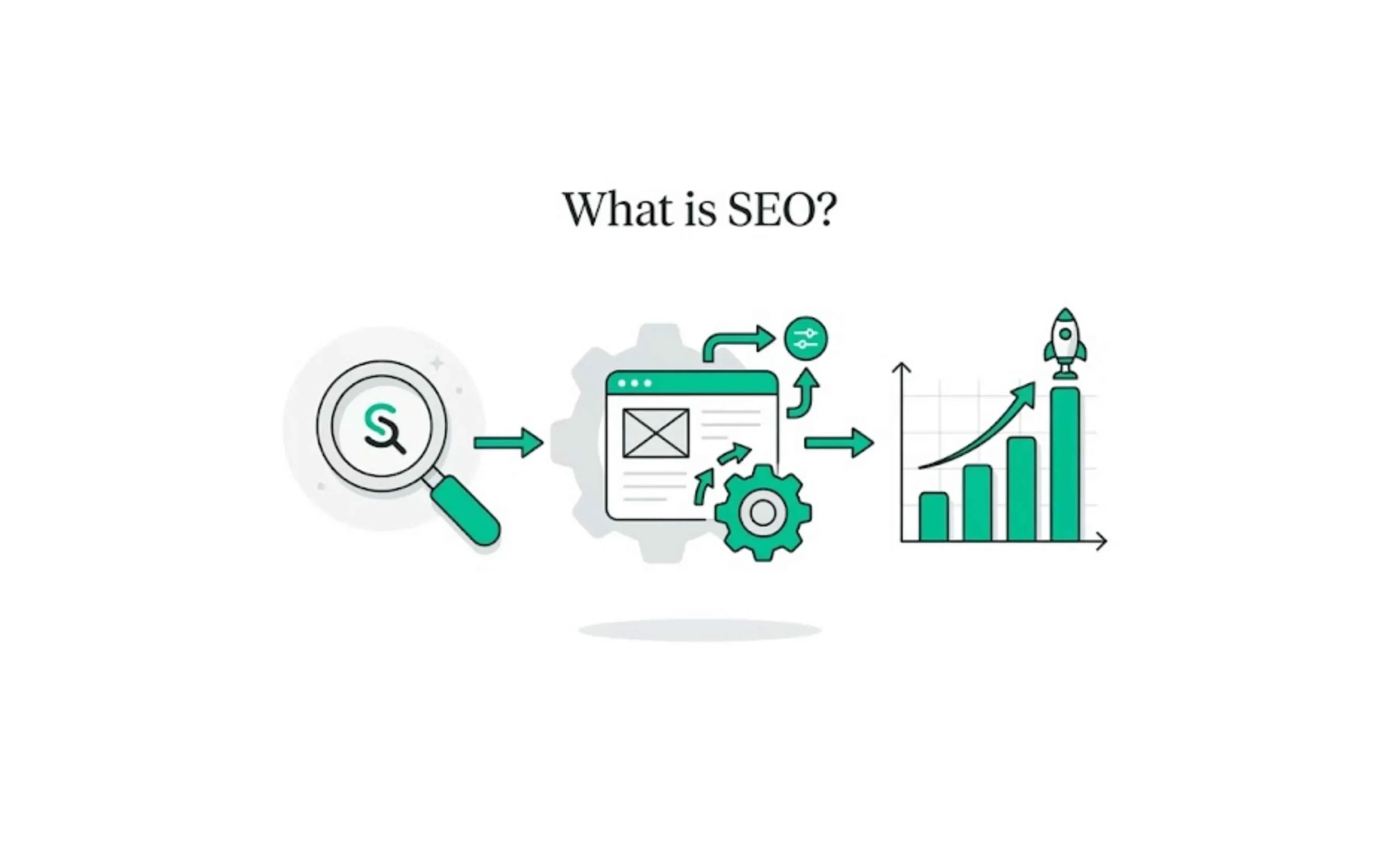
If you’ve ever wondered what SEO is, the simplest answer is this: SEO, or search engine optimization, is the process of improving a website and its content so search engines can understand it, users can find it, and the right pages can appear in relevant search results. Good SEO isn’t about tricking Google into ranking a page. It’s about What Is SEO creating useful, accessible, trustworthy content that satisfies what people are actually searching for.
Whether you run a blog, online store, local business website, news publication, portfolio, or large company site, SEO can help increase search engine traffic, improve online visibility, and bring visitors who are actively looking for information, products, or services.
SEO includes much more than adding keywords to an article. Effective SEO optimization combines helpful content, search intent, keyword research, website structure, technical performance, internal links, backlinks, mobile optimization, and a strong user experience. When these elements work together, your pages have a better opportunity to earn visibility in organic search.
This guide explains how SEO works, how search engines discover and rank web pages, which SEO factors matter, and how you can build a practical SEO strategy that generates sustainable organic search traffic.
What Is SEO and Why Does It Matter?
Search engine optimization (SEO) is the practice of improving web pages and websites so search engines can better understand, evaluate, and display them for relevant searches.
When someone enters a query into Google or another search engine, the search engine has to determine which pages are most useful for that particular search. It considers many signals, including the relevance and quality of the content, the meaning of the query, the page experience, website accessibility, links, and other factors.
For example, imagine someone searches for:
“how to improve website speed”
A page discussing website speed in detail, explaining practical optimization techniques, providing accurate information, and offering a good experience What Is SEO may be a better result than a page that simply repeats the phrase “website speed” dozens of times.
That difference captures the basic idea behind modern SEO.
Why SEO Is Important for Websites
SEO matters because search engines are one of the major ways people discover information online. A website may have excellent products or incredibly useful content, but if search engines cannot understand or find its pages, potential visitors may never see them.
A strong SEO strategy can help a website:
- Increase organic search traffic
- Improve search engine visibility
- Reach people with specific search intent
- Build long-term website traffic
- Generate relevant leads and customers
- Establish website authority
- Improve the discoverability of important pages
- Support broader content marketing
- Reduce dependence on paid advertising
- Build sustainable online visibility
SEO is particularly valuable because organic visitors often arrive with a specific need. Someone searching for “best running shoes for beginners,” for example, already has an interest in the topic.
SEO Is More Than Keywords
Keywords remain important, but successful SEO is not simply about inserting a target phrase into every paragraph.
Modern search engine optimization focuses on the relationship between:
Search query → Search intent → Relevant content → User experience → Search engine understanding
Your goal is to create the best possible resource for the person behind the search.
How Search Engines Understand and Rank Websites
Before a search engine can rank your page, it generally needs to discover the page, crawl it, understand its content, and potentially add it to its index.
Three concepts are especially important:
- Crawling
- Indexing
- Ranking
Understanding these processes makes SEO much easier.
1. Crawling
Search engine crawlers, also called bots or web crawlers, visit web pages to discover content.
They can discover URLs through links, sitemaps, previously known pages, and other pathways. Once a crawler reaches a page, it can process the page’s content and resources.
A website therefore needs to be accessible enough for search engine crawlers to navigate it.
Internal links are particularly useful because they help What Is SEO connect related pages and communicate your website structure.
2. Indexing
After crawling and processing a page, a search engine may decide whether the page belongs in its search engine index.
The index is essentially a massive collection of information about pages that a search engine knows about and may consider for search results.
Indexing does not automatically mean that your page will rank well.
A page can be indexed but still appear far down in the search engine results pages (SERPs).
3. Ranking
When someone performs a search, the search engine evaluates potentially relevant pages and determines which results should appear and in what order.
This is where the search engine’s ranking algorithm comes into play.
The exact algorithms used by search engines are complex and continuously evolving. There isn’t one simple formula that guarantees a top position.
Instead, SEO is about making your content and website better aligned with users’ needs and search engine guidelines.
What Search Engines Try to Understand
Search engines need to understand several things about a page:
- What is the page about?
- Which search queries might it answer?
- Does it satisfy the user’s search intent?
- Is the information useful and relevant?
- Is the content trustworthy?
- Can users access and navigate the page easily?
- Is the website technically accessible?
- How does the page relate to other pages?
- Are there credible external references or links?
- Does the page provide a good experience?
This is why SEO involves content, technical implementation, website structure, links, and user experience rather than keywords alone.
How Does SEO Work From Search to Ranking?
SEO works by helping search engines connect relevant searches with useful web pages.
Consider a simple example.
Someone searches:
“What is SEO?”
The search engine interprets the query and identifies What Is SEO pages that may answer it. It then evaluates relevant information from its index and produces a set of organic results.
A well-optimized page should make its purpose clear.
Its title, headings, content, URL, internal links, structured data where appropriate, and overall website context can help search engines understand the topic.
At the same time, the page must satisfy the person searching.
If the visitor wants a beginner-friendly definition but lands on a page filled with advanced technical terminology and no clear explanation, the page may not satisfy the search intent.
Search Intent Is Central to SEO
Search intent refers to the reason behind a search query.
Common types include:
Informational Intent
The user wants to learn something.
Examples:
- What is SEO?
- How does SEO work?
- What is a meta description?
- How do search engines work?
Navigational Intent
The user is trying to find a particular website, brand, or page.
Examples:
- Google Search Console
- YouTube
- Amazon login
Commercial Investigation
The user is researching options before making a decision.
Examples:
- Best keyword research tools
- SEO software comparison
- Best website hosting for blogs
Transactional Intent
The user is ready to complete an action, often a purchase or signup.
Examples:
- Buy running shoes online
- SEO audit service
- Subscribe to SEO software
Understanding intent helps you create the correct type of content.
If the search is informational, a detailed guide may work well. If it is transactional, a product or service page may be more appropriate.
From Query to Search Results
A simplified SEO process looks like this:
User enters a search query → Search engine interprets intent → Relevant indexed pages are identified → Pages are evaluated → Results are displayed
Your job as an SEO practitioner is to make your website useful at each stage.
The Main SEO Factors That Influence Rankings
There is no single SEO factor that guarantees a first-page ranking.
Search engine rankings are influenced by multiple signals and systems. Some of the most important areas include content quality, relevance, technical accessibility, links, website experience, and the relationship between a page and the searcher’s intent.
1. Content Quality
High-quality content should provide meaningful value to the reader.
It should answer the topic clearly rather than adding words simply to increase the article’s length.
Strong content is generally:
- Relevant
- Accurate
- Helpful
- Clear
- Original
- Well organized
- Easy to read
- Appropriate for the audience
Quality content should solve a problem, answer a question, explain a concept, or help the user make a decision.
2. Content Relevance
A page needs to be relevant to the query.
If someone searches for “how to perform keyword research,” an article about website design may not satisfy that need, even if the website itself is authoritative.
Use your target keywords naturally, but also cover related What Is SEO concepts that help explain the topic comprehensively.
3. Search Intent
Matching search intent is one of the most important parts of modern SEO.
Before creating a page, ask:
What does the searcher actually want?
Look at the types of pages already appearing in the SERPs. Are they tutorials, product pages, definitions, comparison articles, videos, or local business pages?
The format of existing search results can provide clues about user expectations.
4. Backlinks and Link Quality
Backlinks are links from other websites to your website.
They can help search engines discover pages and can contribute to how a website’s authority and reputation are evaluated.
However, not every backlink has equal value.
Relevant, editorially earned links from trustworthy websites are generally more meaningful than large numbers of unrelated or low-quality links.
Quality should come before quantity.
5. Internal Links
Internal links connect pages within the same website.
They help users discover related content and help search engines understand your website structure.
For example, an article about SEO could naturally link to related pages about:
- Keyword research
- Technical SEO
- On-page SEO
- Link building
- Search intent
- Content strategy
This creates a connected content ecosystem rather than isolated pages.
6. User Experience
A page should be easy to use.
Important areas include:
- Clear navigation
- Readable typography
- Logical headings
- Fast page loading
- Mobile compatibility
- Easy interaction
- Minimal distractions
- Helpful page layout
A good user experience supports both visitors and search visibility.
7. Page Speed and Website Performance
Page loading speed affects how quickly visitors can access your content.
Large images, unnecessary scripts, poor hosting configuration, and inefficient code can contribute to slow pages.
Improving page speed can make your website more pleasant What Is SEO to use, particularly on mobile devices.
8. Mobile Optimization
A large amount of web browsing happens on smartphones.
Your website should therefore provide a strong experience across different screen sizes.
A mobile-friendly website should have:
- Responsive design
- Readable text
- Properly sized buttons
- Easy navigation
- Fast loading
- Content that works without horizontal scrolling
9. Website Structure
A clear website structure makes your content easier to navigate.
Organize related pages into logical categories and connect them with contextual internal links.
For example:
SEO Guide → On-Page SEO → Keyword Research → Search Intent
This type of structure helps users understand where they are and how related resources connect.
On-Page SEO: Optimizing Content for Search Intent
On-page SEO focuses on elements you can control directly on a web page.
It includes content, headings, title tags, URLs, internal links, images, HTML elements, and other page-level components.
Create Content Around the User’s Need
Start with the user’s problem instead of starting with a keyword.
Suppose your target keyword is:
“how to improve Google rankings”
Don’t create an article that simply repeats that phrase.
Instead, answer related questions:
- Why isn’t my website ranking?
- How does Google evaluate pages?
- What content improvements can help?
- How does search intent affect rankings?
- What technical problems can prevent visibility?
- How can internal linking help?
- What role do backlinks play?
This approach naturally produces relevant content.
Use Keywords Naturally
Keyword usage should feel natural.
Your primary keyword can appear in important locations such as:
- Page title
- H1
- Introduction
- Relevant H2 headings
- Body content
- URL when appropriate
- Image alt text when descriptive and relevant
Avoid repeating the same phrase unnaturally.
Instead, use variations What Is SEO and related terms.
For example, an article targeting SEO can naturally discuss:
- search engine optimization
- organic search
- search rankings
- search visibility
- search engine traffic
- website optimization
- content optimization
- organic results
Write Helpful Title Tags
A title tag tells users and search engines what a page is about.
A strong title should be:
- Accurate
- Specific
- Relevant
- Concise
- Appealing to the searcher
For this article, a suitable title could be:
What Is SEO? A Complete Guide to Search Engine Optimization
Use Descriptive Headings
Headings make long content easier to scan.
Use one clear H1 and logical H2 and H3 sections.
For example:
H1: What Is SEO?
H2: How Search Engines Understand Websites
H2: How SEO Works
H2: Main SEO Ranking Factors
H2: On-Page SEO
This structure improves readability and What Is SEO helps communicate the page’s topical organization.
Optimize URLs
A clean URL should make the page topic understandable.
For example:
example.com/what-is-seo/
is generally clearer than a URL containing unnecessary numbers, parameters, or unrelated words.
Use Internal Linking Strategically
Don’t add internal links simply because you need more links.
Link when the destination genuinely helps the reader.
Good anchor text should describe the linked page accurately.
For example:
Learn more about keyword research before choosing your target terms.
This is more useful than:
Click here.
Optimize Images
Images can improve comprehension, but they should also be optimized for performance.
Use descriptive filenames and appropriate alt text when an image conveys meaningful information.
Compress large images and choose suitable file formats to reduce unnecessary page weight.
Technical SEO: Making Your Website Easy to Crawl
Technical SEO focuses on the technical elements that influence crawling, indexing, accessibility, and website performance.
You can have excellent content, but technical problems What Is SEO may prevent search engines from accessing or properly understanding it.
Make Your Website Crawlable
A crawlable website allows search engine bots to access important pages.
Check for problems such as:
- Broken links
- Incorrect redirects
- Blocked resources
- Poor navigation
- Duplicate URLs
- Incorrect robots directives
- Server errors
Read more:types of SEO
Use a Logical URL Structure
URLs should be understandable and consistent.
A logical structure can help users and search engines understand the relationship between pages.
For example:
example.com/seo/on-page-seo/
communicates more than a random URL structure.
Improve Website Performance
Technical SEO includes performance.
Look at:
- Server response time
- Image size
- JavaScript
- CSS
- Browser caching
- Third-party scripts
- Core page resources
Improving website performance can make pages faster and more responsive.
Mobile Optimization
Your site should work properly on mobile devices.
Test:
- Navigation
- Menus
- Buttons
- Forms
- Font sizes
- Images
- Tables
- Embedded content
A page that looks excellent on desktop but What Is SEO is difficult to use on a phone provides a poor experience.
HTTPS and Website Security
A secure website protects communication between the visitor and server.
Using HTTPS is a standard part of modern website implementation and is important for user trust and site security.
Structured Data and Schema Markup
Schema markup is structured information that can help search engines understand specific types of content.
Depending on the page, structured data may describe information such as:
- Articles
- Products
- Events
- Organizations
- Local businesses
- Reviews
- FAQs
Structured data should accurately represent the visible content and should not be used to mislead search engines.
XML Sitemaps
An XML sitemap provides search engines with information about important URLs on your site.
It can be particularly useful for larger websites, sites with many pages, or websites where some pages may be difficult to discover through normal navigation.
Fix Indexing Problems
If an important page isn’t appearing in search results, investigate whether it is:
- Crawlable
- Indexable
- Canonicalized correctly
- Returning a valid status code
- Linked internally
- Included appropriately in your sitemap
Technical SEO is ultimately about making your website easier for search engines to access and understand.
Off-Page SEO and the Role of Backlinks
Off-page SEO refers to activities and signals occurring beyond the individual page itself.
One of the best-known elements is link building.
What Are Backlinks?
A backlink is a link from another website to your website.
For example, if a reputable industry publication references your research and links to your article, your website receives an incoming link.
Backlinks can help:
- Increase referral traffic
- Improve content discovery
- Build online authority
- Strengthen relationships with relevant websites
- Support SEO visibility
Quality Matters More Than Quantity
One relevant, editorially earned backlink can be more valuable than dozens of unrelated links.
When evaluating a potential link, consider:
- Relevance
- Website reputation
- Editorial quality
- Context
- Link placement
- Whether the link is genuinely useful to readers
Avoid treating backlink building as a numbers-only exercise.
Ethical Link Building Strategies
Useful approaches include:
Create Link-Worthy Resources
Original research, useful statistics, detailed guides, tools, calculators, studies, and unique resources can naturally attract references.
Digital PR
If you publish something genuinely interesting or newsworthy, relevant publications may reference it.
Guest Contributions
Contributing valuable content to relevant publications can help build relationships and visibility when done legitimately.
Resource Pages
Some websites maintain curated resource pages. If your content genuinely adds value, it may be appropriate to suggest it.
Build Relationships
Networking with writers, publishers, experts, and businesses in your industry can create legitimate opportunities for collaboration and references.
Avoid Manipulative Link Schemes
Buying large quantities of low-quality links, using automated link networks, or creating irrelevant backlinks solely to manipulate rankings can put your website at risk.
A sustainable link building ,What Is SEO ,strategy focuses on earning useful references rather than manufacturing artificial authority.
How to Get More Organic Search Traffic
Getting organic search traffic requires more than publishing random articles.
You need a repeatable process that connects keyword research, content creation, optimization, technical SEO, internal linking, and performance measurement.
1. Perform Keyword Research
Keyword research helps you understand what people search for and how they phrase their problems.
Start with broad topics and expand them into specific queries.
For example:
SEO
can become:
- What is SEO?
- How does SEO work?
- SEO for beginners
- How to improve SEO
- On-page SEO
- Technical SEO
- SEO content strategy
Use reputable keyword research tools to evaluate:
- Search volume
- Keyword difficulty
- Search intent
- Related keywords
- SERP competition
- Keyword trends
- Long-tail opportunities
2. Target Long-Tail Keywords
Long-tail keywords are often more specific search phrases.
For example:
“SEO”
is extremely broad.
A more specific phrase might be:
“how to do SEO for a small business website”
Specific queries may have lower search volume, but they can often reveal clearer user intent.
3. Analyze Keyword Competition
Not every keyword is equally realistic for every website.
Keyword competition can depend on the strength of competing pages, search intent, content quality, backlinks, brand authority, and the type of search results.
A new website may benefit from targeting relevant, specific topics before competing for extremely broad terms.
4. Build Topic Clusters
Instead of publishing disconnected articles, build groups of related content.
For example:
Main Topic: SEO
Supporting topics:
- What is SEO?
- Keyword research
- On-page SEO
- Technical SEO
- Off-page SEO
- Link building
- Search intent
- SEO content writing
- SEO analytics
Link these pages together using contextual internal linking.
This creates a stronger content structure and gives users multiple useful resources.
5. Create Content That Fully Answers the Query
Before publishing, ask:
Does this page completely satisfy the reason someone What Is SEO searched for this keyword?
If the answer is no, improve it.
Add examples, explanations, comparisons, definitions, practical steps, and relevant supporting information where appropriate.
6. Improve Existing Content
SEO doesn’t end when an article is published.
Review pages that:
- Have declining traffic
- Rank on page two
- Receive impressions but few clicks
- Have outdated information
- Don’t fully satisfy search intent
- Compete with another page on your website
Refreshing existing content can be an important part of an effective SEO strategy.
7. Monitor Search Performance
Use analytics and search performance tools to understand what is happening.
Track metrics such as:
- Organic clicks
- Impressions
- Click-through rate
- Search positions
- Organic sessions
- Conversions
- Indexed pages
- Top-performing queries
Don’t focus exclusively on rankings.
A keyword ranking in position one is useful only if it attracts relevant visitors and contributes to your broader goals.
8. Improve Low-Performing Pages
If a page receives impressions but few clicks, consider whether the title and description accurately communicate its value.
If a page receives traffic but visitors don’t take meaningful actions, investigate What Is SEO whether the content matches their expectations.
If a page doesn’t rank at all, investigate relevance, competition, content quality, internal linking, and technical accessibility.
How Keyword Research Helps SEO
Keyword research is the foundation of many SEO campaigns because it connects your content strategy with actual search behavior.
Instead of guessing what people want, keyword research gives you clues about the language and questions users enter into search engines.
Start With Seed Topics
A seed keyword is a broad topic that you can expand into related queries.
For example:
“SEO”
can lead to:
- SEO meaning
- SEO definition
- SEO strategy
- SEO tools
- SEO tips
- SEO for beginners
- SEO marketing
- technical SEO
- on-page SEO
- off-page SEO
Examine Search Intent
Two keywords can look similar but have different intent.
For example:
“SEO tools”
may indicate someone researching software.
“how to use SEO tools”
indicates a need for instructions.
Your content should reflect that distinction.
Consider Search Volume and Difficulty
High search volume can be attractive, but it also often means What Is SEO stronger competition.
A balanced SEO strategy considers:
Search volume + relevance + intent + competition + business value
A low-volume keyword that brings highly relevant visitors can sometimes be more valuable than a high-volume keyword with weak intent.
Common SEO Mistakes to Avoid
SEO becomes easier when you know what not to do.
Keyword Stuffing
Repeating a keyword unnaturally makes content difficult to read.
Write for people first and use keyword phrases naturally.
Publishing Thin Content
Short content isn’t automatically bad, but pages that fail to answer the user’s question provide little value.
Focus on usefulness rather than arbitrary word counts.
Ignoring Search Intent
A page can be beautifully written and still fail if it doesn’t satisfy what the searcher wants.
Always examine the intent behind the query.
Creating Too Many Similar Pages
Publishing multiple pages targeting nearly identical keywords can create unnecessary competition within your own website.
Before creating a new page, check whether an existing page already satisfies that intent.
Ignoring Technical SEO
Great content cannot compensate for every technical problem.
Regularly check crawling, indexing, broken links, page speed, mobile usability, and website structure.
Chasing Backlinks Instead of Value
Backlinks should support a valuable content strategy rather than become the entire strategy.
Create something worth referencing first.
Forgetting Existing Content
You don’t always need another article.
Sometimes the best SEO opportunity is improving a page you already have.
SEO vs. Paid Search: What’s the Difference?
SEO and paid search can both generate visitors from search engines, but they work differently.
SEO focuses on earning organic visibility through relevant content, technical optimization, authority, and a strong website experience.
Paid search advertising involves paying for placements through advertising platforms.
SEO generally requires patience because organic rankings can take time to develop.
Paid campaigns can generate visibility more quickly but require an advertising budget.
Many businesses use both.
SEO can build long-term organic visibility, while paid campaigns can support immediate promotional goals.
How Long Does SEO Take to Work?
There is no universal timeline for SEO.
Some changes may produce improvements relatively quickly, while competitive keywords can take months or longer to gain meaningful visibility.
The timeline depends on factors such as:
- Website age and history
- Competition
- Content quality
- Search intent
- Technical condition
- Backlink profile
- Website authority
- Publishing consistency
- Keyword difficulty
- Industry
A realistic SEO strategy focuses on consistent improvement rather than expecting instant results.
Instead of asking only:
“How fast can I rank?”
ask:
“How can I build a website that deserves to rank?”
That mindset produces a much stronger long-term strategy.
How to Measure SEO Success
SEO performance should be measured against meaningful objectives.
Important metrics can include:
Organic Traffic
Measures visitors arriving through organic search.
Impressions
Shows how often your pages appear in search results.
Clicks
Shows how many users visit your site from organic results.
Click-Through Rate
CTR measures the percentage of impressions that result in clicks.
Keyword Rankings
Rankings help you understand your visibility for specific queries.
Conversions
Conversions may include:
- Purchases
- Form submissions
- Newsletter signups
- Phone calls
- Account registrations
- Downloads
Engagement
Depending on your website, useful engagement metrics can help determine whether visitors are finding the content valuable.
The most important metric depends on your objective.
A blog may prioritize organic traffic and email signups, while an ecommerce store may focus on revenue and qualified organic visitors.
A Practical SEO Strategy for Beginners
If you’re new to SEO, don’t try to optimize everything at once.
Use a simple process.
Step 1: Understand Your Audience
Identify who you want to reach and what problems they need to solve.
Step 2: Research Topics and Keywords
Find relevant keywords and understand their search intent.
Step 3: Study the SERPs
Search your target query and examine what Google currently shows.
Look at:
- Content format
- Search intent
- Competitor topics
- Common questions
- Content depth
- Featured results
- Related searches
Step 4: Create Better Content
Develop useful, accurate, well-structured content that directly satisfies the query.
Step 5: Optimize the Page
Improve:
- Title tag
- H1
- Headings
- URL
- Internal links
- Images
- Keyword relevance
- Readability
- Content structure
Step 6: Check Technical SEO
Make sure the page can be crawled, rendered, indexed, and used comfortably on mobile devices.
Step 7: Promote the Content
Share genuinely useful content through appropriate channels and build relationships that can lead to legitimate references.
Step 8: Measure and Improve
Monitor performance and update pages based on actual data.
SEO is a continuous process rather than a one-time task.
Final Thoughts:
So, what is SEO really about?
At its core, search engine optimization is about connecting people with useful information through organic search.
The strongest SEO strategy doesn’t begin with algorithms. It begins with the user.
Create relevant content. Understand search intent. Build a technically sound and crawlable website. Use keywords naturally. Improve website performance. Create helpful internal links. Earn quality backlinks. Keep your information accurate and useful.
When these pieces work together, your website becomes easier for both people and search engines to understand.
SEO may take time, but its long-term value comes from building assets that can continue attracting organic search traffic after publication. Instead of chasing temporary ranking tricks, focus on creating the most useful answer for the searcher and the strongest overall experience you can provide.
That is the foundation of sustainable SEO.
Frequently Asked Questions About SEO
What does SEO stand for?
SEO stands for Search Engine Optimization. It is the process of improving websites and web pages so search engines can understand their content and users can find them through relevant organic search results.
What is SEO in simple words?
SEO is the process of making a website easier for search engines to understand and easier for people to find. It involves content optimization, technical improvements, keywords, internal links, backlinks, and user experience.
How does SEO work?
SEO works by helping search engines discover, crawl, index, understand, and evaluate web pages. When a user searches, search engines use their ranking systems to determine which relevant pages should appear in the results.
Why is SEO important?
SEO can increase organic visibility and bring relevant visitors to a website without paying for every individual click. It can also help businesses, publishers, and creators build long-term website authority and traffic.
What are the main types of SEO?
The main areas include on-page SEO, technical SEO, and off-page SEO. Content strategy, keyword research, internal linking, website performance, mobile optimization, and link building can all contribute to a broader SEO strategy.
What are SEO ranking factors?
SEO ranking factors include relevance, content quality, search intent, technical accessibility, links, website performance, mobile experience, and many What Is SEO other signals. Search engines use complex systems rather than one single ranking factor.
How can I get more organic search traffic?
Start with keyword research and search intent, create genuinely useful content, optimize your pages, improve technical SEO, build strong internal links, earn relevant backlinks, and continuously measure and improve your content.
How long does SEO take?
SEO has no fixed timeline. Results can vary depending on competition, website authority, content quality, technical issues, keyword difficulty, and many other factors. Consistent improvement is usually more effective than expecting instant rankings.
Is SEO better than paid advertising?
SEO and paid advertising serve different purposes. SEO can provide long-term organic visibility, while paid advertising can generate targeted visibility quickly. Many businesses use both approaches as part of their digital marketing strategy.
What is on-page SEO?
On-page SEO involves optimizing elements directly on your web page, including content, headings, title tags, URLs, internal links, images, and other page elements to improve relevance, usability, and search engine understanding.
What is technical SEO?
Technical SEO focuses on the technical side of a website, including crawling, indexing, site architecture, page speed, mobile optimization, redirects, structured data, HTTPS, and other technical elements that affect accessibility and performance.